
Gabapentin,
does it really help with Reduced chronic pelvic pain in women without obvious pelvic pathology?
research showsThe grade is D with 34 points. Both co-primary outcomes in GaPP2, worst and average pain during weeks 13 to 16, failed. Adjusted differences were -0.20 (97.5% CI -0.81 to 0.42; P=.47) and -0.18 (-0.71 to 0.35; P=.45), respectively. Both intervals exclude the validated one-point NRS minimum difference for this population, while serious adverse events were more frequent, 10/153 (7%) versus 3/153 (2%), P=.04.
ads claimEfficacy in another neuropathic-pain condition does not establish efficacy for chronic pelvic pain without obvious pathology. Direct evidence must be separated by indication.
Useful facts when choosing a product
- Gabapentin is a prescription gabapentinoid binding the alpha-2-delta auxiliary subunit of voltage-gated calcium channels.
- GaPP2 titrated treatment to a maximum of 2,700 mg daily over 16 weeks.
- This verdict is specific to chronic pelvic pain in women and separate from other neuropathic-pain indications.
What the research actually shows
This double-blind placebo-controlled trial at 39 UK centers randomized 306 women, 153 per arm. Its co-primary success rule stated: "These outcomes were considered separately and an improvement in one (or both) would conclude that gabapentin was efficacious". Thus, worst and average pain were tested separately and improvement in at least one would have established efficacy, but both failed. The effect threshold was also prespecified: "We calculated the sample size based on a recognised minimally important difference for chronic pain of 1 point on a 0–10 NRS". Axis 5 C1 therefore rests on a prespecified one-point threshold rather than a post hoc convention. Safety followed intention-to-treat principles, but primary average- and worst-pain data were unavailable for 62 and 60 women, respectively, and the main estimates used available observations. Multiple-imputation sensitivity analyses supported the conclusion, but missingness above 15% was counted as one design limitation. A secure online system minimized allocation on four factors; active and placebo capsules had identical appearance, route, and administration; and patients, clinicians, and research staff remained unaware of assignment. The worst- and average-pain co-primary outcomes matched ISRCTN77451762. The MRC-NIHR Efficacy and Mechanism Evaluation program funded the trial.
Why this is classified as D (34)
Both co-primary pain outcomes excluded a validated one-point benefit and serious adverse events increased, but independent repeated refutation is absent, giving D with 34 points.
Counterpoint. Verdict 1682 is C with 58 points for postherpetic neuralgia, and verdict 1136 is C with 55 points for restless legs syndrome; those indications differ. Verdict 780 is F with 13 points for sciatica, and verdict 1859 is D with 28 points for migraine, but neither is a repeat of this pelvic-pain trial.
Rejudgment record. Cross-check applied — Cross-checked GaPP2, its HTA report, and ISRCTN77451762 for co-primary outcomes, the one-point threshold, missingness and imputation, masking, public funding, and serious adverse events
| Endpoint | P | Patient-reported treatment goal - the symptom is the goal |
| Replication | R1 | Single confirmatory trial |
| Independence | I2 | Decisive evidence is publicly or non-profit funded |
| Effect size | E- | Harm increased in the trials |
| Precision | C1 | The confidence interval excludes meaningful benefit |
The scoring table and the verdict agree (D).
Sub-claim grades by effect
This ingredient is marketed for several effects. A single overall grade blends strong and weak claims together, so each effect is graded separately here. The overall grade reflects the strongest disconfirming or core claim.
| Effect (sub-claim) | Grade | Basis |
|---|---|---|
| Reduced worst and average pelvic pain during weeks 13 to 16 | D | Both co-primary outcomes were null and excluded a one-point benefit. |
| Efficacy in other pain indications | ? | Direct evidence is graded separately for each indication. |
Cross-check — Codex and Claude
Evidence Table
| Study | Design | Sample | Funding | Endpoint | Result | Weight |
|---|---|---|---|---|---|---|
| Study 1 | 39-center double-blind placebo-controlled randomized trial | 244 | Public funding from the MRC-NIHR Efficacy and Mechanism Evaluation program | Co-primary worst and average pain NRS during weeks 13 to 16 | Worst pain -0.20 (97.5% CI -0.81 to 0.42), P=.47; average pain -0.18 (-0.71 to 0.35), P=.45; serious adverse events 7% versus 2%, P=.04 | Publicly funded direct null trial with a harm signal |
Receipt — 1 References
All 1 cited sources were verified for existence at the original page (as of 2026-08-18).
Reviewed and approved: Chamgap Editorial Team · Approval date: 2026-08-18 · Corrections: none
Cite this verdict
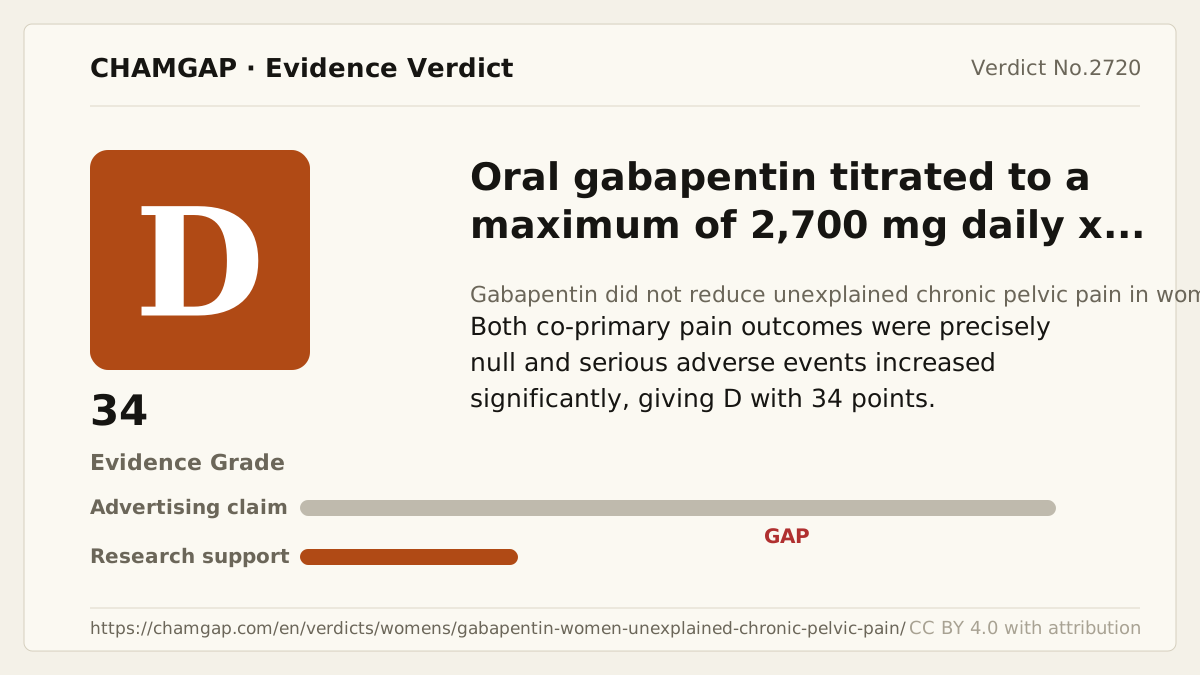
[Chamgap] Gabapentin x chronic pelvic pain in women without obvious pathology — Evidence Grade D·34. 1 cited sources checked. Source: https://chamgap.com/en/verdicts/womens/gabapentin-women-unexplained-chronic-pelvic-pain/ · CC BY 4.0CC BY 4.0 — free to use with attribution; do not distort grades, numbers, or verdict meaning.
What this document does and does not do
Chamgap is an information source. It reports what research has and has not confirmed; it does not tell readers what to take or buy. That decision belongs to readers and, when needed, medical or legal professionals. This verdict reflects literature available up to the search date and may change as new research appears. Nothing here is medical advice.