
Endometrial scratching before IVF,
does it really help with Increase in live birth per randomized woman?
research showsThe grade is D with 34 points. The five-country PIP trial randomized 1,364 women and found live birth in 180/690 (26.1%) assigned scratching versus 176/674 (26.1%) assigned no procedure, adjusted OR 1.00 (95% CI 0.78 to 1.27). The UK first-IVF trial analyzed all 1,048 randomized women and found 202/523 (38.6%) versus 195/525 (37.1%), difference 1.5 points (95% CI -4.4 to 7.4). Priya Bhide was a coauthor on both trials. These are repeated null results, but the 10-point target was a sample-size assumption rather than a validated minimum important difference, so precise refutation cannot be declared and the grade is D rather than F.
ads claimThe ability to produce a small endometrial injury does not establish a higher probability of taking home a baby. Early pregnancy signals from small trials should not be placed above modern large live-birth results.
Useful facts when choosing a product
- PIP used a Pipelle scratch in the cycle preceding or early in the embryo-transfer cycle.
- The specific Korean fertility-clinic procedure page could not be opened at its current address.
- PIP reported median pain of 3.5/10 and uncommon excessive pain, dizziness, and bleeding reactions.
What the research actually shows
Lensen and colleagues randomized and analyzed 1,364 women at 13 sites in five countries, 690 to scratching and 674 to no intervention. Live birth was 180/690 versus 176/674, adjusted OR 1.00 (0.78 to 1.27). Median procedural pain was 3.5 on a ten-point scale. Fourteen reactions included five excessive-pain events, seven episodes of faintness, dizziness, or nausea, and two excessive-bleeding events. Funders were the University of Auckland, A+ Trust, Auckland District Health Board, Nurture Foundation, and Maurice and Phyllis Paykel Trust. Metwally and colleagues randomized 1,048 first-IVF or ICSI patients to usual treatment, 525, or scratching, 523, and analyzed all randomized women. Live birth was 195/525 versus 202/523, difference 1.5 points (-4.4 to 7.4). The NIHR HTA program funded the trial, and Priya Bhide was a coauthor on both trials. Additional trials such as SCRaTCH exist but were not verified and cited as evidence for this verdict. The specific Endometrial Scratch and Stimulation page at a Korean fertility clinic could not be opened at its current address.
Why this is classified as D (34)
Publicly funded large trials repeatedly found no benefit on the same live-birth endpoint, but they share one coauthor and there is no validated minimum important difference, equivalence margin, or patient anchor. The sample-size target of 10 points cannot serve as a refutation threshold, giving D with 34 points.
Counterpoint. A pooled analysis of the UK trial and eight similar trials found OR 1.03 (0.87 to 1.22), but without a validated clinical threshold this interval still does not support an F grade.
Rejudgment record. Cross-check applied — Repeated null live-birth results in two large trials with one overlapping coauthor, while rejecting a sample-size assumption as a validated benefit-exclusion threshold
| Endpoint | H | Hard endpoint - actual events such as death |
| Replication | R1 | Single confirmatory trial |
| Independence | I2 | Decisive evidence is publicly or non-profit funded |
| Effect size | E0 | Null |
| Precision | C0 | The confidence interval leaves room for benefit |
The scoring table and the verdict agree (D).
Sub-claim grades by effect
This ingredient is marketed for several effects. A single overall grade blends strong and weak claims together, so each effect is graded separately here. The overall grade reflects the strongest disconfirming or core claim.
| Effect (sub-claim) | Grade | Basis |
|---|---|---|
| Increased live birth in unselected IVF patients | D | PIP found 26.1% versus 26.1%. |
| Increased live birth in first-IVF patients | D | The 1,048-participant trial found 38.6% versus 37.1%, a null result. |
| Benefit in recurrent implantation failure | ? | This subgroup was not pooled into the unselected and first-IVF verdict. |
Cross-check — Codex and Claude
Evidence Table
| Study | Design | Sample | Funding | Endpoint | Result | Weight |
|---|---|---|---|---|---|---|
| Study 1 | Multinational multicenter open-label randomized superiority trial | 674 | University of Auckland, A+ Trust, Auckland District Health Board, Nurture Foundation, and Maurice and Phyllis Paykel Trust | Live birth per randomized woman | 180/690 (26.1%) versus 176/674 (26.1%), adjusted OR 1.00 (95% CI 0.78 to 1.27). | Pivotal international large trial |
| Study 2 | Sixteen-center open-label randomized superiority trial | 523 | UK National Institute for Health Research Health Technology Assessment | Live birth per randomized woman after first IVF | 195/525 (37.1%) with usual treatment versus 202/523 (38.6%) with scratch, difference 1.5 points (95% CI -4.4 to 7.4), P=0.621. | Large repeated null trial sharing one coauthor with PIP |
Receipt — 3 References
All 3 cited sources were verified for existence at the original page (as of 2026-08-06).
Reviewed and approved: Chamgap Editorial Team · Approval date: 2026-08-06 · Corrections: none
Cite this verdict
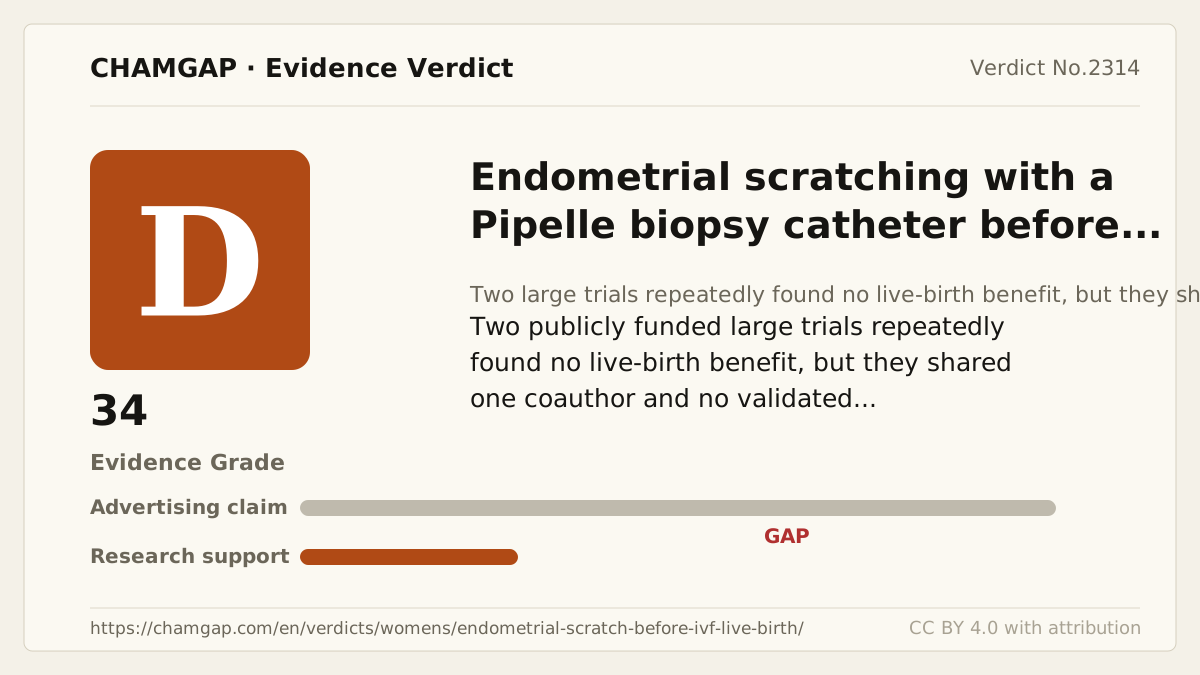
[Chamgap] Endometrial scratching before IVF x increased live birth — Evidence Grade D·34. 3 cited sources checked. Source: https://chamgap.com/en/verdicts/womens/endometrial-scratch-before-ivf-live-birth/ · CC BY 4.0CC BY 4.0 — free to use with attribution; do not distort grades, numbers, or verdict meaning.
What this document does and does not do
Chamgap is an information source. It reports what research has and has not confirmed; it does not tell readers what to take or buy. That decision belongs to readers and, when needed, medical or legal professionals. This verdict reflects literature available up to the search date and may change as new research appears. Nothing here is medical advice.