
Direct mailing of HPV self-sampling kits,
does it really help with Increased six-month cervical screening completion among adults who were overdue or long-term non-attenders?
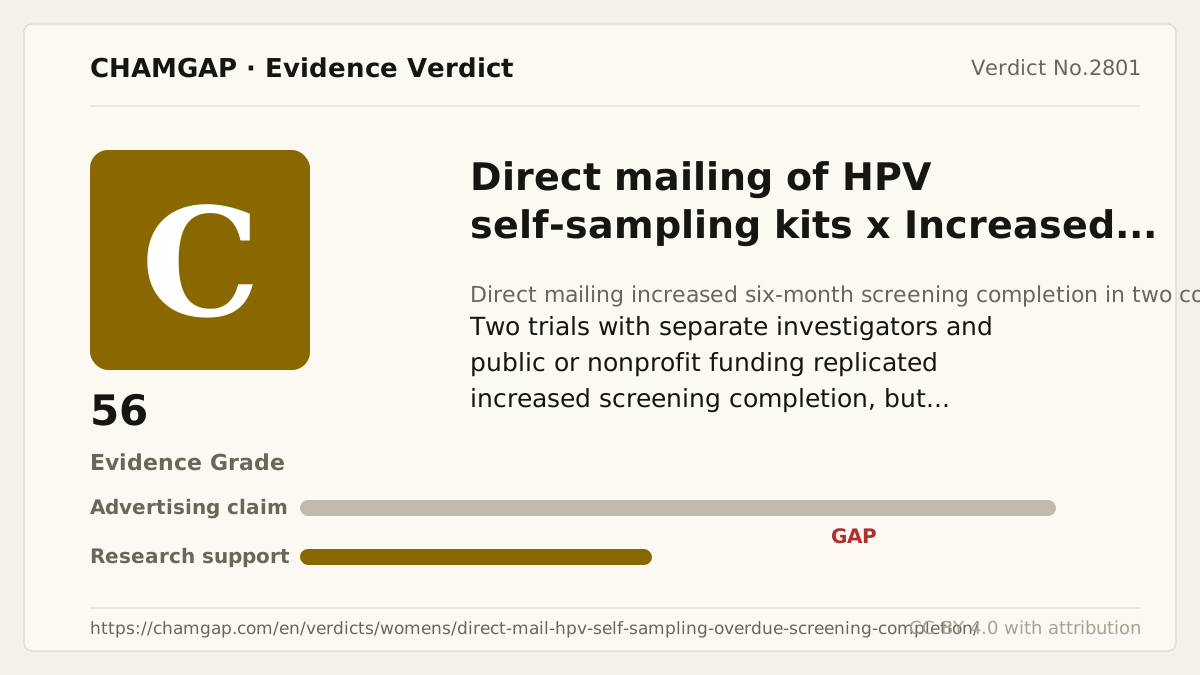
research showsThe grade is C with 56 points. In the Norwegian trial of long-term non-attenders, six-month participation was 27.7% with direct mailing and 4.8% with a routine reminder, an absolute increase of 22.9 points (95% CI 20.7 to 25.2; P<0.0001). In the overdue stratum of the US STEP trial, completion was 35.7% versus 18.8%, RR 1.90 (95% CI 1.68 to 2.16), absolute increase 16.9 points (13.8 to 20.0). Screening completion is not itself a health outcome, however; it matters through later detection and prevention, so the grade is capped at C.
ads claimIt is supported to say that direct mailing increased six-month screening completion. It is not supported to say that cancer was prevented within six months or that the self-sampling assay itself was superior to clinician sampling.
Useful facts when choosing a product
- Norway used the Evalyn Brush, whereas STEP used a COPAN FLOQSwab with Cobas 4800 testing.
- No evidence was identified that direct mailing of self-sampling kits to non-attenders has been introduced into Korea's national cancer screening program or that the same kits are authorized and distributed in Korea.
- A high-risk HPV-positive or unsatisfactory self-sample requires the specified in-person follow-up.
What the research actually shows
Norway randomized 6,000 people 1:1:1, and STEP analyzed 31,355 randomized people. Axis 6 B0 evidence ① Allocation concealment: "Randomisation procedures were performed using the sample function in Stata by a programmer who was not involved in the conduct of the trial." STEP reported, "Randomization allocation was concealed by the study programmer and revealed to investigators only for necessary safety monitoring." ② Blinding: Norway reported, "Blinding was not possible due to the nature of the interventions." Participant blinding was likewise impossible in STEP, but Norway used national screening records and STEP stated, "Outcomes were obtained from the EHR and claims." ③ Analysis population and missingness: Norway stated, "The main analyses of participation, which is the trial's primary outcome measure, are intention-to-treat"; STEP used "intention-to-treat principles" and reported "there were no exclusions due to missing data." ④ Prespecified primary endpoint: Norway specified "participation as the primary outcome" and STEP stated, "The primary outcome was screening completion within 6 months postrandomization"; these match NCT03873376 and NCT04679675.
Why this is classified as C (56)
Two independent publicly or nonprofit funded randomized trials replicated large absolute increases with objective records and documented allocation and analysis procedures. Because the primary endpoint was screening participation rather than cancer or mortality, the surrogate cap gives C with 56 points.
Counterpoint. The trials operated in Norwegian national screening and a US insured integrated system. Korea may differ in invitation pathways, authorization, specimen return, and follow-up of positive results.
Rejudgment record. Primary sources and registrations checked — Two independent pragmatic randomized trials replicated large absolute increases in objective six-month screening records, but completion is a surrogate for clinical events
| Endpoint | S | Surrogate marker - laboratory or imaging measures |
| Replication | R2 | Independently replicated across trials |
| Independence | I2 | Decisive evidence is publicly or non-profit funded |
| Effect size | E+ | Meets the clinically important threshold |
The scoring table and the verdict agree (C).
Sub-claim grades by effect
This ingredient is marketed for several effects. A single overall grade blends strong and weak claims together, so each effect is graded separately here. The overall grade reflects the strongest disconfirming or core claim.
| Effect (sub-claim) | Grade | Basis |
|---|---|---|
| Increased six-month screening completion with direct mailing | C | Two independent trials found increases of 22.9 and 16.9 points. |
| Prevention of invasive cervical cancer by direct mailing itself | ? | The trials measured screening completion, not incident invasive cancer. |
Cross-check — Codex and Claude
Evidence Table
| Study | Design | Sample | Funding | Endpoint | Result | Weight |
|---|---|---|---|---|---|---|
| Study 1 | Three-arm pragmatic randomized controlled trial | 5,667 | Norwegian Cancer Society and Thea Steen Memorial fund | Valid self-sample return or clinician-collected screening within six months | Direct mail 27.7% versus routine reminder 4.8%, absolute difference +22.9 points (95% CI 20.7 to 25.2), P<0.0001 | Independent nonprofit-funded replication trial |
| Study 2 | Pragmatic parallel single-blind randomized trial | 1,408 | NCI/NIH R01CA240375 | Screening completion in EHR and claims within six months after randomization | Overdue stratum 35.7% versus 18.8%, RR 1.90 (95% CI 1.68 to 2.16), absolute difference +16.9 points (13.8 to 20.0) | Independent publicly funded replication trial |
Receipt — 2 References
All 2 cited sources were verified for existence at the original page (as of 2026-08-18).
Reviewed and approved: Chamgap Editorial Team · Approval date: 2026-08-18 · Corrections: none
Cite this verdict
[Chamgap] Direct mailing of HPV self-sampling kits × increased six-month cervical screening completion among overdue or non-attending adults — Evidence Grade C·56. 2 cited sources checked. Source: https://chamgap.com/en/verdicts/womens/direct-mail-hpv-self-sampling-overdue-screening-completion/ · CC BY 4.0CC BY 4.0 — free to use with attribution; do not distort grades, numbers, or verdict meaning.
What this document does and does not do
Chamgap is an information source. It reports what research has and has not confirmed; it does not tell readers what to take or buy. That decision belongs to readers and, when needed, medical or legal professionals. This verdict reflects literature available up to the search date and may change as new research appears. Nothing here is medical advice.