
Delayed second-procedure TARGIT intraoperative radiotherapy,
does it really help with Increased five-year local recurrence in the conserved breast and failed noninferiority versus whole-breast external-beam radiotherapy?
research showsThe grade is B. In the stratum receiving delayed TARGIT-IORT by reopening the wound after initial breast-conserving surgery, five-year local recurrence was 23/581 (3.96%) versus 6/572 (1.05%) with whole-breast EBRT. The +2.91-point absolute difference had an upper 90% confidence limit of 4.4%, exceeding the prespecified 2.5% margin, so noninferiority failed and local control was harmed.
ads claim'Intraoperative radiotherapy' must not be treated as one undifferentiated intervention. This verdict concerns a delayed second operation and cannot be merged with same-operation immediate treatment. IORT is also discussed in Korea, but timing, selection, and the policy for added EBRT must be distinguished during counseling.
Useful facts when choosing a product
- Delayed TARGIT-IORT was delivered a median of 37 days after initial excision by reopening the original wound.
- A 20-Gy surface dose was delivered over 20 to 50 minutes and attenuated to 5 to 7 Gy at 1 cm depth.
- Under the risk-adapted protocol, 31/581 patients (5.3%) assigned delayed TARGIT-IORT also received EBRT.
What the research actually shows
In the parallel postpathology study opened in 2004, 1,153 women whose cancer had already been excised were assigned using a separate randomization table to delayed TARGIT-IORT 581 or EBRT 572. The allocation sentence was, 'Random allocation was in a 1:1 ratio ... with randomization blocks stratified by center.' Treatment was open label, but the primary result was objective local recurrence with long-term follow-up. Defect name: Noninferiority design. Listed item: Noninferiority design. Avoidability: Avoidable - the trial could have prespecified and powered a superiority or harm test for local recurrence. Active-only control was not counted because whole-breast radiotherapy was standard care and omitting radiation or performing sham second surgery would have been ethically inappropriate. Unblinded subjective endpoint: not applicable - local recurrence is an objective event. UCLH/UCL sponsored the study with public and charity funding, but Carl Zeiss supported data management and radiobiology research, paid consultancy to one author, and funded travel and accommodation for steering and monitoring meetings and presentations. Funding was therefore mixed. Verdict 2773 is C with 56 points and asks whether whole-breast radiotherapy can use fewer fractions; this verdict asks whether intraoperative partial irradiation can replace it.
Why this is classified as B (72)
A 1,153-person randomized hard-outcome trial found local-recurrence harm beyond the prespecified 2.5% margin; one noninferiority design with mixed funding gives B with 72 points.
Counterpoint. The local-recurrence excess is clear, but long-term survival and distant disease-free survival differences were not statistically significant and should not be overstated.
Rejudgment record. Cross-check applied — Cross-checked the delayed TARGIT-A paper's separate 1,153-person randomization, second-procedure timing, five-year conserved-breast recurrence, 2.5-point margin, public funding, and Carl Zeiss relationships
| Endpoint | H | Hard endpoint - actual events such as death |
| Replication | R1 | Single confirmatory trial |
| Independence | I1 | Mixed funding sources |
| Effect size | E+ | Meets the clinically important threshold |
The scoring table and the verdict agree (B).
Sub-claim grades by effect
This ingredient is marketed for several effects. A single overall grade blends strong and weak claims together, so each effect is graded separately here. The overall grade reflects the strongest disconfirming or core claim.
| Effect (sub-claim) | Grade | Basis |
|---|---|---|
| Noninferior five-year local control with delayed second-procedure TARGIT-IORT | D | The upper 90% confidence limit of 4.4% crossed the prespecified 2.5% margin. |
| Local-recurrence harm from delayed second-procedure TARGIT-IORT | B | Five-year recurrence was 3.96% versus 1.05%, an absolute excess of 2.91 points. |
Cross-check — Codex and Claude
Evidence Table
| Study | Design | Sample | Funding | Endpoint | Result | Weight |
|---|---|---|---|---|---|---|
| Study 1 | International multicenter open-label randomized phase 3 noninferiority delayed second-procedure stratum | 572 | UCLH/UCL sponsorship and public or charity funding; Carl Zeiss data-management, research, consultancy, travel, and accommodation support | Five-year local recurrence in the conserved breast; prespecified absolute noninferiority margin 2.5 points | 23/581 (3.96%) versus 6/572 (1.05%), absolute difference +2.91 points, upper 90% confidence limit 4.4%; noninferiority failed | Large randomized actual-recurrence trial with noninferiority design and mixed funding |
Receipt — 1 References
All 1 cited sources were verified for existence at the original page (as of 2026-08-18).
Reviewed and approved: Chamgap Editorial Team · Approval date: 2026-08-18 · Corrections: none
Cite this verdict
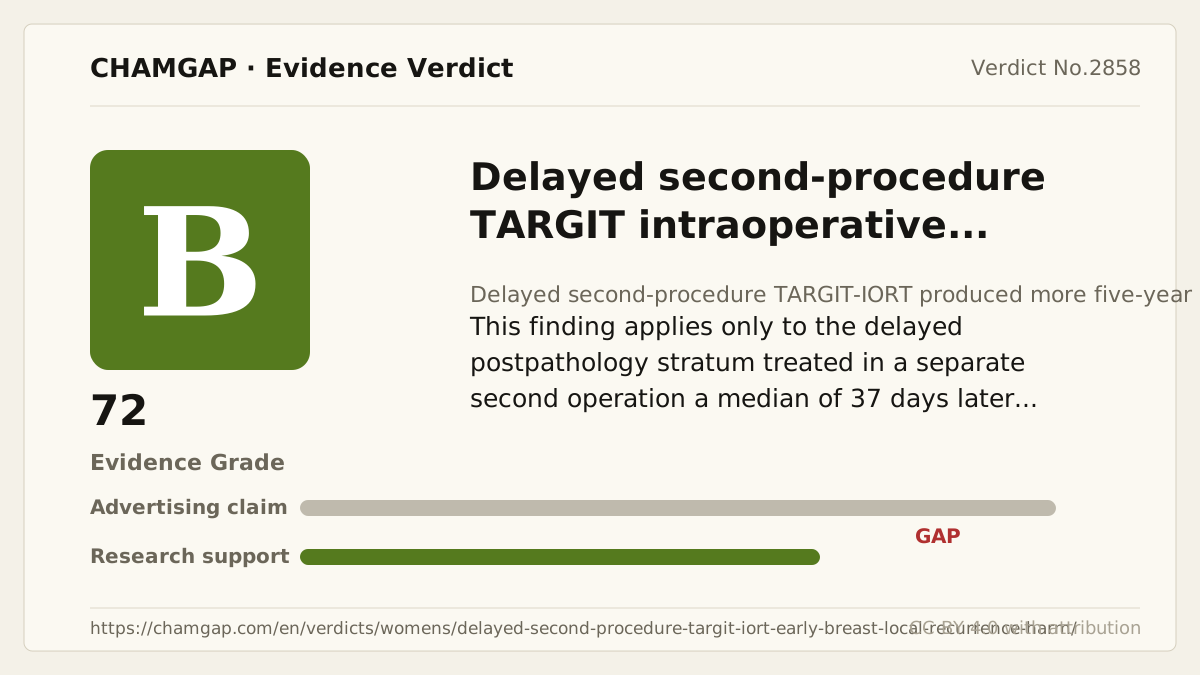
[Chamgap] Delayed Second-Procedure TARGIT Intraoperative Radiotherapy Harms Local Control in Early Breast Cancer — Evidence Grade B·72. 1 cited sources checked. Source: https://chamgap.com/en/verdicts/womens/delayed-second-procedure-targit-iort-early-breast-local-recurrence-harm/ · CC BY 4.0CC BY 4.0 — free to use with attribution; do not distort grades, numbers, or verdict meaning.
What this document does and does not do
Chamgap is an information source. It reports what research has and has not confirmed; it does not tell readers what to take or buy. That decision belongs to readers and, when needed, medical or legal professionals. This verdict reflects literature available up to the search date and may change as new research appears. Nothing here is medical advice.