
Chemical hair straightener use,
does it really help with Associated with increased incidence of uterine cancer?
research showsThe grade is C. In a prospective Sister Study cohort of 33,947 women followed for a mean 10.9 years, 378 uterine cancers occurred. Adjusted HR was 1.80 (95% CI 1.12-2.88) for any use in the prior year and 2.55 (1.46-4.45) for more than four uses. Estimated risk by age 70 was 1.64% without use and 4.05% with frequent use, an absolute difference of 2.41 points (0.52-4.80).
ads claimKorean magic-straightening services vary across chemical relaxers, heat pressing, and keratin-type formulations. This study did not record brand, ingredient, or treatment setting, so it cannot quantify a specific Korean service's risk.
Useful facts when choosing a product
- Estimated risk by age 70 was 4.05% for frequent users and 1.64% for nonusers, a 2.41-point difference.
- Permanent, semipermanent, or temporary dyes, bleach/highlights, and perms/body waves were not clearly associated with increased uterine cancer.
- Verdict 2281 is D with 34 points and concerns personal permanent dye and blood cancers; both exposure and cancer endpoint differ here.
What the research actually shows
Chang et al. followed 33,947 women aged 35-74 with a uterus and no prior uterine cancer. Baseline self-report covered use in the prior 12 months of dyes, bleach or highlights, straighteners/relaxers/pressing products, and permanents/body waves. Brands and ingredients were not collected, and pressing could include heated combs or flatirons with less-harsh or no chemical product. Self-reported cancers were confirmed from medical or pathology records when available. The outcome was all uterine cancer, including uterine sarcoma, not endometrial cancer alone, although type I endometrial-restricted estimates were similar. Adjusted HRs were 1.20 (0.63-2.29) for four or fewer uses and 2.55 (1.46-4.45) for more than four uses, trend P=.002. Funding was the NIH/NIEHS Intramural Research Program, grants Z01-ES044005 and Z1AES103332-01. A clinical-trial registration number is not applicable to this observational cohort.
Why this is classified as C (56)
Prospective hard events, HR 2.55, a 2.41-point absolute difference, and dose response support the harm claim, but a single cohort with one-time self-reported product class, no ingredients, time-varying exposure error, and residual confounding supports C with 56 points.
Counterpoint. C means neither proven safety nor proven causation. The low-absolute-risk observational signal needs replication and ingredient-specific research.
Rejudgment record. Cross-check applied — Prospective total and frequency-specific hazard ratios with absolute risks, while accounting for baseline self-report, unmeasured ingredients, time-varying exposure, and residual confounding
| Endpoint | H | Hard endpoint - actual events such as death |
| Replication | R1 | Single confirmatory trial |
| Independence | I2 | Decisive evidence is publicly or non-profit funded |
| Effect size | E+ | Meets the clinically important threshold |
The scoring table and the verdict agree (C).
Sub-claim grades by effect
This ingredient is marketed for several effects. A single overall grade blends strong and weak claims together, so each effect is graded separately here. The overall grade reflects the strongest disconfirming or core claim.
| Effect (sub-claim) | Grade | Basis |
|---|---|---|
| More than four uses per year and increased overall uterine cancer | C | HR was 2.55 and the age-70 absolute difference was 2.41 points. |
| A specific straightener ingredient causes uterine cancer | ? | Brands and ingredients were not collected, preventing ingredient-specific judgment. |
Cross-check — Codex and Claude
Evidence Table
| Study | Design | Sample | Funding | Endpoint | Result | Weight |
|---|---|---|---|---|---|---|
| Study 1 | US prospective cohort | 378 | NIH/NIEHS Intramural Research Program (Z01-ES044005, Z1AES103332-01) | All uterine cancer, confirmed by medical or pathology records when available | Ever-use HR 1.80 (1.12-2.88); >4/year HR 2.55 (1.46-4.45); risk by age 70, 4.05% vs 1.64% | Pivotal single prospective cohort |
Receipt — 2 References
All 2 cited sources were verified for existence at the original page (as of 2026-08-08).
Reviewed and approved: Chamgap Editorial Team · Approval date: 2026-08-08 · Corrections: none
Cite this verdict
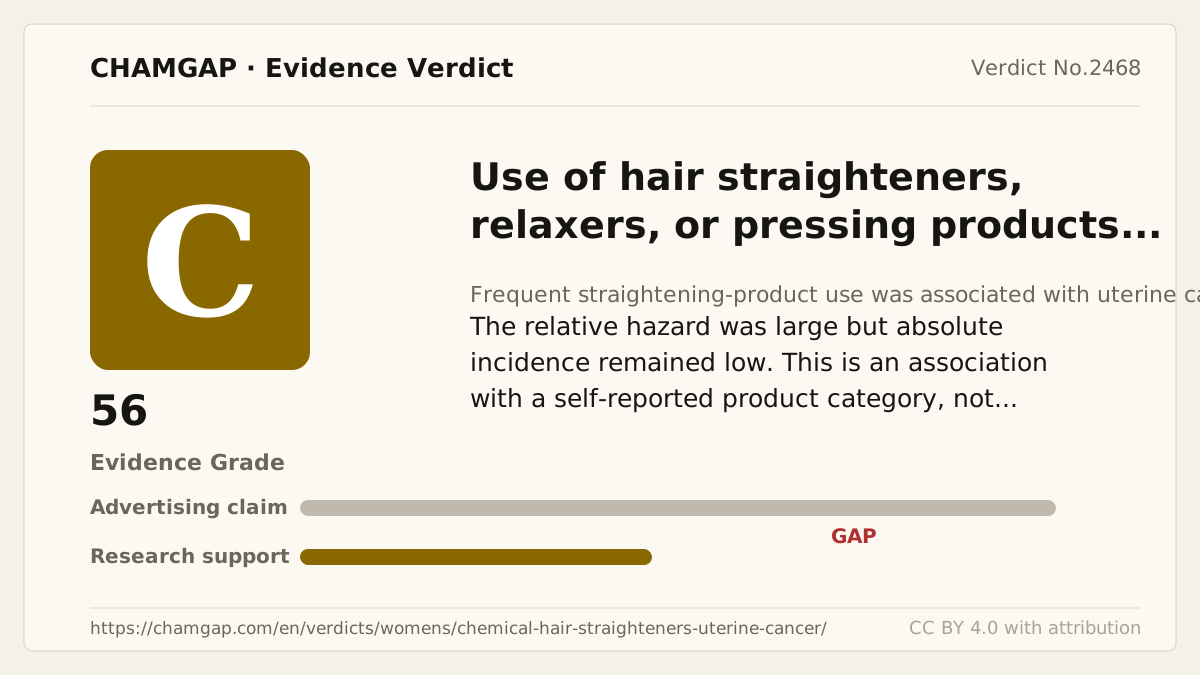
[Chamgap] Chemical hair straightener use x associated with increased uterine cancer — Evidence Grade C·56. 2 cited sources checked. Source: https://chamgap.com/en/verdicts/womens/chemical-hair-straighteners-uterine-cancer/ · CC BY 4.0CC BY 4.0 — free to use with attribution; do not distort grades, numbers, or verdict meaning.
What this document does and does not do
Chamgap is an information source. It reports what research has and has not confirmed; it does not tell readers what to take or buy. That decision belongs to readers and, when needed, medical or legal professionals. This verdict reflects literature available up to the search date and may change as new research appears. Nothing here is medical advice.