
Preincision cefazolin,
does it really help with Prevention of maternal infection versus the same antibiotic after cord clamping?
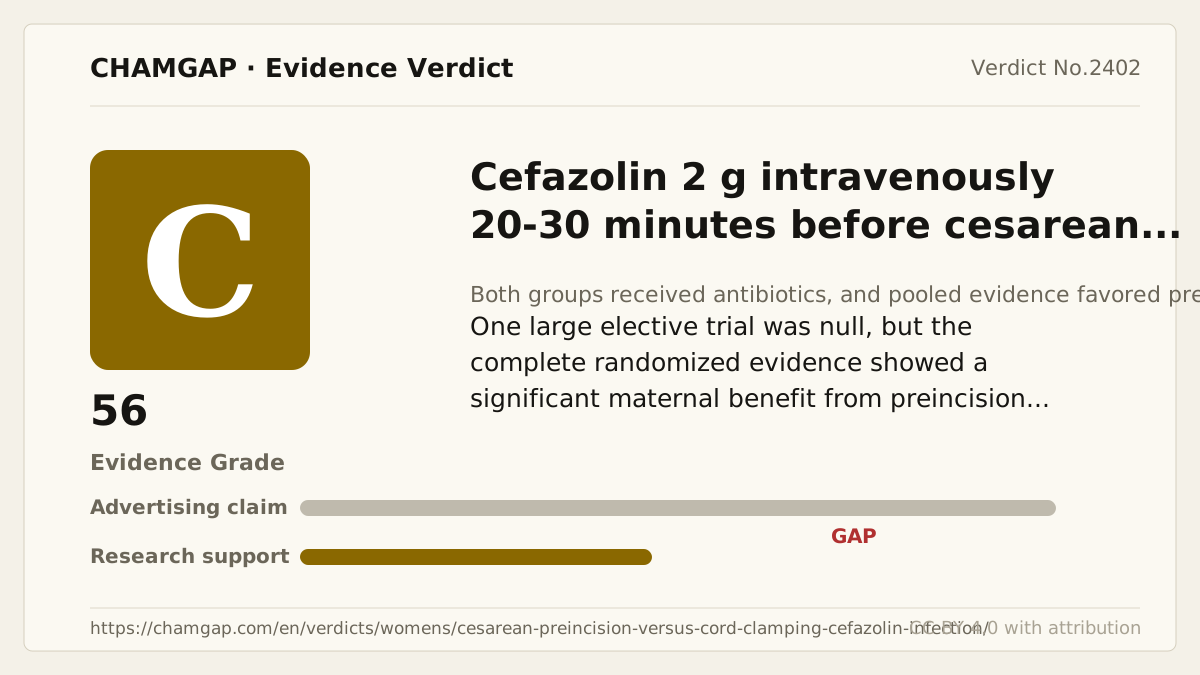
research showsThe grade is C. Both comparison arms received prophylactic antibiotics. A Cochrane synthesis of 10 randomized trials and 5,041 women found lower primary composite maternal infectious morbidity with preincision dosing, RR 0.57 (95% CI 0.45 to 0.72).
ads claimState clearly that both timing arms received the same drug and dose.
Useful facts when choosing a product
- Both timing arms received the same prophylactic intravenous antibiotic within each trial; both Witt timing arms received cefazolin 2 g.
- The pooled primary outcome was composite maternal infectious morbidity.
- Neonatal sepsis and sepsis workup were null; neonatal antibiotic treatment was reported in one trial with 90 neonates, RR 0.84 (95% CI 0.12 to 5.68).
What the research actually shows
Cochrane pooled 10 randomized trials and 5,041 women through March 2014. Both arms received prophylactic intravenous antibiotics; only timing differed. The primary composite maternal morbidity RR was 0.57 (95% CI 0.45 to 0.72), endometritis RR 0.54 (0.36 to 0.79), and surgical-site infection RR 0.59 (0.44 to 0.81). Neonatal sepsis was reported in five trials and 2,907 neonates, RR 0.76 (0.51 to 1.13); sepsis workup in four trials and 1,170 neonates, RR 0.92 (0.69 to 1.23); and neonatal antibiotic treatment in one trial and 90 neonates, RR 0.84 (0.12 to 5.68). Exact heterogeneity values for these three neonatal outcomes and the review's original funding and conflict-of-interest wording could not be verified. Trials with unclear allocation concealment and high or unclear blinding risk were included.
Why this is classified as C (56)
Pooled maternal benefit with unclear allocation concealment and high or unclear blinding risk gives C with 56 points.
Counterpoint. This does not refute antibiotic prophylaxis itself.
Rejudgment record. Cross-check applied — Pooled benefit across 10 randomized timing trials with prophylactic antibiotics in both arms
| Endpoint | H | Hard endpoint - actual events such as death |
| Replication | R1 | Single confirmatory trial |
| Independence | I1 | Mixed funding sources |
| Effect size | E+ | Meets the clinically important threshold |
The scoring table and the verdict agree (C).
Sub-claim grades by effect
This ingredient is marketed for several effects. A single overall grade blends strong and weak claims together, so each effect is graded separately here. The overall grade reflects the strongest disconfirming or core claim.
| Effect (sub-claim) | Grade | Basis |
|---|---|---|
| Prevention of composite maternal infection | C | The pooled RR across 10 trials was 0.57 (95% CI 0.45 to 0.72). |
Cross-check — Codex and Claude
Evidence Table
| Study | Design | Sample | Funding | Endpoint | Result | Weight |
|---|---|---|---|---|---|---|
| Study 1 | Double-blind three-arm randomized trial | 1,112 | No separate funding statement; Financial Disclosure: None reported | Composite wound infection, endometritis, or urinary infection | 18/370 versus 14/371; risk difference 1.1 points (95% CI -1.8 to 4.0) | Pivotal timing comparison |
| Study 2 | Systematic review and meta-analysis of randomized trials | 5,041 | The review's original funding and conflict-of-interest wording could not be verified | Primary composite maternal infectious morbidity; endometritis; surgical-site infection | RR 0.57 (0.45-0.72); 0.54 (0.36-0.79); 0.59 (0.44-0.81) | Pooled estimate of the complete randomized evidence |
| Study 3 | Systematic review and meta-analysis of randomized trials | 7,131 | Could not be verified from the accessible abstract | Endometritis; wound complications; neonatal sepsis | RR 0.52 (0.37-0.72); 0.54 (0.42-0.69); 0.83 (0.61-1.14) | Broadest updated randomized evidence |
Receipt — 4 References
All 4 cited sources were verified for existence at the original page (as of 2026-08-07).
Reviewed and approved: Chamgap Editorial Team · Approval date: 2026-08-07 · Corrections: none
Cite this verdict
[Chamgap] Preincision cefazolin x postcesarean infection versus dosing after cord clamping — Evidence Grade C·56. 4 cited sources checked. Source: https://chamgap.com/en/verdicts/womens/cesarean-preincision-versus-cord-clamping-cefazolin-infection/ · CC BY 4.0CC BY 4.0 — free to use with attribution; do not distort grades, numbers, or verdict meaning.
What this document does and does not do
Chamgap is an information source. It reports what research has and has not confirmed; it does not tell readers what to take or buy. That decision belongs to readers and, when needed, medical or legal professionals. This verdict reflects literature available up to the search date and may change as new research appears. Nothing here is medical advice.