
Active management of the third stage of labor,
does it really help with Reduced postpartum hemorrhage of at least 500 mL versus physiological or expectant management?
research showsThe grade is B. Postpartum hemorrhage of at least 500 mL occurred in 50/846 versus 152/849 in Bristol and 51/748 versus 126/764 in Hinchingbrooke. Absolute risk fell by about 12 and 10 percentage points, a large and consistent effect. D. R. Elbourne participated in both trials, so they were not counted as replication by fully independent investigator groups, giving B with 76 points.
ads claimActive management is not one drug or maneuver; it is a bundle of uterotonic use, cord handling, and placental delivery. Evidence for the bundle cannot be split into separate proof for each drug, traction technique, or immediate cord clamping.
Useful facts when choosing a product
- Bristol usually used 5 units oxytocin plus 0.5 mg ergometrine, cord clamping within 30 seconds, and controlled cord traction.
- Hinchingbrooke used a prophylactic uterotonic within two minutes, immediate cord clamping and cutting, and controlled traction or maternal effort.
- The historical bundles may differ from modern management that incorporates delayed cord clamping.
- No duplicate ingredient-outcome verdict or reuse of either PMID/DOI pair was found in the existing list.
What the research actually shows
Bristol assigned 1,695 women, 846 versus 849, using correspondingly numbered sealed opaque envelopes. Active management usually included oxytocin plus ergometrine, cord clamping within 30 seconds, and controlled cord traction. Clinical blood-loss assessment was unblinded, although allocation concealment was adequate. Hinchingbrooke assigned 1,512 low-risk women, 748 versus 764, analyzed them by intention to treat, and objective blood-loss measures confirmed the result. ISRCTN63422923 was registered on January 23, 2004, after 1993-95 recruitment and 1998 publication, so it was retrospective despite the registry display. Both trials had public or nonprofit funding, but D. R. Elbourne in Bristol and D. Elbourne in Hinchingbrooke are the same investigator, Diana Elbourne. This overlap prevents fully independent replication, so axis 2 remains R1.
Why this is classified as B (76)
Two publicly funded trials enrolling more than 1,500 women each reduced a hard hemorrhage event by about 10 to 12 points. The common investigator prevented independent-replication credit, and unblinded clinical blood-loss assessment remained a limitation, giving B with 76 points.
Counterpoint. This verdict compares historical active-management bundles with physiological or expectant management in hospital vaginal birth. Cesarean delivery, home birth, comparisons among uterotonics, and omission of controlled cord traction are separate questions.
Rejudgment record. Cross-check applied — We cross-checked randomized and analyzed counts, hemorrhage events, bundle components, public funding, shared investigators, and the actual ISRCTN registration date.
| Endpoint | H | Hard endpoint - actual events such as death |
| Replication | R1 | Single confirmatory trial |
| Independence | I2 | Decisive evidence is publicly or non-profit funded |
| Effect size | E+ | Meets the clinically important threshold |
The scoring table and the verdict agree (B).
Sub-claim grades by effect
This ingredient is marketed for several effects. A single overall grade blends strong and weak claims together, so each effect is graded separately here. The overall grade reflects the strongest disconfirming or core claim.
| Effect (sub-claim) | Grade | Basis |
|---|---|---|
| Bundled active management of the third stage reduces postpartum hemorrhage of at least 500 mL. | B | Two large trials found absolute risk reductions of about 10 to 12 percentage points. |
| Early cord clamping alone causes the reduction in postpartum hemorrhage. | ? | The trials also changed uterotonic use and placental traction, so the isolated effect of early clamping was not estimated. |
Cross-check — Codex and Claude
Evidence Table
| Study | Design | Sample | Funding | Endpoint | Result | Weight |
|---|---|---|---|---|---|---|
| Study 1 | Single-hospital individually randomized controlled trial | 849 | Additional WHO Maternity and Child Division funds and DHSS support for the National Perinatal Epidemiology Unit | Postpartum hemorrhage defined as clinically estimated blood loss of at least 500 mL | 50/846 (5.9%) versus 152/849 (17.9%); active-versus-physiological RR 0.33 (95% CI 0.24-0.45) | Large publicly and nonprofit funded positive hemorrhage trial |
| Study 2 | Individually randomized 2-by-2 factorial trial in low-risk women | 764 | Public Health and Operational Research Committee of the Anglia and Oxford Regional Health Authority and Department of Health support for the National Perinatal Epidemiology Unit | Postpartum hemorrhage defined as estimated blood loss of at least 500 mL within 24 hours | 51/748 (6.8%) versus 126/764 (16.5%); active-versus-expectant RR 0.41 (95% CI 0.30-0.56), P<.0001 | Large publicly funded trial in the same direction but with a shared investigator |
Receipt — 2 References
All 2 cited sources were verified for existence at the original page (as of 2026-08-14).
Reviewed and approved: Chamgap Editorial Team · Approval date: 2026-08-14 · Corrections: none
Cite this verdict
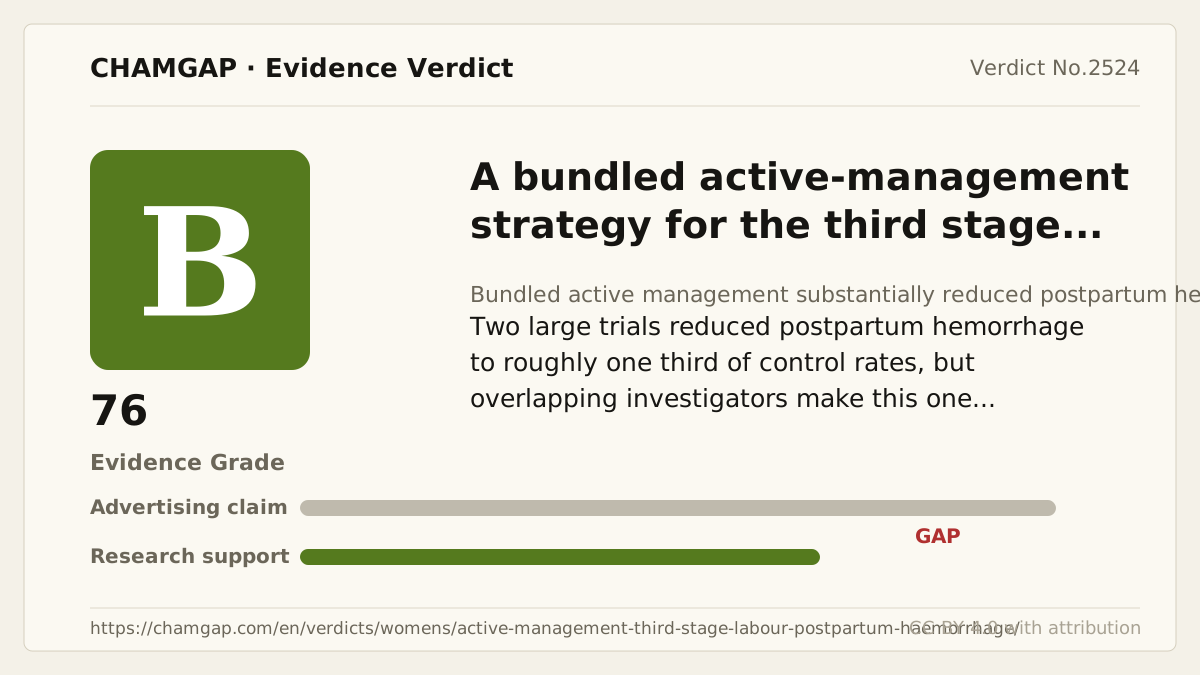
[Chamgap] Active management of the third stage of labor x prevention of postpartum hemorrhage — Evidence Grade B·76. 2 cited sources checked. Source: https://chamgap.com/en/verdicts/womens/active-management-third-stage-labour-postpartum-haemorrhage/ · CC BY 4.0CC BY 4.0 — free to use with attribution; do not distort grades, numbers, or verdict meaning.
What this document does and does not do
Chamgap is an information source. It reports what research has and has not confirmed; it does not tell readers what to take or buy. That decision belongs to readers and, when needed, medical or legal professionals. This verdict reflects literature available up to the search date and may change as new research appears. Nothing here is medical advice.