
White noise for newborns and infants,
does it really help with Increased likelihood of falling asleep?
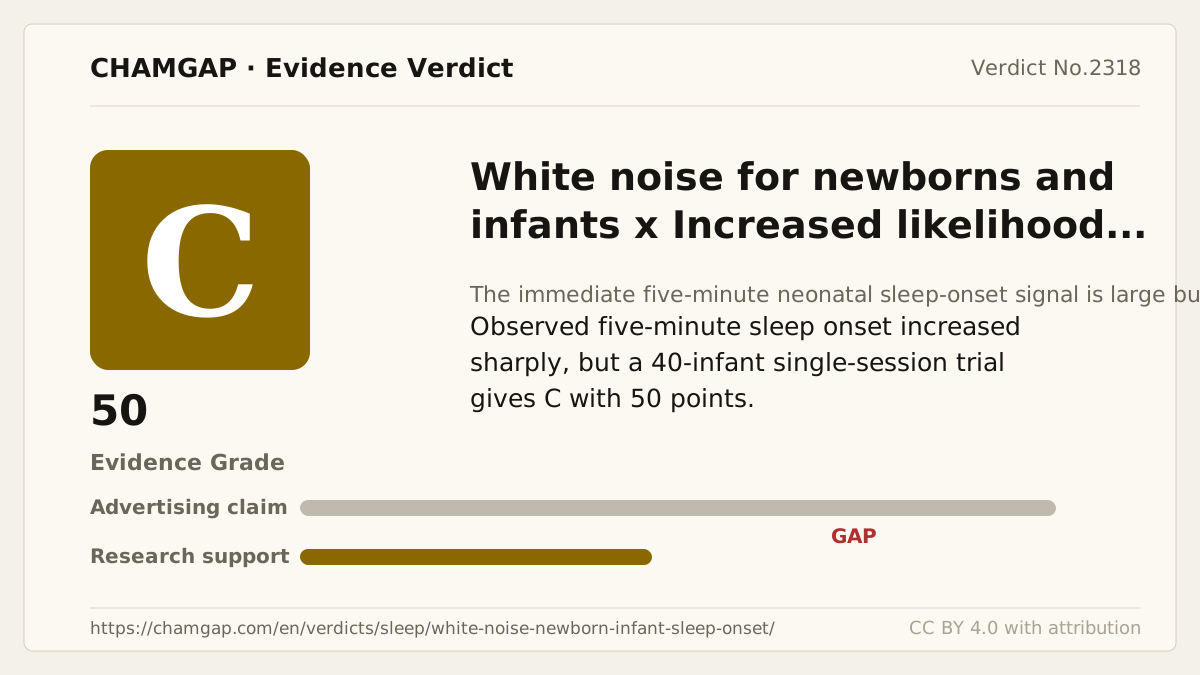
research showsThe grade is C. In a single observation, 40 newborns aged 2 to 7 days were randomized 20 per group. Sixteen of 20, 80%, fell asleep within five minutes with white noise versus 5 of 20, 25%, without noise. Sleep was behaviorally observed by one investigator rather than reported by parents, and observation lasted only about five minutes. The 55-point absolute difference is large, but the very small sample and absence of multi-night testing limit the grade to C with 50 points.
ads claimA one-session response within five minutes cannot establish longer overnight sleep or durable sleep habits in all infants. Apps and devices also differ in spectrum and output from the study device.
Useful facts when choosing a product
- The trial randomized 40 newborns aged 2 to 7 days, 20 per group, in one session.
- Sleep onset was behaviorally judged by one observer for about five minutes, not parent-reported.
- Reported output was about 67 to 72.5 dB, and multi-night use was not studied.
What the research actually shows
Spencer and colleagues randomized 40 healthy newborns aged 2 to 7 days, 20 to white noise and 20 to no noise. One investigator watched for sleep during about five minutes; no polysomnography, actigraphy, or parent sleep diary was used. The device produced approximately 72.5 dB at 500 Hz and 67 dB at 9 kHz and was placed roughly 30 to 50 cm from the infant's head. This was one brief sleep-onset observation, not a multi-night test of latency, awakenings, total sleep, or long-term habits. Verdict 1259 is C with 55 points for adult and older-adult sleep onset and subjective sleep quality; the population and endpoint differ from the observed neonatal outcome here.
Why this is classified as C (50)
A large absolute sleep-onset difference rests on one small, single-session, unmasked-observer trial, giving C with 50 points.
Counterpoint. This verdict recognizes an immediate neonatal signal but does not establish long-term infant sleep, sleep maintenance, or hearing safety.
Rejudgment record. Cross-check applied — The original report was checked for age, randomized count, observation method and duration, sound level, and absolute sleep-onset values
| Endpoint | P | Patient-reported treatment goal - the symptom is the goal |
| Replication | R1 | Single confirmatory trial |
| Independence | I1 | Mixed funding sources |
| Effect size | E+ | Meets the clinically important threshold |
The scoring table and the verdict agree (C).
Sub-claim grades by effect
This ingredient is marketed for several effects. A single overall grade blends strong and weak claims together, so each effect is graded separately here. The overall grade reflects the strongest disconfirming or core claim.
| Effect (sub-claim) | Grade | Basis |
|---|---|---|
| Single-session neonatal sleep onset within five minutes | C | Rates were 80% versus 25%, but this was one session in 40 infants. |
| Improved infant sleep across multiple nights | ? | No direct repeated overnight trial was identified. |
Cross-check — Codex and Claude
Evidence Table
| Study | Design | Sample | Funding | Endpoint | Result | Weight |
|---|---|---|---|---|---|---|
| Study 1 | Single-session randomized controlled trial | 20 | Not stated in the paper | Sleep onset within five minutes, behaviorally observed by one investigator | 16/20 (80%) versus 5/20 (25%) | Only direct neonatal sleep-onset trial |
| Study 2 | Laboratory sound-level measurement of infant sleep machines | 14 | Academic nonprofit research | Maximum output at 30, 100, and 200 cm | All 14 exceeded 50 dBA at 30 cm and three exceeded 85 dBA | Safety only, not used for efficacy grade |
Receipt — 2 References
All 2 cited sources were verified for existence at the original page (as of 2026-08-06).
Reviewed and approved: Chamgap Editorial Team · Approval date: 2026-08-06 · Corrections: none
Cite this verdict
[Chamgap] White noise for newborns and infants x sleep onset — Evidence Grade C·50. 2 cited sources checked. Source: https://chamgap.com/en/verdicts/sleep/white-noise-newborn-infant-sleep-onset/ · CC BY 4.0CC BY 4.0 — free to use with attribution; do not distort grades, numbers, or verdict meaning.
What this document does and does not do
Chamgap is an information source. It reports what research has and has not confirmed; it does not tell readers what to take or buy. That decision belongs to readers and, when needed, medical or legal professionals. This verdict reflects literature available up to the search date and may change as new research appears. Nothing here is medical advice.