
Wearing socks in bed,
does it really help with Improved sleep onset and sleep?
research showsThe grade is C with 54 points. In a laboratory crossover study of six healthy young men, actigraphy-measured sleep latency and efficiency improved on the sock night, but each condition lasted only one night and confidence intervals were not reported.
ads claimBlinding socks was infeasible, but the main endpoints were device measured, so lack of blinding alone was not counted as a defect. The small sample and one-night duration remain. A distinct intervention, stopping smartphone use 30 minutes before bed, is covered by verdict 2200, which is C with 54 points.
Useful facts when choosing a product
- The study sock was 90% polyester and 10% spandex and covered the ankle.
- Visits were a mean six days and at least two days apart; only the order of the two conditions was stated to be randomized.
- The study was supported by a National Research Foundation of Korea nanomaterials program.
What the research actually shows
Objective endpoints were actigraphy-measured latency, efficiency, total sleep time, and awakenings. Subjective sleep questionnaires did not differ significantly. No validated clinical threshold was available; approximation from the reported group standard deviations places the objective contrasts in the large statistical range, but this does not incorporate within-person correlation and is highly uncertain with six participants.
Why this is classified as C (54)
Sleep latency, total sleep time, and sleep efficiency directly measure sleep, the treatment target, rather than predict another event as surrogates. The six-person, one-night design still gives C with 54 points because of bias limitations.
Counterpoint. Warm feet may improve comfort, but chronic insomnia treatment, hot environments, and patients with poor circulation were not established.
Rejudgment record. Cross-check applied — A random-order crossover experiment showed objective sleep-index signals but was limited to six healthy men and one night per condition
| Endpoint | P | Patient-reported treatment goal - the symptom is the goal |
| Replication | R1 | Single confirmatory trial |
| Independence | I2 | Decisive evidence is publicly or non-profit funded |
| Effect size | E+ | Meets the clinically important threshold |
The scoring table and the verdict agree (C).
Sub-claim grades by effect
This ingredient is marketed for several effects. A single overall grade blends strong and weak claims together, so each effect is graded separately here. The overall grade reflects the strongest disconfirming or core claim.
| Effect (sub-claim) | Grade | Basis |
|---|---|---|
| Shorter objective sleep latency in a cool environment | C | Positive in a one-night study of six men. |
| Treatment of chronic insomnia | ? | Patients with insomnia and long-term use were not studied. |
Cross-check — Codex and Claude
Evidence Table
| Study | Design | Sample | Funding | Endpoint | Result | Weight |
|---|---|---|---|---|---|---|
| Ko Y, Lee JY. 2018 | Two-condition random-order crossover experiment; one night per condition | 6 | National Research Foundation of Korea | Actigraphy latency, efficiency, total sleep time, and awakenings | Latency 8.5 vs 16.0 min; efficiency 93.8% vs 86.2%; confidence intervals not reported | Objective signal but extremely small and short |
Receipt — 1 References
All 1 cited sources were verified for existence at the original page (as of 2026-08-07).
Reviewed and approved: Chamgap Editorial Team · Approval date: 2026-08-07 · Corrections: none
Cite this verdict
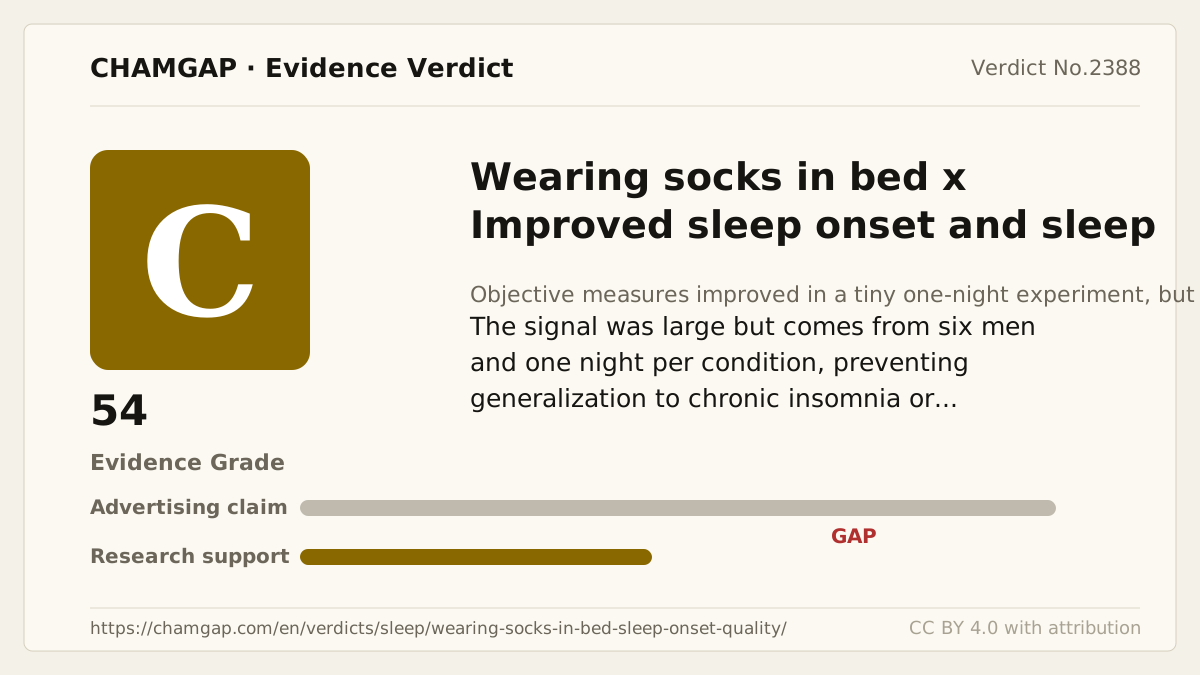
[Chamgap] Wearing socks in bed x sleep onset and sleep quality — Evidence Grade C·54. 1 cited sources checked. Source: https://chamgap.com/en/verdicts/sleep/wearing-socks-in-bed-sleep-onset-quality/ · CC BY 4.0CC BY 4.0 — free to use with attribution; do not distort grades, numbers, or verdict meaning.
What this document does and does not do
Chamgap is an information source. It reports what research has and has not confirmed; it does not tell readers what to take or buy. That decision belongs to readers and, when needed, medical or legal professionals. This verdict reflects literature available up to the search date and may change as new research appears. Nothing here is medical advice.