
Low-dose doxepin,
does it really help with Improved sleep maintenance and reduced nighttime wakefulness in chronic insomnia?
research showsLow-dose doxepin 3 to 6 mg is rated B specifically for sleep maintenance and nighttime wakefulness in chronic insomnia. Across five placebo-controlled randomized trials involving 858 participants, objective wake after sleep onset decreased by about 22 minutes and total sleep time increased by 26 to 32 minutes, meeting clinical thresholds. Sleep maintenance and nighttime wakefulness are treatment targets themselves, not surrogate outcomes. Industry sponsorship is concentrated, so a high B is inappropriate and the verdict is B with 62 points. This rating does not extend to sleep onset or next-day residual sedation.
ads claimMarketing may expand a sleep-maintenance benefit into rapid sleep onset, perfect sleep, and complete resolution of next-day fatigue. The evidence is centered on wake after sleep onset and later-night maintenance.
Useful facts when choosing a product
- Silenor-type low-dose doxepin is a prescription medicine for insomnia characterized by sleep-maintenance difficulty; adults commonly use 6 mg, while 3 mg is appropriate for some patients.
- Adults aged 65 years or older generally start at 3 mg and should not exceed 6 mg daily.
- Taking it within three hours of a meal may increase next-day effects, and it should be used only when seven to eight hours of sleep are available.
- The dose is far below antidepressant dosing, but somnolence can occur and alcohol or other sedatives can increase impairment.
What the research actually shows
The FDA label summarizes six randomized double-blind trials of low-dose doxepin in 1,423 participants with chronic or transient insomnia and supports objective and subjective wake-after-sleep-onset efficacy. Krystal 2011 randomized 221 adults with chronic primary insomnia to 3 mg, 6 mg, or placebo for 35 days; both doses reduced wake after sleep onset at multiple time points. Krystal 2010 randomized 240 adults aged 65 years or older to 1 mg, 3 mg, or placebo for 12 weeks and found improvements in later-night maintenance and total sleep time. AASM downgraded the overall evidence to low quality for publication bias and imprecision and made only a weak recommendation, while both published trials included authors tied to the developer.
Why this is classified as B (62)
Five placebo-controlled randomized trials involving 858 participants found a 22-minute reduction in objective wake after sleep onset and a 26-to-32-minute increase in total sleep time, meeting clinical thresholds for sleep maintenance. Sleep maintenance and nighttime wakefulness are direct patient outcomes and treatment targets, so a surrogate-outcome ceiling does not apply. Consistency across trials and parity with peer hypnotic verdicts support B, while concentrated industry sponsorship makes a high B inappropriate and limits the result to 62 points. This grade applies only to sleep maintenance and not to sleep onset or next-day residual sedation.
Counterpoint. Cognitive behavioral therapy is first-line for chronic insomnia, and sleep apnea, depression or anxiety, pain, and medication causes require assessment. Driving should be avoided if next-day somnolence occurs.
Rejudgment record. Consistency recalibration (rule 1 clarification) — Treated sleep maintenance and nighttime wakefulness as direct patient outcomes and treatment targets rather than surrogates; five placebo-controlled trials involving 858 participants found a 22-minute reduction in wake after sleep onset and a 26-to-32-minute increase in total sleep time meeting clinical thresholds, supporting B while concentrated industry sponsorship limits the score to 62 and sleep onset and residual sedation remain excluded
Sub-claim grades by effect
This ingredient is marketed for several effects. A single overall grade blends strong and weak claims together, so each effect is graded separately here. The overall grade reflects the strongest disconfirming or core claim.
| Effect (sub-claim) | Grade | Basis |
|---|---|---|
| Improved sleep maintenance and reduced nighttime wakefulness in chronic insomnia | B | Five trials involving 858 participants found a 22-minute reduction in objective wake after sleep onset and a 26-to-32-minute increase in total sleep time, meeting clinical sleep-maintenance thresholds. |
| Improved sleep onset | ? | Effects are weaker and less consistent than for sleep maintenance, preventing a firm independent conclusion. |
| Relatively limited next-day residual sedation | C | Major psychomotor signals were limited, but somnolence can occur and absence of risk is not established. |
Cross-check — Codex and Claude
Evidence Table
| Study | Design | Sample | Funding | Endpoint | Result | Weight |
|---|---|---|---|---|---|---|
| Krystal AD et al. 2011 | Thirty-five-day randomized double-blind placebo-controlled sleep-laboratory trial | 221 | Sponsored by Somaxon Pharmaceuticals with company employees as coauthors | Polysomnographic wake after sleep onset, total sleep time, sleep efficiency, and patient reports | Both 3 and 6 mg significantly reduced wake after sleep onset on nights 1, 15, and 29, with sustained maintenance benefit. | Key objective direct evidence |
| Krystal AD et al. 2010 | Twelve-week randomized double-blind placebo-controlled laboratory and outpatient trial | 240 | Sponsored by Somaxon Pharmaceuticals with a company employee as coauthor | Polysomnographic total sleep time, maintenance, later-night sleep, and subjective ratings | Doses of 1 and 3 mg improved maintenance and later-night sleep over 12 weeks, with more consistent effects at 3 mg. | Longer-duration replication in older adults |
Receipt — 4 References
All 4 cited sources were verified for existence at the original page (as of 2026-07-23).
Reviewed and approved: Chamgap Editorial Team · Approval date: 2026-07-23 · Corrections: none
Cite this verdict
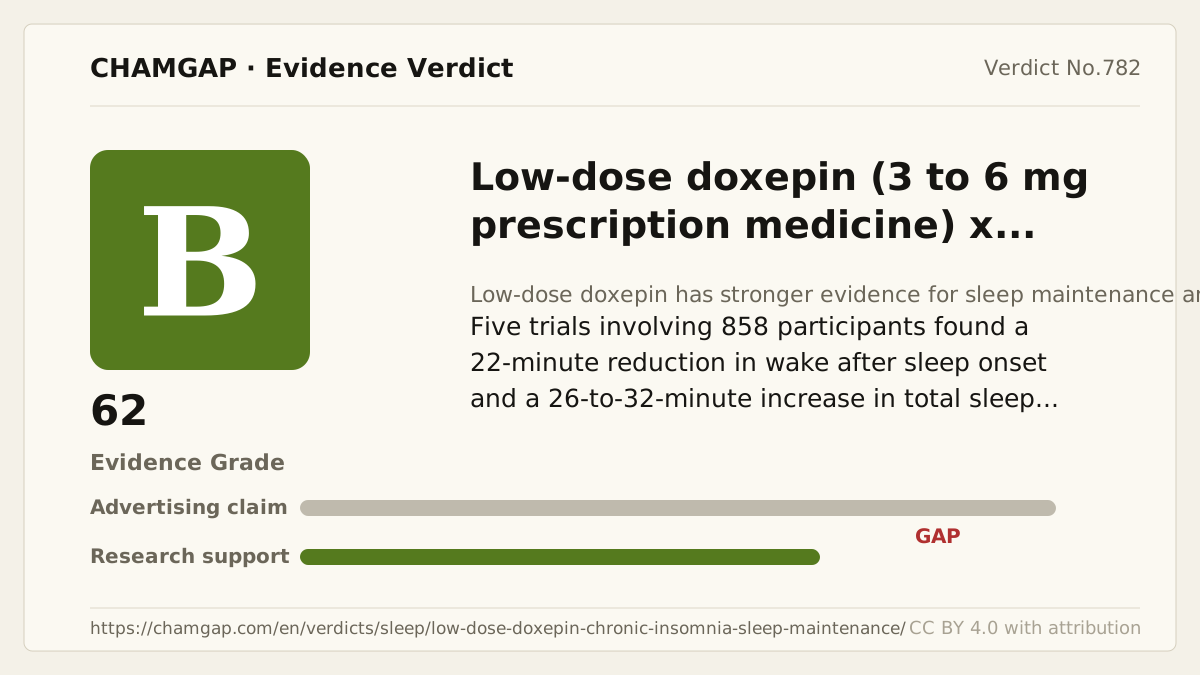
[Chamgap] Low-dose doxepin x improved sleep maintenance in chronic insomnia — Evidence Grade B·62. 4 cited sources checked. Source: https://chamgap.com/en/verdicts/sleep/low-dose-doxepin-chronic-insomnia-sleep-maintenance/ · CC BY 4.0CC BY 4.0 — free to use with attribution; do not distort grades, numbers, or verdict meaning.
What this document does and does not do
Chamgap is an information source. It reports what research has and has not confirmed; it does not tell readers what to take or buy. That decision belongs to readers and, when needed, medical or legal professionals. This verdict reflects literature available up to the search date and may change as new research appears. Nothing here is medical advice.