
L-serine,
does it really help with Improvement in sleep quality and nighttime awakenings?
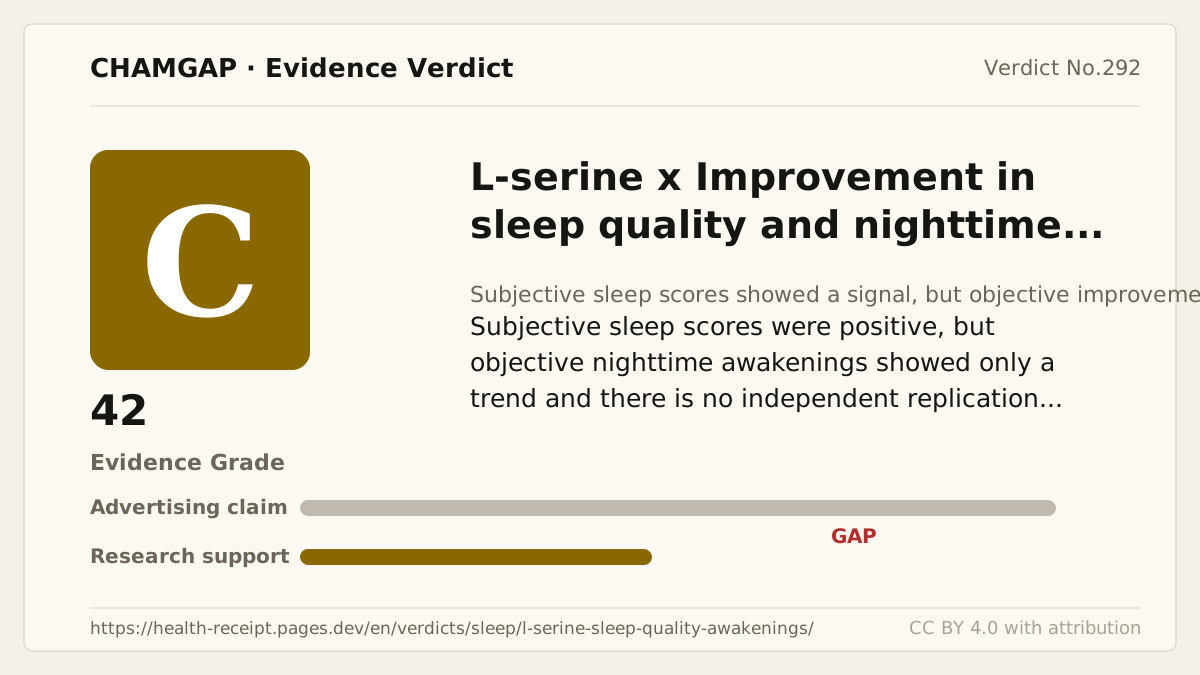
research showsL-serine 3 g improved subjective sleep-initiation and sleep-maintenance scores in brief crossover trials of adults dissatisfied with sleep. The evidence depends on analyses of 45 and seven people in one manufacturer-authored paper, however, and nighttime awakenings by actigraphy were not statistically significant, yielding C.
ads claimClaims of 'deep sleep' or 'not waking during the night' go beyond the study: sleep stages and depth were not measured, and objective reduction in awakenings was not established.
Useful facts when choosing a product
- The direct sleep-trial dose was 3 g 30 minutes before bedtime.
- The main positive outcomes were morning subjective questionnaires.
- The actigraphy sample was six, and nighttime awakenings had p=0.08.
- The studies lasted only days.
What the research actually shows
Ito 2014 Study 1 recruited 53 people and analyzed 45; 3 g of L-serine 30 minutes before bed for four nights produced higher OSA sleep-maintenance and sleep-initiation scores than placebo. Study 2 recruited nine and analyzed questionnaires in seven and actigraphy in six. Ratings of sleeping well and satisfaction improved, but sleep latency, sleep time, and arousal time did not, while objective awakening frequency showed only a trend at p=0.08.
Why this is classified as C (42)
A randomized placebo-controlled human signal rules out an unknown or D grade, but one manufacturer paper, small samples, subjective outcomes, and negative objective results yield C with 42 points.
Counterpoint. A subjective sleep-initiation and maintenance signal exists at 3 g before bedtime. It is not evidence for objective sleep architecture or chronic insomnia treatment.
Rejudgment record. New verdict — Positive subjective outcomes in randomized crossover trials, but one manufacturer paper, small samples, and nonsignificant actigraphy
Sub-claim grades by effect
This ingredient is marketed for several effects. A single overall grade blends strong and weak claims together, so each effect is graded separately here. The overall grade reflects the strongest disconfirming or core claim.
| Effect (sub-claim) | Grade | Basis |
|---|---|---|
| Improvement in subjective sleep quality, initiation, and maintenance | C | Some questionnaire outcomes were positive in analyses of 45 and seven people, but all come from one manufacturer paper. |
| Reduction in objective nighttime awakenings | D | In six people with actigraphy, awakening frequency showed only a nonsignificant trend. |
Cross-check — Codex and Claude
Evidence Table
| Study | Design | Sample | Funding | Endpoint | Result | Weight |
|---|---|---|---|---|---|---|
| Ito Y et al. 2014 Study 1 | Randomized double-blind placebo-controlled crossover trial | 45 | Conducted by FANCL researchers | OSA subjective sleep ratings | Sleep-maintenance and sleep-initiation scores improved; three other factors were not significant. | Key |
| Ito Y et al. 2014 Study 2 | Randomized double-blind placebo-controlled crossover trial | 6 | Conducted by FANCL researchers | SMH questionnaire and actigraphy | Some subjective items improved; objective results were nonsignificant, with awakening frequency at p=0.08. | Key |
Receipt — 1 References
All 1 cited sources were verified for existence at the original page (as of 2026-07-11).
Reviewed and approved: Chamgap Editorial Team · Approval date: 2026-07-11 · Corrections: none
Cite this verdict
[Chamgap] L-serine x improvement in sleep quality and nighttime awakenings — Evidence Grade C·42. 1 cited sources checked. Source: https://chamgap.com/en/verdicts/sleep/l-serine-sleep-quality-awakenings/ · CC BY 4.0CC BY 4.0 — free to use with attribution; do not distort grades, numbers, or verdict meaning.
What this document does and does not do
Chamgap is an information source. It reports what research has and has not confirmed; it does not tell readers what to take or buy. That decision belongs to readers and, when needed, medical or legal professionals. This verdict reflects literature available up to the search date and may change as new research appears. Nothing here is medical advice.