
Chinstrap alone,
does it really help with Reduced snoring and treatment of obstructive sleep apnea?
research showsThe grade is D. In a prospective study of 26 people with sleep apnea, median snoring index changed from 253.2 to 180.0 events per hour and technician-rated snoring from 3.0 to 2.5, neither significantly. AHI did not improve, changing from 16.0 to 25.9 per hour. A dramatic single case was not replicated, giving D with 28 points.
ads claimPhysically helping keep the mouth closed does not itself establish clinical treatment of snoring or upper-airway collapse. Neither snoring nor AHI improved in this study.
Useful facts when choosing a product
- The study tested a chinstrap alone, not a chinstrap added to CPAP.
- A neck microphone measured snoring index and a technician used a 0-to-3 subjective scale.
- CPAP titration significantly improved multiple measures, providing a positive control for the measurement system.
What the research actually shows
Bhat S, Gushway-Henry N, Polos P et al. studied 26 adults with AHI at least 5 using a ResMed Chin Restraint for roughly two hours, comparing it with a separate diagnostic polysomnogram and later-night CPAP titration. Chinstrap sleep time ranged from 81 to 179.5 minutes, and total sleep time and REM proportion differed from the diagnostic study. There was no randomized order or concurrent no-device control, and technician-rated subjective snoring was unmasked. The article states that the study was not industry supported but identifies no specific public or nonprofit funder. Registration and a prespecified primary endpoint could not be confirmed.
Why this is classified as D (28)
A patient-centered snoring target was measured in humans but did not improve in one 26-person, nonrandomized short comparison. Small sample, different-night sleep-architecture confounding, and unmasked subjective assessment give D with 28 points.
Counterpoint. A rare anatomical responder cannot be excluded, and adjunctive use to reduce CPAP leak is outside this verdict.
Rejudgment record. Cross-check applied — We cross-checked the 26-person analyzed sample, sleep time, snoring and AHI medians, nonparametric analysis, measurement order, funding disclosure, and the single case report.
| Endpoint | P | Patient-reported treatment goal - the symptom is the goal |
| Replication | R1 | Single confirmatory trial |
| Independence | I1 | Mixed funding sources |
| Effect size | E0 | Null |
| Precision | C0 | The confidence interval leaves room for benefit |
The scoring table and the verdict agree (D).
Sub-claim grades by effect
This ingredient is marketed for several effects. A single overall grade blends strong and weak claims together, so each effect is graded separately here. The overall grade reflects the strongest disconfirming or core claim.
| Effect (sub-claim) | Grade | Basis |
|---|---|---|
| Reduced snoring | D | Neither objective nor subjective snoring measures improved significantly. |
| Treatment of obstructive sleep apnea | D | AHI and oxygen-saturation nadir did not improve. |
Cross-check — Codex and Claude
Evidence Table
| Study | Design | Sample | Funding | Endpoint | Result | Weight |
|---|---|---|---|---|---|---|
| Study 1 | Prospective modified split-night self-controlled study | 26 | Disclosed as not industry supported, with no specific funding source identified | Snoring index and technician snoring scale; secondary AHI and oxygen-saturation nadir | Snoring index 253.2 vs 180.0/h, score 3.0 vs 2.5, AHI 16.0 vs 25.9/h; all nonsignificant | Primary null prospective evidence |
Receipt — 2 References
All 2 cited sources were verified for existence at the original page (as of 2026-08-14).
Reviewed and approved: Chamgap Editorial Team · Approval date: 2026-08-14 · Corrections: none
Cite this verdict
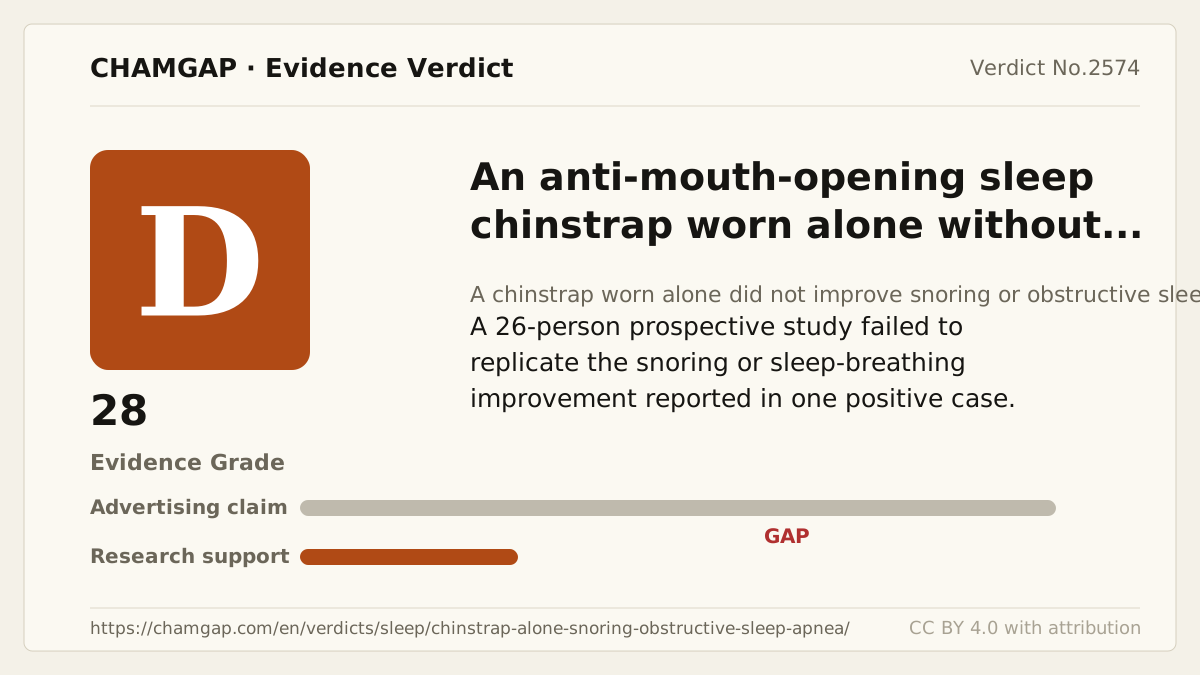
[Chamgap] Chinstrap alone x improved snoring and obstructive sleep apnea — Evidence Grade D·28. 2 cited sources checked. Source: https://chamgap.com/en/verdicts/sleep/chinstrap-alone-snoring-obstructive-sleep-apnea/ · CC BY 4.0CC BY 4.0 — free to use with attribution; do not distort grades, numbers, or verdict meaning.
What this document does and does not do
Chamgap is an information source. It reports what research has and has not confirmed; it does not tell readers what to take or buy. That decision belongs to readers and, when needed, medical or legal professionals. This verdict reflects literature available up to the search date and may change as new research appears. Nothing here is medical advice.