
Blue-enriched workplace lighting,
does it really help with Improved subjective alertness and nocturnal sleep quality in workers?
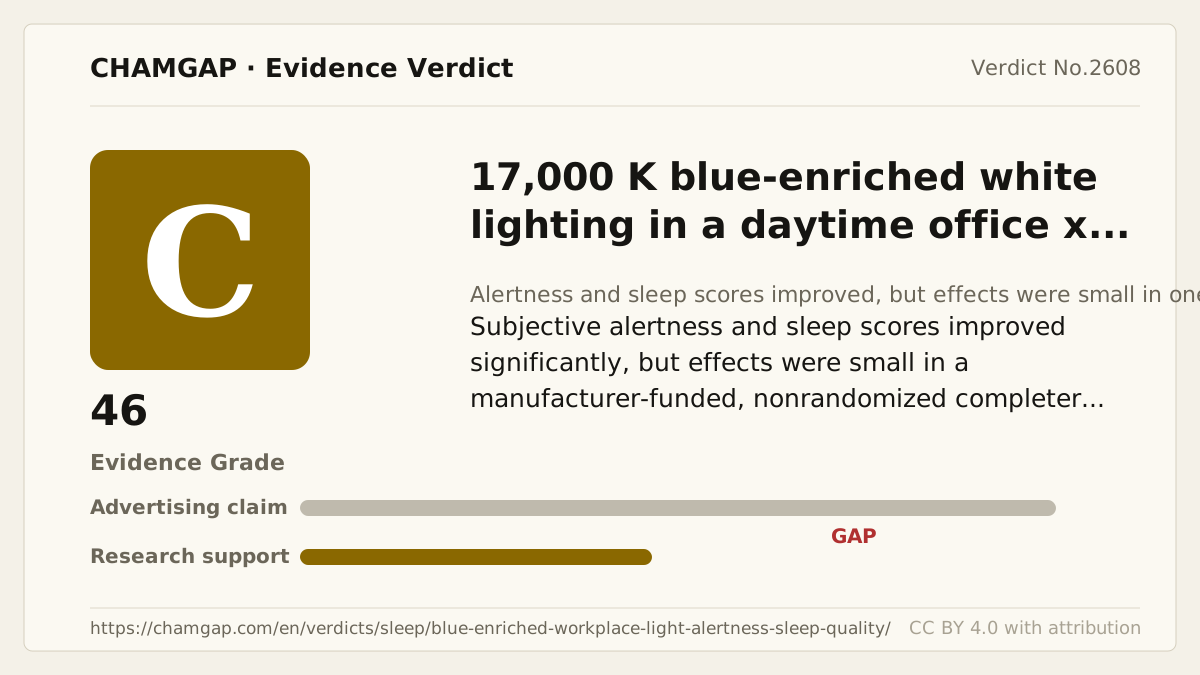
research showsThe grade is C with 46 points. In a floor-level crossover study enrolling 104 workers and analyzing 94, PSQI was 4.68 versus 5.42 and KSS sleepiness 3.60 versus 4.04 under blue-enriched light. These equal about 0.25 and 0.36 standard deviations, below medium magnitude. Floor sequence was not randomized, only completers were analyzed, and Philips funded the study.
ads claimThe 17,000 K lamp genuinely produced more output from 420 to 480 nm than the 4,000 K lamp. That physical difference does not establish large sleep or productivity benefits for every office worker.
Useful facts when choosing a product
- Both lamps were 18 W fluorescent tubes; the 17,000 K source produced more 420-480 nm output.
- Measured mean illuminance was 310 lx under blue-enriched light and 421 lx under standard white light.
- Philips Lighting supported the study, and Luc JM Schlangen was affiliated with Philips Lighting.
What the research actually shows
Two office floors experienced 17,000 K and 4,000 K lighting for four weeks each in opposite order. Assignment was determined by work location, not individual or cluster randomization; mixed models included baseline, condition, participant, and order. Mean work-surface illuminance was 310 lx under 17,000 K and 421 lx under 4,000 K, so spectrum was not the only difference. Philips Lighting supported the study and one coauthor was employed by Philips Lighting.
Why this is classified as C (46)
Participant-centered scores were positive but below medium magnitude. Nonrandom floor sequence, completer-only analysis, and manufacturer-only evidence give C with 46 points.
Counterpoint. This was four-week winter exposure in one UK office; other seasons, latitudes, buildings, nighttime exposure, and long-term safety are separate.
Rejudgment record. Cross-check applied — Cross-checked table means and standard errors, mixed-model methods, nonrandom floor assignment, withdrawals, expectation effects, and Philips support in the publisher PDF
| Endpoint | P | Patient-reported treatment goal - the symptom is the goal |
| Replication | R1 | Single confirmatory trial |
| Independence | I0 | Evidence comes only from manufacturer studies |
| Effect size | E~ | Statistically positive but below the threshold |
The scoring table and the verdict agree (C).
Sub-claim grades by effect
This ingredient is marketed for several effects. A single overall grade blends strong and weak claims together, so each effect is graded separately here. The overall grade reflects the strongest disconfirming or core claim.
| Effect (sub-claim) | Grade | Basis |
|---|---|---|
| Improved daytime alertness | C | The result was significant, but the KSS difference was about 0.36 SD. |
| Improved nocturnal sleep quality | C | The PSQI difference was about 0.25 SD and was not significant after expectation adjustment. |
Cross-check — Codex and Claude
Evidence Table
| Study | Design | Sample | Funding | Endpoint | Result | Weight |
|---|---|---|---|---|---|---|
| Viola AU, James LM, Schlangen LJM, Dijk DJ. 2008 | Nonrandomized floor-level eight-week crossover field study | 94 | Supported by Philips Lighting; one coauthor employed by Philips Lighting | PSQI sleep quality, KSS sleepiness, and self-reported alertness | PSQI 4.68 (SE 0.29) versus 5.42 (0.31), P=0.016; KSS 3.60 (0.13) versus 4.04 (0.12), P=0.0004 | Single manufacturer-funded field study |
Receipt — 1 References
All 1 cited sources were verified for existence at the original page (as of 2026-08-15).
Reviewed and approved: Chamgap Editorial Team · Approval date: 2026-08-15 · Corrections: none
Cite this verdict
[Chamgap] Blue-enriched workplace lighting x alertness and sleep quality — Evidence Grade C·46. 1 cited sources checked. Source: https://chamgap.com/en/verdicts/sleep/blue-enriched-workplace-light-alertness-sleep-quality/ · CC BY 4.0CC BY 4.0 — free to use with attribution; do not distort grades, numbers, or verdict meaning.
What this document does and does not do
Chamgap is an information source. It reports what research has and has not confirmed; it does not tell readers what to take or buy. That decision belongs to readers and, when needed, medical or legal professionals. This verdict reflects literature available up to the search date and may change as new research appears. Nothing here is medical advice.