
Tissue adhesive,
does it really help with Long-term cosmetic results comparable to sutures in clean, linear, low-tension simple lacerations?
research showsThe grade is C with 54 points. Randomized trials by separate teams and a 13-trial Cochrane review found no short- or long-term cosmetic difference, and the review judged the 95% intervals smaller than the proposed 12-to-15-mm minimum important difference. Yet the pivotal long-term assessments retained only 98 of 130 and 65 of 163 participants. Manufacturer funding was documented for the directly cited Quinn 1997 and Barnett 1998 trials, but this verdict did not verify funding sources for the 13 trials included in the Cochrane synthesis.
ads claimThe finding applies to clean, linear, low-tension wounds not needing deep sutures. It does not promise equal results over joints, on hands or feet, or in contaminated, bite, crush, mucosal, deep, or high-tension wounds.
Useful facts when choosing a product
- Cyanoacrylate adhesive joins superficial wound edges and does not replace deep-layer closure when that is required.
- Quinn retained 98 of 130 participants for three-month photography; Barnett retained 65 of 163 for 12-month assessment.
- Cochrane found a +2.4-point dehiscence risk difference (95% CI +0.1 to +4.9), about one extra event per 40 wounds.
What the research actually shows
Quinn randomized 136 lacerations in 130 participants and obtained three-month photographs for 98, scored by a masked plastic surgeon; mean cosmetic VAS was 67 versus 68 mm (P=0.65). Barnett randomized 163 children, 83 versus 80, but only 65 had cosmetic assessment at three and 12 months; both comparisons gave P>0.7. Cochrane synthesized 13 RCTs and found no cosmetic difference at any time, but trials were small and concealment reporting was weak. Funding was verified as Closure Medical Corporation for Quinn 1997 and B. Braun Company Pty Ltd. for Barnett 1998. This verdict did not verify funding sources for the 13 trials in the Cochrane synthesis and therefore cannot characterize all of the evidence as manufacturer-funded.
Why this is classified as C (54)
Repeated cosmetic results support comparability, but the pivotal long-term trials were small and had major attrition. Manufacturer funding was verified for the two directly cited trials, while funding for the 13 trials in the Cochrane synthesis was not verified; the grade remains C with 54 points.
Counterpoint. Comparable cosmesis applies only to selected low-tension wounds, and the small increase in dehiscence must be disclosed.
Rejudgment record. Cross-check applied — Cross-checked actual long-term analyzed counts, masking, funding, cosmetic intervals, and dehiscence risk against the two pivotal RCTs and Cochrane review
| Endpoint | P | Patient-reported treatment goal - the symptom is the goal |
| Replication | R2 | Independently replicated across trials |
| Independence | I1 | Mixed funding sources |
| Effect size | E+ | Meets the clinically important threshold |
The scoring table and the verdict agree (C).
Sub-claim grades by effect
This ingredient is marketed for several effects. A single overall grade blends strong and weak claims together, so each effect is graded separately here. The overall grade reflects the strongest disconfirming or core claim.
| Effect (sub-claim) | Grade | Basis |
|---|---|---|
| Comparable long-term cosmesis to sutures in selected simple lacerations | C | Multiple RCTs and the review found cosmetic differences smaller than the proposed important threshold. |
| No increase in dehiscence versus sutures | D | Dehiscence increased by 2.4 absolute points with adhesive. |
Cross-check — Codex and Claude
Evidence Table
| Study | Design | Sample | Funding | Endpoint | Result | Weight |
|---|---|---|---|---|---|---|
| Quinn J, Wells G, Sutcliffe T, Jarmuske M, Maw J, Stiell I, Johns P. 1997 | Randomized simple-laceration trial with masked three-month photographic assessment | 98 | Funded by manufacturer Closure Medical Corporation | Validated 100-mm cosmetic VAS at three months | Mean 67 versus 68 mm, P=0.65 | Pivotal mixed-age cosmetic RCT |
| Barnett P, Jarman FC, Goodge J, Silk G, Aickin R. 1998 | Randomized pediatric simple-laceration trial with masked photographic assessment | 65 | Funded by manufacturer B. Braun Company Pty Ltd. | Photographic cosmesis at three and 12 months | No between-group difference at either time, P>0.7 | Repeated cosmetic RCT by a separate author group |
| Farion K, Osmond MH, Hartling L, Russell K, Klassen T, Crumley E, Wiebe N. 2002 Cochrane | Systematic review of randomized trials for simple traumatic lacerations | 13 | Funding sources for the 13 included trials were not verified in this verdict | Short- and long-term cosmesis, pain, procedure time, and complications | No cosmetic difference at any time; pain -13.4 mm; time -4.7 minutes; dehiscence risk difference +2.4 points, NNH 40 | Synthesis of repeated direction and harms |
Receipt — 3 References
All 3 cited sources were verified for existence at the original page (as of 2026-08-15).
Reviewed and approved: Chamgap Editorial Team · Approval date: 2026-08-15 · Corrections: none
Cite this verdict
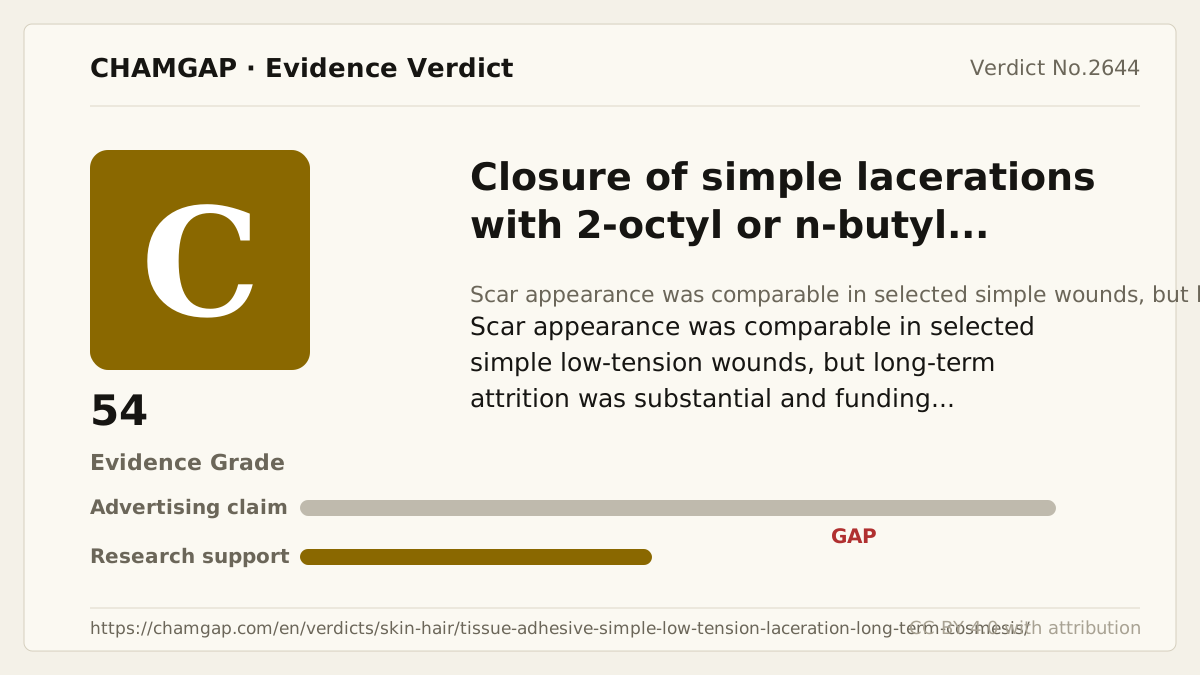
[Chamgap] Tissue adhesive x long-term cosmesis of simple low-tension lacerations — Evidence Grade C·54. 3 cited sources checked. Source: https://chamgap.com/en/verdicts/skin-hair/tissue-adhesive-simple-low-tension-laceration-long-term-cosmesis/ · CC BY 4.0CC BY 4.0 — free to use with attribution; do not distort grades, numbers, or verdict meaning.
What this document does and does not do
Chamgap is an information source. It reports what research has and has not confirmed; it does not tell readers what to take or buy. That decision belongs to readers and, when needed, medical or legal professionals. This verdict reflects literature available up to the search date and may change as new research appears. Nothing here is medical advice.