
Paper tape,
does it really help with Prevention of hypertrophic scar formation?
research showsThe grade is C with 54 points. A trial randomized 70 patients but retained only 39; hypertrophic scars at 12 weeks occurred in 0% with paper tape versus 41% with no treatment, with 13.6-fold higher odds in control. The contrast was large, but 44% did not complete the study and no prespecified single-primary hierarchy was verified.
ads claimMarketing should not display the large relative contrast while hiding 44% attrition. A cesarean-prevention result also cannot be generalized to other operations, treatment of established scars, or keloid treatment.
Useful facts when choosing a product
- The trial applied paper tape to cesarean wounds for 12 weeks and compared it with no postoperative scar intervention.
- Only 39 of 70 randomized participants completed the study.
- Four taped participants developed a localized red rash that was minor and transient.
What the research actually shows
The 2005 RCT by Atkinson JA, McKenna KT, Barnett AG, McGrath DJ, and Rudd M randomized 70 women after cesarean delivery to 12 weeks of paper tape or no scar intervention, but only 39 completed the study. At 12 weeks, hypertrophic scarring was 0% versus 41%, exact P=.003, and control-versus-tape OR was 13.6 (95% CI 3.6 to 66.9). Mean scar-volume difference was 0.16 cm3 (95% CI 0.00 to 0.29). The full-text funding and conflict statements were not obtained, and Europe PMC reports a null grantsList. PubMed indexes the article as non-US government research support, but that is an indexing category rather than a funding statement and cannot establish the funding source. This verdict therefore did not count independence as a strength.
Why this is classified as C (54)
A large clinical-event contrast was offset by 44% attrition, a small sample, no verified primary hierarchy, and only one trial, giving C with 54 points.
Counterpoint. After tape removal, one hypertrophic and four stretched scars appeared in the treatment group, leaving durability beyond 12 weeks uncertain.
Rejudgment record. Cross-check applied — Cross-checked 70 randomized, 39 completers, 0% versus 41%, the odds ratio and interval, and rash reports against the PubMed source
| Endpoint | H | Hard endpoint - actual events such as death |
| Replication | R1 | Single confirmatory trial |
| Independence | I1 | Mixed funding sources |
| Effect size | E+ | Meets the clinically important threshold |
The scoring table and the verdict agree (C).
Sub-claim grades by effect
This ingredient is marketed for several effects. A single overall grade blends strong and weak claims together, so each effect is graded separately here. The overall grade reflects the strongest disconfirming or core claim.
| Effect (sub-claim) | Grade | Basis |
|---|---|---|
| Prevention of hypertrophic scars after cesarean delivery | C | The result was 0% versus 41%, but only 39 completers were analyzed. |
| Treatment of established hypertrophic scars | ? | This trial studied prevention, not treatment of established scars. |
Cross-check — Codex and Claude
Evidence Table
| Study | Design | Sample | Funding | Endpoint | Result | Weight |
|---|---|---|---|---|---|---|
| Atkinson JA, McKenna KT, Barnett AG, McGrath DJ, Rudd M. 2005 | Randomized trial of 12-week paper tape versus no treatment after cesarean delivery; outcome hierarchy not verified | 39 | Full-text funding and conflict statements not obtained; Europe PMC grantsList is null; PubMed non-US government research support is an indexing category and does not establish the funding source | Hypertrophic scar formation at 12 weeks and ultrasound scar volume | Hypertrophic scarring 0% versus 41%, P=.003; control-versus-tape OR 13.6 (95% CI 3.6 to 66.9); scar-volume difference 0.16 cm3 (0.00 to 0.29) | Only direct trial, limited by major attrition; independence was not counted as a strength |
Receipt — 1 References
All 1 cited sources were verified for existence at the original page (as of 2026-08-15).
Reviewed and approved: Chamgap Editorial Team · Approval date: 2026-08-15 · Corrections: none
Cite this verdict
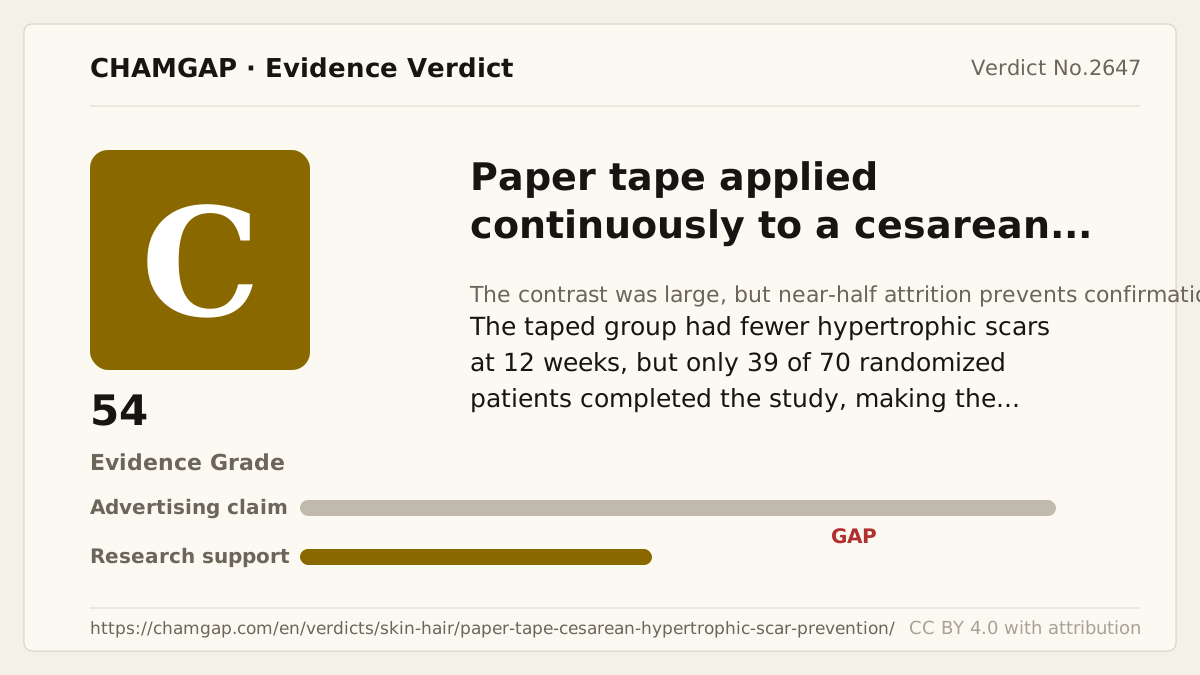
[Chamgap] Paper tape x prevention of hypertrophic cesarean scars — Evidence Grade C·54. 1 cited sources checked. Source: https://chamgap.com/en/verdicts/skin-hair/paper-tape-cesarean-hypertrophic-scar-prevention/ · CC BY 4.0CC BY 4.0 — free to use with attribution; do not distort grades, numbers, or verdict meaning.
What this document does and does not do
Chamgap is an information source. It reports what research has and has not confirmed; it does not tell readers what to take or buy. That decision belongs to readers and, when needed, medical or legal professionals. This verdict reflects literature available up to the search date and may change as new research appears. Nothing here is medical advice.