
Negative-pressure wound therapy,
does it really help with Shorter time to complete epithelialization in surgical wounds healing by secondary intention?
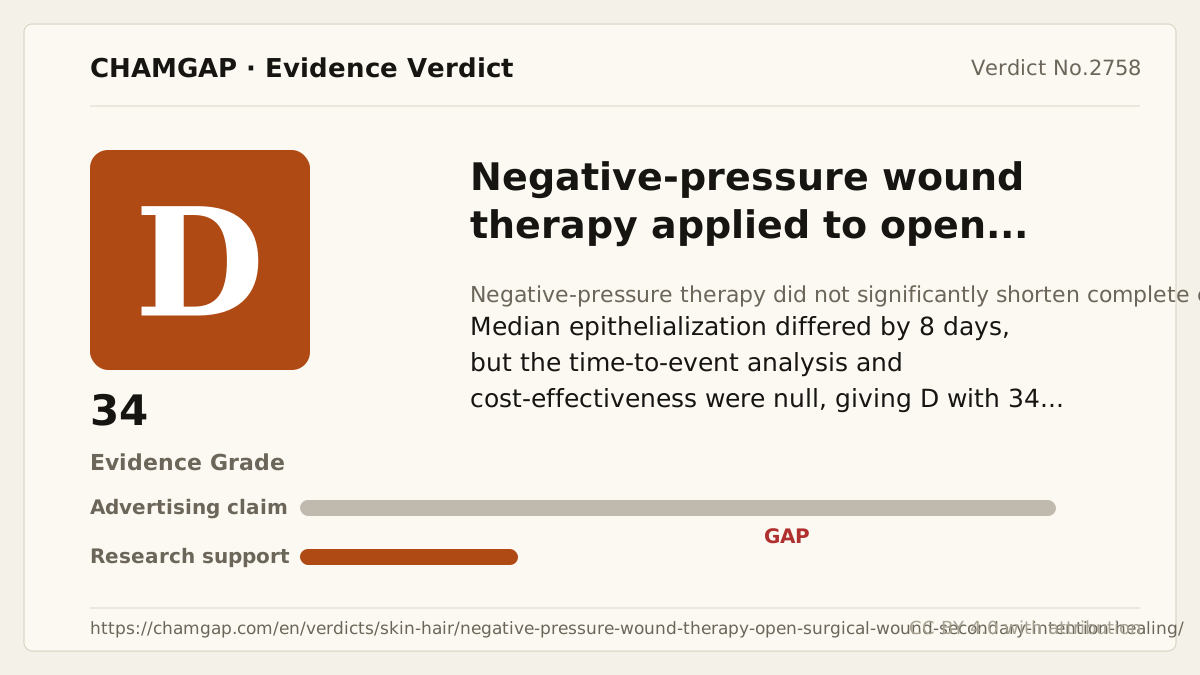
research showsThe grade is D. SWHSI-2 across 29 UK NHS sites analyzed all 686 randomized participants. Median time to complete epithelialization was 187 days with negative-pressure wound therapy versus 195 days with usual dressings. The absolute median difference was 8 days, but the primary time-to-event result was null, HR 1.08 (95% CI 0.88 to 1.32), p=0.47. This is direct publicly funded large-trial evidence, but one null trial whose interval still reaches the prespecified target effect gives D with 34 points.
ads claimHR 1.08 must not be advertised as 8% faster healing. It is a ratio of instantaneous healing hazards and its confidence interval includes 1. The understandable absolute result is a median of 187 versus 195 days, an uncertain 8-day difference.
Useful facts when choosing a product
- The trial permitted CE-marked negative-pressure devices used in the NHS rather than mandating one manufacturer product.
- Usual care prohibited negative pressure but allowed the clinical team to choose the dressing.
- Most wounds were open foot or leg wounds after vascular surgery, and 80% of participants had diabetes.
What the research actually shows
Across 29 UK sites, 686 participants were assigned to negative-pressure therapy (349) or usual dressings (337), and all were included in the primary analysis. Healing by 12 months occurred in 202/349 (57.9%) versus 196/337 (58.2%); medians were 187 versus 195 days, HR 1.08 (0.88 to 1.32). Funding came from the National Institute for Health Research Health Technology Assessment Programme. No specific manufacturer product was mandated, and the article did not report company supply. The trial statistician independently generated the allocation sequence, which was implemented through a centralized secure online randomization service. Participants and the clinical and research teams could not be masked, and the primary endpoint of complete epithelial cover was assessed unmasked. Masked assessors reviewed wound photographs to verify that outcome. All 686 randomized participants were analyzed as allocated in the intention-to-treat population; missing baseline values were mean-imputed, and healing times were right-censored at the last known unhealed timepoint. The prespecified primary endpoint matched registration ISRCTN26277546.
Why this is classified as D (34)
A publicly funded, centrally allocated, all-randomized large hard-endpoint trial was null for healing time but did not exclude the target effect, giving D with 34 points.
Counterpoint. D means healing acceleration was not demonstrated in this trial; it does not deny every drainage or wound-management use in selected complex wounds.
Rejudgment record. Cross-check applied — Pairs the all-randomized 686-participant healing-time HR of 1.08 (0.88 to 1.32) with the 8-day absolute median difference, accounts for central allocation, missing-data handling, and prospective registration, and distinguishes unmasked primary assessment from masked photo verification
| Endpoint | H | Hard endpoint - actual events such as death |
| Replication | R1 | Single confirmatory trial |
| Independence | I2 | Decisive evidence is publicly or non-profit funded |
| Effect size | E0 | Null |
| Precision | C0 | The confidence interval leaves room for benefit |
The scoring table and the verdict agree (D).
Sub-claim grades by effect
This ingredient is marketed for several effects. A single overall grade blends strong and weak claims together, so each effect is graded separately here. The overall grade reflects the strongest disconfirming or core claim.
| Effect (sub-claim) | Grade | Basis |
|---|---|---|
| Shorter time to complete epithelialization | D | The median difference was 8 days, but HR 1.08 (0.88 to 1.32) was null. |
| Improved cost-effectiveness | D | Both within-trial and model-based analyses remained below usual cost-effectiveness thresholds. |
Cross-check — Codex and Claude
Evidence Table
| Study | Design | Sample | Funding | Endpoint | Result | Weight |
|---|---|---|---|---|---|---|
| Study 1 | Pragmatic open-label randomized trial at 29 NHS sites with masked photographic review | 686 | National Institute for Health Research Health Technology Assessment Programme | Time to complete epithelialization | Median 187 versus 195 days, absolute difference 8 days; HR 1.08 (95% CI 0.88 to 1.32), p=0.47 | Publicly funded large all-randomized hard-outcome trial; null benefit with target-effect uncertainty remaining |
Receipt — 2 References
All 2 cited sources were verified for existence at the original page (as of 2026-08-18).
Reviewed and approved: Chamgap Editorial Team · Approval date: 2026-08-18 · Corrections: none
Cite this verdict
[Chamgap] Negative-pressure wound therapy x healing of open surgical wounds by secondary intention — Evidence Grade D·34. 2 cited sources checked. Source: https://chamgap.com/en/verdicts/skin-hair/negative-pressure-wound-therapy-open-surgical-wound-secondary-intention-healing/ · CC BY 4.0CC BY 4.0 — free to use with attribution; do not distort grades, numbers, or verdict meaning.
What this document does and does not do
Chamgap is an information source. It reports what research has and has not confirmed; it does not tell readers what to take or buy. That decision belongs to readers and, when needed, medical or legal professionals. This verdict reflects literature available up to the search date and may change as new research appears. Nothing here is medical advice.