
Immediate post-laser sunscreen,
does it really help with Reduced post-procedure pigmentation?
research showsThe grade is C. Thirty Thai participants with skin phototype IV received fractional CO2 laser on both facial sides. One side received petrolatum ointment four times daily and the other the same ointment plus morning broad-spectrum sunscreen from the next day. Among 26 completers, the one-week melanin index was lower on the sunscreen side, but erythema and barrier recovery did not differ and no independent replication exists.
ads claimSunscreen is common in Korean post-laser instructions, but this trial tested one phototype, one 10-mJ/10%-density CO2 protocol, one Beiersdorf product, and concomitant petrolatum. It cannot establish durable prevention for every laser, sunscreen, or application schedule.
Useful facts when choosing a product
- The control was active petrolatum wound care four times daily for one week, not no treatment.
- The intervention added Beiersdorf Eucerin Sun Fluid broad-spectrum sunscreen the morning after treatment.
- NCT01756664 estimated enrollment of 20, while the paper reported 30 enrolled and 26 completers; registry results could not be verified.
- Verdict 1431 is B with 75 points for daily sunscreen and squamous-cell carcinoma, and verdict 936 is B with 68 points for daily sunscreen and photoaging. Both address different long-term outcomes, not the immediate post-laser one-week pigment index here.
What the research actually shows
Wanitphakdeedecha et al. enrolled 30 phototype-IV participants receiving fractional CO2 resurfacing for acne scars, and 26 completed all visits. Eucerin Sun Fluid SPF 50+ was added from the morning after treatment; later sources also label it SPF 60+, so the product label is inconsistent across accessible sources. After day seven, sunscreen was used on both sides through three months. Patient or physician satisfaction and a clinical grading outcome were not reported in the accessible results. The Funding sources wording was 'This study was sponsored by Beiersdorf (Thailand).' Conflict of interest was 'None declared.'
Why this is classified as C (50)
The registered NCT01756664 three-month primary time point failed while only week one was positive, giving C with 50 points through the primary-failed-secondary-positive path. The exact three-month value could not be verified from the source paper.
Counterpoint. Randomized within-person assignment and instrumental measurement are strengths, but they do not extend the finding beyond this short surrogate outcome.
Rejudgment record. Cross-check applied — Initial NCT01756664 record designated three-month melanin index as primary; it failed while only week one was positive, with active petrolatum control, unconfirmed paired analysis, sponsorship, and completer analysis
| Endpoint | S | Surrogate marker - laboratory or imaging measures |
| Replication | R1 | Single confirmatory trial |
| Independence | I0 | Evidence comes only from manufacturer studies |
| Effect size | E+ | Meets the clinically important threshold |
The scoring table and the verdict agree (C).
Sub-claim grades by effect
This ingredient is marketed for several effects. A single overall grade blends strong and weak claims together, so each effect is graded separately here. The overall grade reflects the strongest disconfirming or core claim.
| Effect (sub-claim) | Grade | Basis |
|---|---|---|
| Reduced melanin index one week after treatment | C | It was lower than active petrolatum control but is a short surrogate. |
| Durable clinical prevention of post-inflammatory hyperpigmentation | ? | Patient or physician clinical assessment and durable between-side benefit could not be verified. |
Cross-check — Codex and Claude
Evidence Table
| Study | Design | Sample | Funding | Endpoint | Result | Weight |
|---|---|---|---|---|---|---|
| Study 1 | Randomized split-face comparison with active petrolatum wound care on both sides | 26 | This study was sponsored by Beiersdorf (Thailand). | Registered primary: three-month melanin index; paper measurements: weeks 1 and 2 and months 1, 2, and 3 | Registered three-month primary time point failed and its exact value could not be verified from the source paper; only week one was positive (P=0.001); paired analysis could not be verified and a paired effect size cannot be recovered | Only direct trial, with a failed registered primary followed by a positive short time point |
Receipt — 4 References
All 4 cited sources were verified for existence at the original page (as of 2026-08-08).
Reviewed and approved: Chamgap Editorial Team · Approval date: 2026-08-08 · Corrections: none
Cite this verdict
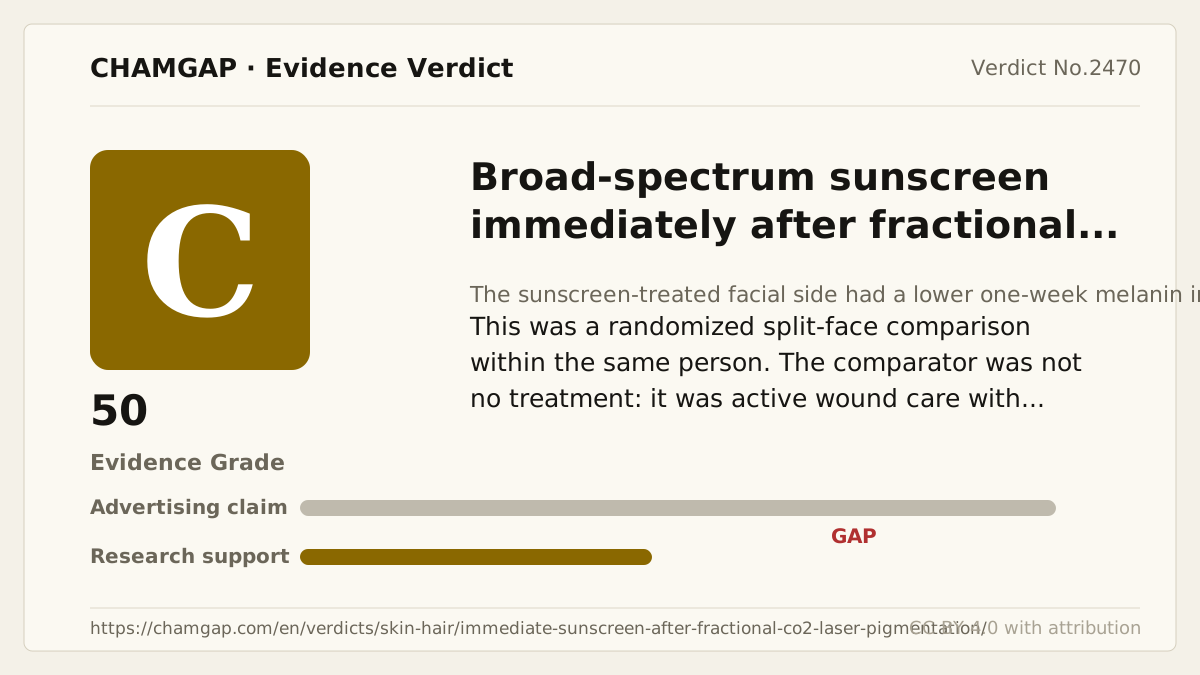
[Chamgap] Immediate post-laser sunscreen x reduced post-procedure pigmentation — Evidence Grade C·50. 4 cited sources checked. Source: https://chamgap.com/en/verdicts/skin-hair/immediate-sunscreen-after-fractional-co2-laser-pigmentation/ · CC BY 4.0CC BY 4.0 — free to use with attribution; do not distort grades, numbers, or verdict meaning.
What this document does and does not do
Chamgap is an information source. It reports what research has and has not confirmed; it does not tell readers what to take or buy. That decision belongs to readers and, when needed, medical or legal professionals. This verdict reflects literature available up to the search date and may change as new research appears. Nothing here is medical advice.