
Gel-nail ultraviolet curing lamps,
does it really help with Increased incidence of skin cancer on the hands?
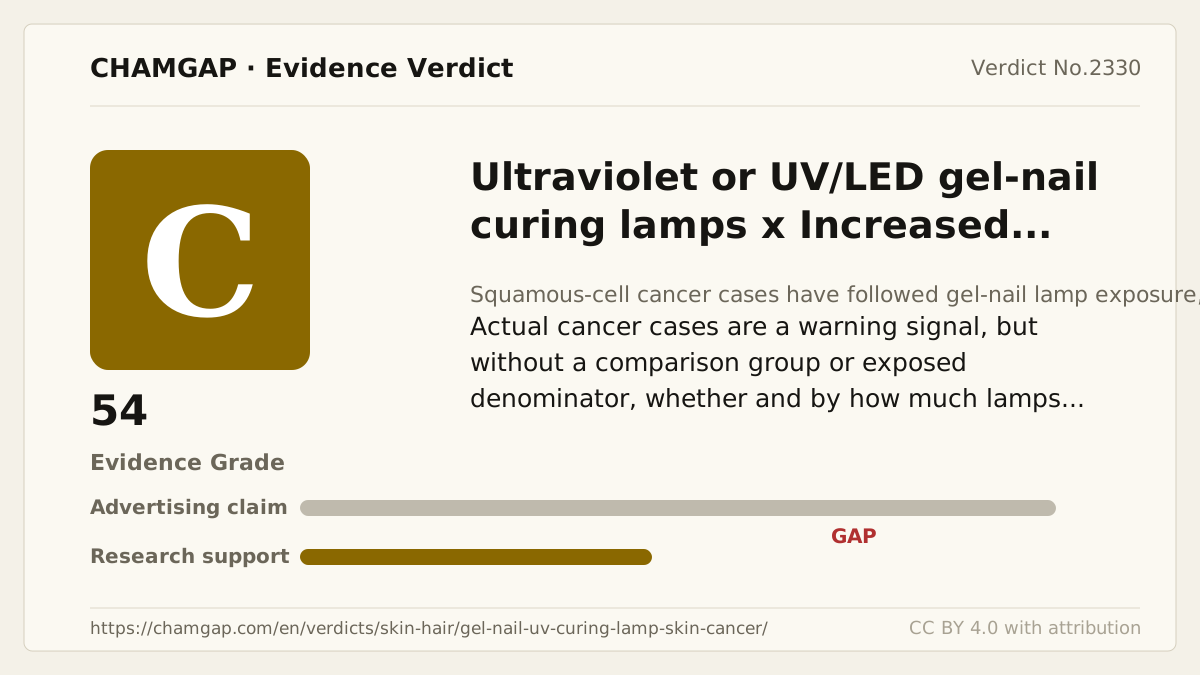
research showsThe grade is C. No cohort or case-control study comparing individual-level skin-cancer incidence in nail-lamp users and nonusers was identified. Human cases do exist: six patients with squamous-cell carcinoma and one with melanoma in situ, seven in total. This is therefore not an ungraded claim with no human study.
ads claimKorean beauty and health articles repeatedly translate cell death and mutation findings from nail-lamp experiments into skin-cancer concern. Those experiments measured DNA damage and mutations in cultured human and mouse cells, not cancer incidence in people.
Useful facts when choosing a product
- Both UV and so-called LED nail lamps generally emit light in the UVA range to cure gel.
- Cell experiments can demonstrate DNA-damage potential but do not provide human skin-cancer incidence.
- Human case reports exist, but no exposed denominator or comparison group permits quantification of excess risk.
What the research actually shows
Human measurements are mainly actual squamous-cell carcinomas and actinic keratoses in patients reporting lamp exposure. A 2024 systematic review included nine studies: three case reports, one cross-sectional study, and five experimental studies, with high or unclear risk of bias. Without the number of exposed users and an unexposed comparator, no standardized effect, incidence ratio, or absolute risk difference can be recovered.
Why this is classified as C (54)
Actual human skin-cancer cases prevent an ungraded verdict, but no incidence-comparison study exists and coexposures such as tanning and photosensitizing medication cannot be separated. Effect magnitude is not estimable, giving C with 54 points.
Counterpoint. Case reports neither prove that nail lamps cause skin cancer nor establish that the risk is absent or trivial. A long-term cohort comparing exposure dose and incidence is needed.
Rejudgment record. Cross-check applied — Cross-check of 2009, 2019, and 2020 case reports plus 2024 and 2025 reviews for human cancer endpoints, case count, co-risk factors, and absence of incidence comparators
| Endpoint | H | Hard endpoint - actual events such as death |
| Replication | R1 | Single confirmatory trial |
| Independence | I2 | Decisive evidence is publicly or non-profit funded |
| Effect size | EX | The clinical size of the effect could not be judged |
The scoring table and the verdict agree (C).
Sub-claim grades by effect
This ingredient is marketed for several effects. A single overall grade blends strong and weak claims together, so each effect is graded separately here. The overall grade reflects the strongest disconfirming or core claim.
| Effect (sub-claim) | Grade | Basis |
|---|---|---|
| Existence of actual squamous-cell cancer cases after repeated nail-lamp exposure | C | Published human cases exist. |
| Quantified increase in skin-cancer incidence | ? | No incidence comparison between users and nonusers was identified. |
Cross-check — Codex and Claude
Evidence Table
| Study | Design | Sample | Funding | Endpoint | Result | Weight |
|---|---|---|---|---|---|---|
| MacFarlane·Alonso 2009 | Two-patient case report | 2 | Not stated | Dorsal-hand nonmelanoma skin cancer and squamous-cell carcinoma | Actual cancers after fifteen years of twice-monthly exposure in one patient and about eight sessions in one year in another | Human cancer events without a comparator |
| Study 2 | Single case report | 1 | Not stated | More than 25 dorsal-hand actinic keratoses and two in-situ squamous-cell carcinomas | Lamp use every three weeks for eighteen years with weekly indoor tanning for eighteen years | Major concurrent ultraviolet exposure |
| Study 3 | Single case report | 1 | Not stated | Numerous squamous-cell carcinomas on hands and feet | Lamp use every two to three weeks for ten years while taking hydrochlorothiazide | Confounded by photosensitizing medication |
| Study 4 | Single case report | 1 | Not stated | Squamous-cell carcinoma of the nail unit | Occurred after repeated UV nail-lamp exposure; exact cumulative duration and other risk-factor details were not confirmed | Additional human cancer case without a comparator |
| Salerni G·Macoc M 2025 | Single case report | 1 | Not stated | Nail melanoma in situ of the left ring finger | Lamp use every three weeks for five years; traumatic nail changes were present and other risk factors were not stated | Additional human cancer case without a comparator |
Receipt — 8 References
All 8 cited sources were verified for existence at the original page (as of 2026-08-06).
Reviewed and approved: Chamgap Editorial Team · Approval date: 2026-08-06 · Corrections: none
Cite this verdict
[Chamgap] Gel-nail ultraviolet curing lamps x skin cancer — Evidence Grade C·54. 8 cited sources checked. Source: https://chamgap.com/en/verdicts/skin-hair/gel-nail-uv-curing-lamp-skin-cancer/ · CC BY 4.0CC BY 4.0 — free to use with attribution; do not distort grades, numbers, or verdict meaning.
What this document does and does not do
Chamgap is an information source. It reports what research has and has not confirmed; it does not tell readers what to take or buy. That decision belongs to readers and, when needed, medical or legal professionals. This verdict reflects literature available up to the search date and may change as new research appears. Nothing here is medical advice.