
Ear piercing,
does it really help with Increased nickel contact sensitization?
research showsThe grade is C. Human studies directly compared piercing history, not measured nickel release, and the endpoint was a positive nickel-sulfate patch test rather than symptomatic dermatitis. A 2025 meta-analysis found 5.9-fold higher odds of sensitization in pierced adults from the general population than in non-pierced adults (95% CI 3.6 to 9.4).
ads claimThe human evidence directly compared piercing history with patch-test nickel sensitization. It should not be expanded into direct measurement of nickel release from particular earrings or incidence of symptomatic contact dermatitis.
Useful facts when choosing a product
- Human studies measured piercing history rather than nickel release from a specific item of jewellery.
- Sensitization is a positive nickel-sulfate patch test; allergic contact dermatitis is a clinical event with symptoms such as itch, erythema, or eczema. This grade addresses sensitization.
What the research actually shows
The 2025 review included 26 non-randomized studies of piercing and nickel sensitization. For this comparison, all used cross-sectional analyses that paired current patch testing with past or current piercing history; there were zero case-control studies and zero prospective cohorts measuring incident sensitization. Five adult general-population studies with 5,333 participants and five studies with 20,330 dermatitis patients yielded pooled ORs of 5.9 (3.6 to 9.4) and 3.6 (2.3 to 5.8), respectively. These designs cannot establish temporal or causal direction.
Why this is classified as C (50)
Associations appeared across regions and research groups, but the decisive endpoint was patch-test sensitization and the underlying evidence was cross-sectional. All three studies measured patch-test sensitization, yet their populations and units of analysis differed, so they were not independent repetitions of the same design. The principal pooled estimate was unadjusted for sex and age and heterogeneity was high. These limitations give C with 50 points.
Counterpoint. An independent Danish adolescent study also found sensitization prevalence of 15.9% in pierced girls and 3.6% in unpierced girls, with sex-adjusted OR 3.18 (1.43 to 7.08). Boys had an imprecise OR of 0.88 (0.24 to 3.23), and only 69.4% of positive patch tests were judged clinically relevant, so test positivity was not equivalent to current dermatitis.
Rejudgment record. Cross-check applied — All three studies measured patch-test sensitization, but their populations and units of analysis differed, so they were not independent repetitions of the same design; sensitization was also separated from clinical dermatitis
| Endpoint | S | Surrogate marker - laboratory or imaging measures |
| Replication | R1 | Single confirmatory trial |
| Independence | I1 | Mixed funding sources |
| Effect size | E+ | Meets the clinically important threshold |
The scoring table and the verdict agree (C).
Sub-claim grades by effect
This ingredient is marketed for several effects. A single overall grade blends strong and weak claims together, so each effect is graded separately here. The overall grade reflects the strongest disconfirming or core claim.
| Effect (sub-claim) | Grade | Basis |
|---|---|---|
| Association between piercing history and nickel patch-test sensitization | C | The pooled adult general-population OR was 5.9 (3.6 to 9.4), but the evidence was cross-sectional and observational. |
| Incident symptomatic nickel contact dermatitis after piercing | ? | The main meta-analysis pooled patch-test sensitization rather than incidence of symptomatic dermatitis. |
Cross-check — Codex and Claude
Evidence Table
| Study | Design | Sample | Funding | Endpoint | Result | Weight |
|---|---|---|---|---|---|---|
| Study 1 | Meta-analysis of 26 non-randomized cross-sectional analyses | 20,330 | Supported by the Danish Environmental Protection Agency under the Ministry of Environment; authors declared no conflicts | Nickel sensitization confirmed by nickel-sulfate patch testing | Adult general-population OR 5.9 (95% CI 3.6 to 9.4); dermatitis-patient OR 3.6 (2.3 to 5.8) | Decisive pooled observational evidence; principal pooled estimates were unadjusted for sex and age |
| Study 2 | Cross-sectional general-population survey in five European countries | 3,119 | supported by the Research Institute for Fragrance Materials, Inc. | Positive nickel patch test | Past piercing 20.8% versus never pierced 6.4%; adjusted OR 1.80 (1.26 to 2.57) | Large cross-sectional analysis adjusting for sex, age group, country, body mass index, and piercing |
| Study 3 | School-based cross-sectional survey | 1,146 | Supported by the University of Southern Denmark Faculty of Health Sciences, the Danish Asthma and Allergy Association, and charitable foundations; Pharmacia & Upjohn donated test materials | Positive nickel patch test and assessed clinical relevance | Pierced girls 15.9% versus unpierced girls 3.6%; sex-adjusted OR 3.18 (1.43 to 7.08) | Absolute-prevalence replication by a separate author group; cross-sectional design |
Receipt — 4 References
All 4 cited sources were verified for existence at the original page (as of 2026-08-07).
Reviewed and approved: Chamgap Editorial Team · Approval date: 2026-08-07 · Corrections: none
Cite this verdict
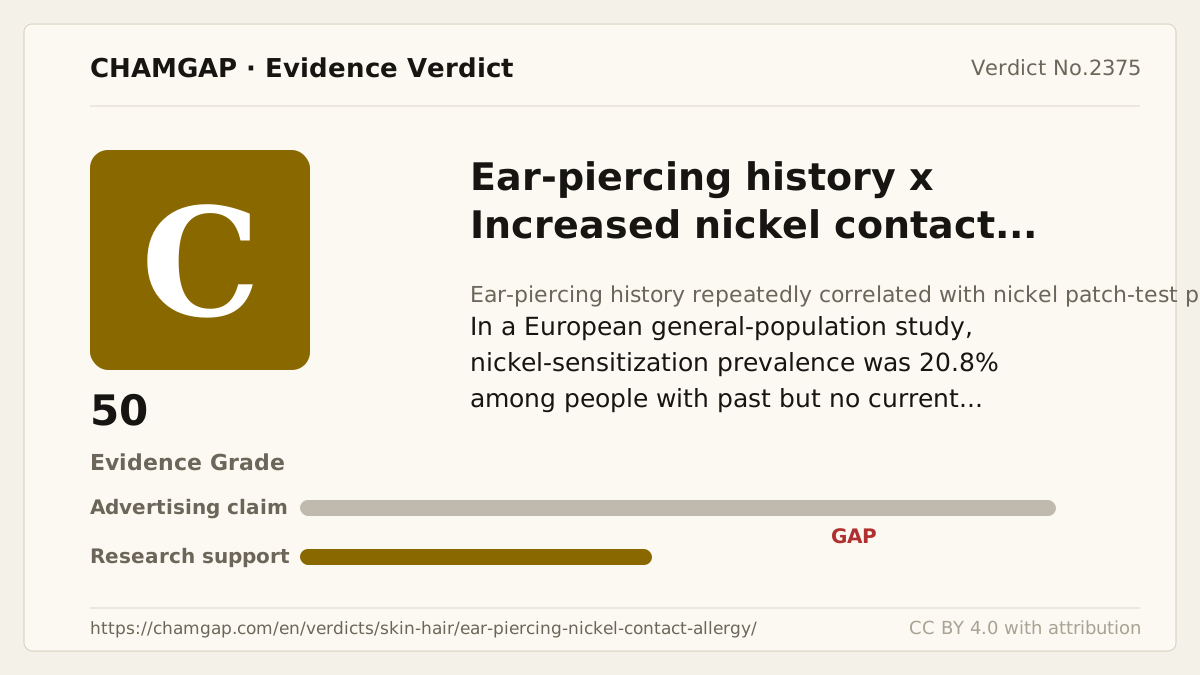
[Chamgap] Ear piercing x patch-test nickel sensitization — Evidence Grade C·50. 4 cited sources checked. Source: https://chamgap.com/en/verdicts/skin-hair/ear-piercing-nickel-contact-allergy/ · CC BY 4.0CC BY 4.0 — free to use with attribution; do not distort grades, numbers, or verdict meaning.
What this document does and does not do
Chamgap is an information source. It reports what research has and has not confirmed; it does not tell readers what to take or buy. That decision belongs to readers and, when needed, medical or legal professionals. This verdict reflects literature available up to the search date and may change as new research appears. Nothing here is medical advice.