
Bacitracin ointment,
does it really help with Better prevention of postoperative wound infection than white petrolatum?
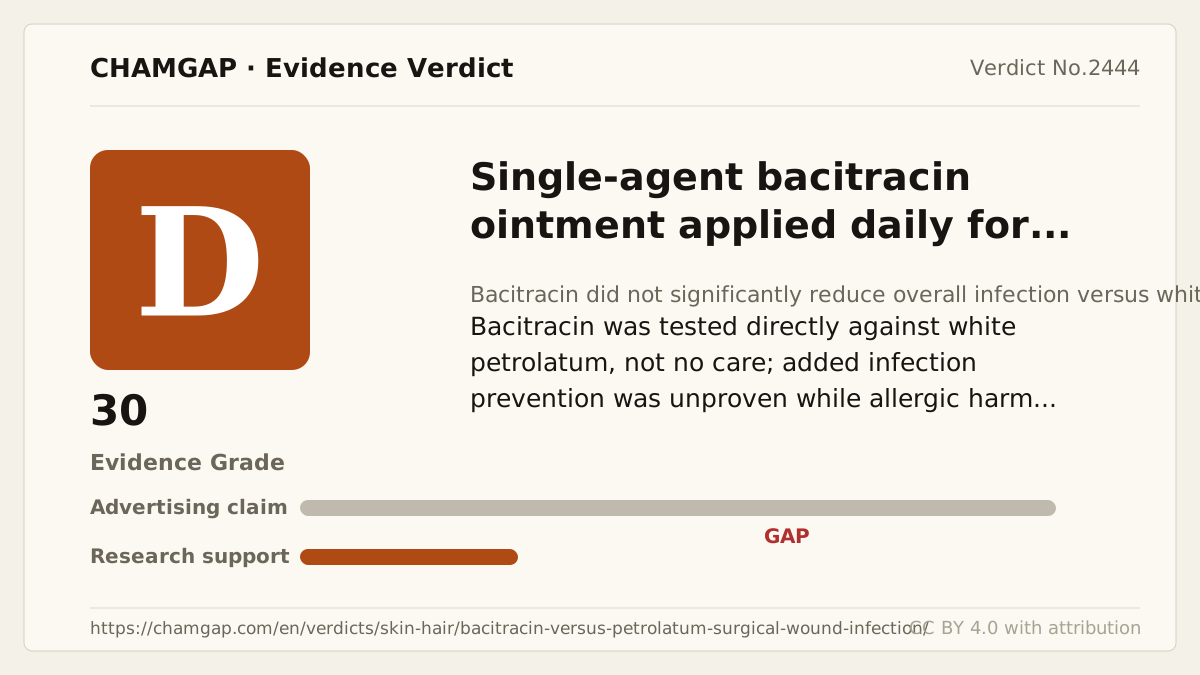
research showsThe grade is D with 30 points. Only 884 completers from 922 randomized dermatologic-surgery patients were analyzed. Infection occurred in 9/440 (2.0%) with white petrolatum versus 4/444 (0.9%) with bacitracin. The 95% CI for petrolatum minus bacitracin was -0.4 to 2.7 points and P=.37, so superiority was not established.
ads claimAntibiotic wound ointments are commonly sold in Korean pharmacies, but this trial did not show that bacitracin prevents more infections than petrolatum in clean dermatologic-surgery wounds. Antimicrobial resistance is an additional stewardship concern, but it was not used to lower the efficacy grade.
Useful facts when choosing a product
- This was bacitracin versus white petrolatum, not ointment versus no treatment.
- Application began after surgery and continued daily for 7-10 days with four-week follow-up.
- Bacitracin is a recognized contact allergen; North American referral patch-test data reported 6.9% positivity.
What the research actually shows
At Walter Reed Army Medical Center, 922 dermatologic-surgery patients with 1,249 wounds at allocation were randomized by patient. The wound-level analysis included 1,207 wounds, which must be distinguished from the allocation count. Matching tubes appropriately masked patients and assessors. Analysis was restricted to 440 petrolatum and 444 bacitracin completers rather than all randomized patients. The article listed infection and allergic contact dermatitis as main outcomes without a clear prespecified primary endpoint or success rule across multiple main results. Completer analysis and unclear outcome-success rules were counted as the two avoidable flaws. Ointment was applied daily for 7-10 days and assessed on days 1, 7, and 28. No separate funding statement was verified.
Why this is classified as D (30)
The null overall-infection result plus completer analysis and unclear prespecified outcome-success rules gives D with 30 points.
Counterpoint. The organism-specific S. aureus result favored bacitracin despite the null overall-infection endpoint.
Rejudgment record. Cross-check applied — Null overall infection with completer analysis and unclear prespecified primary endpoint and multi-outcome success rules
| Endpoint | H | Hard endpoint - actual events such as death |
| Replication | R1 | Single confirmatory trial |
| Independence | I1 | Mixed funding sources |
| Effect size | E0 | Null |
| Precision | C0 | The confidence interval leaves room for benefit |
The scoring table and the verdict agree (D).
Sub-claim grades by effect
This ingredient is marketed for several effects. A single overall grade blends strong and weak claims together, so each effect is graded separately here. The overall grade reflects the strongest disconfirming or core claim.
| Effect (sub-claim) | Grade | Basis |
|---|---|---|
| Superior overall infection prevention versus white petrolatum | D | The difference was not significant, P=.37. |
| Same contact-dermatitis risk as petrolatum | D | The trial found 0 versus 4 cases, and bacitracin is a recognized contact allergen. |
Cross-check — Codex and Claude
Evidence Table
| Study | Design | Sample | Funding | Endpoint | Result | Weight |
|---|---|---|---|---|---|---|
| Study 1 | Randomized double-blind direct comparison with white petrolatum and completer analysis | 1,207 | No separate funding statement was verified in the accessible original record | Overall infection and allergic contact dermatitis over four weeks | Overall infection 9/440 (2.0%) vs 4/444 (0.9%), difference 95% CI -0.4 to 2.7 points, P=.37; contact dermatitis 0 vs 4 (0.9%) | Pivotal direct-comparison trial |
Receipt — 3 References
All 3 cited sources were verified for existence at the original page (as of 2026-08-08).
Reviewed and approved: Chamgap Editorial Team · Approval date: 2026-08-08 · Corrections: none
Cite this verdict
[Chamgap] Bacitracin ointment x better wound-infection prevention than petrolatum — Evidence Grade D·30. 3 cited sources checked. Source: https://chamgap.com/en/verdicts/skin-hair/bacitracin-versus-petrolatum-surgical-wound-infection/ · CC BY 4.0CC BY 4.0 — free to use with attribution; do not distort grades, numbers, or verdict meaning.
What this document does and does not do
Chamgap is an information source. It reports what research has and has not confirmed; it does not tell readers what to take or buy. That decision belongs to readers and, when needed, medical or legal professionals. This verdict reflects literature available up to the search date and may change as new research appears. Nothing here is medical advice.