
Alternating-pressure mattress,
does it really help with Reduced new category 2 or worse pressure ulcers in high-risk acutely ill inpatients?
research showsThe grade is D with 34 points. PRESSURE 2 randomized 2,029 high-risk acutely ill inpatients to alternating-pressure air mattresses (1,016) or high-specification foam (1,013). Through up to 60 treatment days plus 30 days, new category 2 or worse ulcers occurred in 70 (6.9%) versus 90 (8.9%); Fine-Gray HR 0.76 (95% CI 0.56-1.04; P=0.089), so the primary result was not significant.
ads claimThis was not mattress versus no mattress. It tested added benefit over an established pressure-redistributing high-specification foam surface.
Useful facts when choosing a product
- Alternating-pressure mattresses cyclically change pressure in powered air cells.
- The control was active high-specification foam on an electric profiling bed.
- Verdict 2303 is D with 30 points for repositioning intervals, not mattress technology.
What the research actually shows
At 54 NHS sites, 2,029 high-risk adults were randomized to usual-stock alternating-pressure or high-specification foam mattresses. Primary bedside ulcer assessment was unblinded. Only 85% consented to photography, making central validation incomplete, and photographic validation was differential between groups; among available photographs, blinded central review agreed with bedside assessment in 87.8%, kappa 0.82. A planned interim analysis was performed, but the trial was not stopped early. NIHR funded the trial. The independent 2005 Vanderwee, Grypdonck, and Defloor trial compared an alternating-pressure overlay alone against viscoelastic foam plus four-hourly turning and followed patients only during hospitalization. Because its comparator bundle and duration differed, it is an incomplete independent replication rather than an exact repeat. Ulcer incidence was 15.6% in the alternating-pressure group versus 15.3% in the control group, with no superiority; axis 2 remains R1. The 2.5- and 3.3-point design values were not validated minimum clinically important differences.
Why this is classified as D (34)
The large publicly funded trial had a null primary result, with unblinded primary assessment and incomplete differential photographic validation. The B1 route gives D with 34 points.
Counterpoint. A positive treatment-phase sensitivity analysis leaves possible value for selected high-risk patients.
Rejudgment record. Cross-check applied — PRESSURE 2 was null, and primary assessment was unblinded with incomplete differential photographic validation
| Endpoint | H | Hard endpoint - actual events such as death |
| Replication | R1 | Single confirmatory trial |
| Independence | I2 | Decisive evidence is publicly or non-profit funded |
| Effect size | E0 | Null |
| Precision | C0 | The confidence interval leaves room for benefit |
The scoring table and the verdict agree (D).
Sub-claim grades by effect
This ingredient is marketed for several effects. A single overall grade blends strong and weak claims together, so each effect is graded separately here. The overall grade reflects the strongest disconfirming or core claim.
| Effect (sub-claim) | Grade | Basis |
|---|---|---|
| Reduced new category 2 or worse ulcers over full follow-up | D | The result was not significant, HR 0.76 (0.56-1.04). |
| Reduced new category 2 or worse ulcers during treatment | C | The sensitivity analysis gave HR 0.66 (0.46-0.93). |
Cross-check — Codex and Claude
Evidence Table
| Study | Design | Sample | Funding | Endpoint | Result | Weight |
|---|---|---|---|---|---|---|
| Study 1 | Multicenter open active-comparator randomized trial with competing-risk analysis | 1,013 | NIHR Health Technology Assessment Programme | Time to new category 2 or worse pressure ulcer through a maximum 90 days | 70 (6.9%) vs 90 (8.9%), Fine-Gray HR 0.76 (0.56-1.04), P=0.089 | Pivotal large publicly funded trial |
| Study 2 | Randomized active-comparator trial of alternating pressure versus high-specification foam plus turning | 447 | No funding statement was verified in the original article | New category 2 or worse pressure ulcer | Alternating-pressure group 15.6% versus control group 15.3%, no superiority | Incomplete independent replication because comparator bundle and duration differed; axis 2 remains R1 |
Receipt — 3 References
All 3 cited sources were verified for existence at the original page (as of 2026-08-08).
Reviewed and approved: Chamgap Editorial Team · Approval date: 2026-08-08 · Corrections: none
Cite this verdict
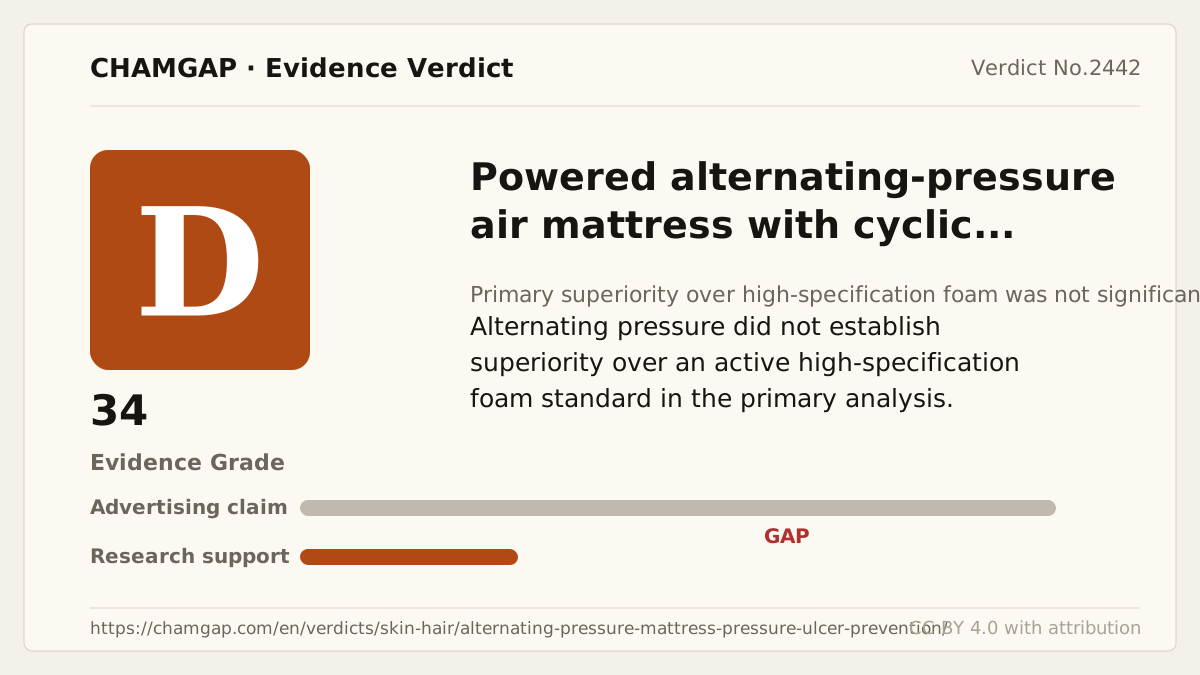
[Chamgap] Alternating-pressure mattress x reduced pressure-ulcer incidence — Evidence Grade D·34. 3 cited sources checked. Source: https://chamgap.com/en/verdicts/skin-hair/alternating-pressure-mattress-pressure-ulcer-prevention/ · CC BY 4.0CC BY 4.0 — free to use with attribution; do not distort grades, numbers, or verdict meaning.
What this document does and does not do
Chamgap is an information source. It reports what research has and has not confirmed; it does not tell readers what to take or buy. That decision belongs to readers and, when needed, medical or legal professionals. This verdict reflects literature available up to the search date and may change as new research appears. Nothing here is medical advice.