
High-dose vitamin E 400 IU,
does it really help with Primary prevention of prostate cancer in men from the general population?
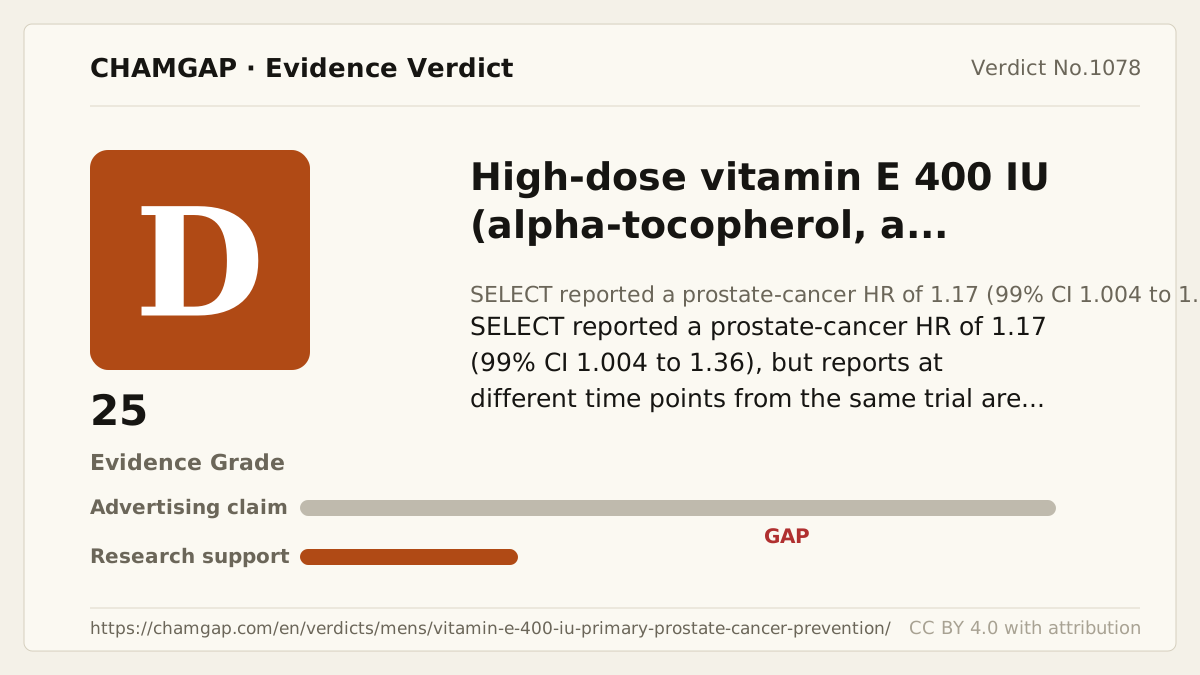
research showsSELECT reported a prostate-cancer HR of 1.17 (99% CI 1.004 to 1.36), but reports at different time points from the same trial are not independent replications. Across six randomized trials, RR was 0.88 (95% CI 0.71 to 1.08), leaving room for a 29% risk reduction. Because clinically meaningful benefit is not excluded, the grade is D with 25 points, not F.
ads claimMarketing expands the biological idea of an antioxidant and the nutritional role of vitamin E in food into cancer prevention by a high-dose isolated supplement. The direct large trial of 400 IU/day in nondeficient men found harm rather than benefit.
Useful facts when choosing a product
- SELECT tested synthetic all-rac-alpha-tocopheryl acetate at 400 IU/day, and its supplement result should not be equated with vitamin E consumed in food.
- A 400-IU dose is far above the amount used merely to meet ordinary nutritional needs, while treatment of true deficiency is a separate medical indication from primary cancer prevention.
- Vitamin E is fat soluble, so total intake can become high when multivitamins and single-ingredient products are combined; duplicate sources should be checked.
- High-dose vitamin E can increase bleeding tendency, and a randomized-trial meta-analysis reported a hemorrhagic-stroke signal, requiring particular caution with anticoagulants, antiplatelet drugs, and surgery.
What the research actually shows
SELECT randomized 35,533 men between 2001 and 2004 to selenium, vitamin E, both, or double placebo. The 2009 initial report found no prostate-cancer prevention and a direction toward increased risk with vitamin E. The 2011 analysis of 34,887 men found a significant increase with vitamin E 400 IU/day alone, HR 1.17 (99% CI 1.004 to 1.36). However, the pooled RR across six randomized trials was 0.88 (95% CI 0.71 to 1.08), which does not exclude meaningful prevention.
Why this is classified as D (25)
SELECT reported a prostate-cancer HR of 1.17 (99% CI 1.004 to 1.36), but reports at different time points from the same trial are not independent replications. Across six randomized trials, RR was 0.88 (95% CI 0.71 to 1.08), leaving room for a 29% risk reduction. Because clinically meaningful benefit is not excluded, the grade is D with 25 points, not F.
Counterpoint. This verdict does not address treatment of vitamin E deficiency or clinician-directed use for another condition. Taking 400 IU to prevent prostate cancer in a nondeficient man directly conflicts with the SELECT result. Grade-independent note: USPSTF recommends against vitamin E supplementation for cancer prevention. This recommendation and harm signals are not used to determine the efficacy grade.
Rejudgment record. New verdict — SELECT reported a prostate-cancer HR of 1.17 (99% CI 1.004 to 1.36), but reports at different time points from the same trial are not independent replications. Across six randomized trials, RR was 0.88 (95% CI 0.71 to 1.08), leaving room for a 29% risk reduction. Because clinically meaningful benefit is not excluded, the grade is D with 25 points, not F.
Sub-claim grades by effect
This ingredient is marketed for several effects. A single overall grade blends strong and weak claims together, so each effect is graded separately here. The overall grade reflects the strongest disconfirming or core claim.
| Effect (sub-claim) | Grade | Basis |
|---|---|---|
| Primary prevention of prostate cancer | D | SELECT refuted prevention and found increased prostate-cancer risk with vitamin E 400 IU/day, HR 1.17. |
| Reduced incidence of prostate cancer | D | There were 620 cases with vitamin E versus 529 with placebo, an absolute increase rather than a reduction. |
| Net cancer-prevention benefit in men from the general population | D | The United States Preventive Services Task Force recommends against vitamin E supplements for cancer prevention in community-dwelling adults. |
Cross-check — Codex and Claude
Evidence Table
| Study | Design | Sample | Funding | Endpoint | Result | Weight |
|---|---|---|---|---|---|---|
| Klein EA et al. 2011 SELECT | Extended follow-up of a multicenter randomized double-blind placebo-controlled primary-prevention trial | 8,696 | Public funding led by the United States National Cancer Institute; study agents were supplied by manufacturers | Incidence of prostate cancer | There were 620 cases with vitamin E versus 529 with placebo, HR 1.17 (99% CI 1.004 to 1.36; p=.008), an absolute increase of 1.6 cases per 1,000 person-years. | Decisive large direct refutation and harm |
| Lippman SM et al. 2009 SELECT | Initial report of a multicenter randomized double-blind placebo-controlled primary-prevention trial | 427 | Public funding led by the United States National Cancer Institute; study agents were supplied by manufacturers | Prostate and other cancer incidence and safety | Neither vitamin E nor selenium, alone or together, prevented prostate cancer, and supplementation was stopped early. | Initial large-scale null result |
| US Preventive Services Task Force 2022 | Preventive-services recommendation based on a systematic evidence review | 739,803 | Public support from the Agency for Healthcare Research and Quality | Primary prevention of cancer, cardiovascular disease, and mortality, plus harms | Issued a grade D recommendation against vitamin E supplementation to prevent cancer or cardiovascular disease in community-dwelling adults. | Recommendation against use |
Receipt — 4 References
All 4 cited sources were verified for existence at the original page (as of 2026-07-21).
Reviewed and approved: Chamgap Editorial Team · Approval date: 2026-07-21 · Corrections: none
Cite this verdict
[Chamgap] High-dose vitamin E 400 IU x primary prevention of prostate cancer — Evidence Grade D·25. 4 cited sources checked. Source: https://chamgap.com/en/verdicts/mens/vitamin-e-400-iu-primary-prostate-cancer-prevention/ · CC BY 4.0CC BY 4.0 — free to use with attribution; do not distort grades, numbers, or verdict meaning.
What this document does and does not do
Chamgap is an information source. It reports what research has and has not confirmed; it does not tell readers what to take or buy. That decision belongs to readers and, when needed, medical or legal professionals. This verdict reflects literature available up to the search date and may change as new research appears. Nothing here is medical advice.