
Catheter clamping before removal,
does it really help with Improved trial-without-catheter success and prevention of recatheterization?
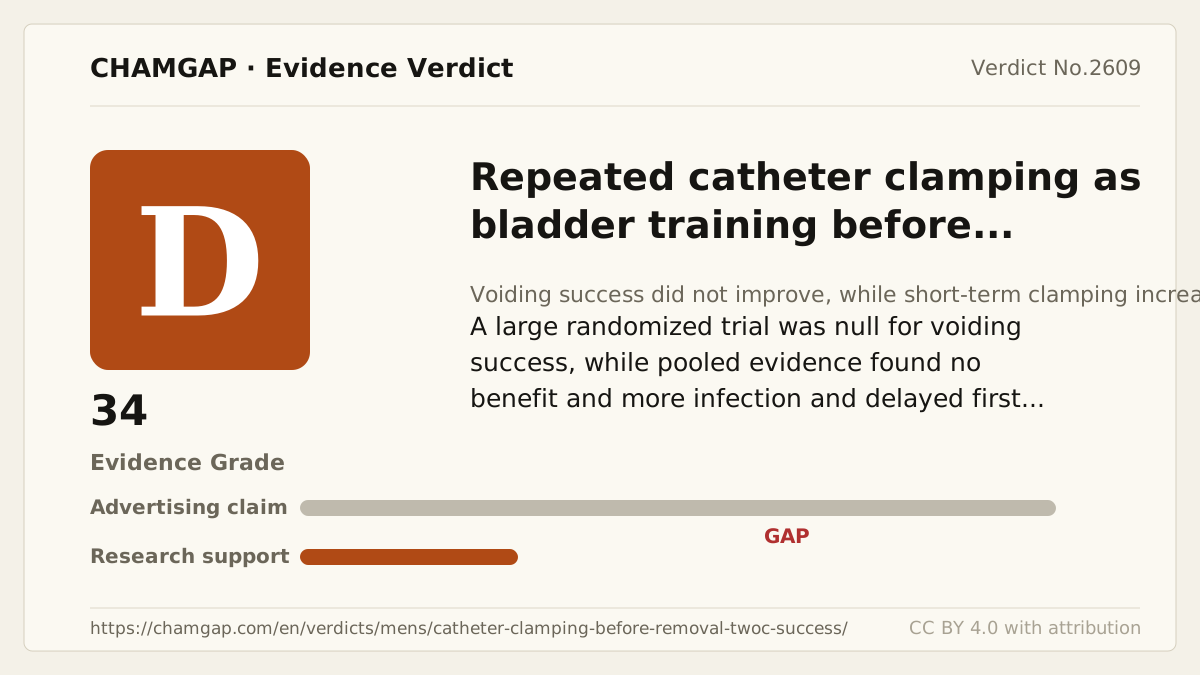
research showsThe grade is D with 34 points. In a randomized trial of 845 men with BPH-related acute urinary retention, seven-day trial-without-catheter success was 65.2% with clamping versus 68.6% with free drainage. A meta-analysis of 17 studies and 3,908 participants likewise found no bladder-function benefit and found more UTI with short-term use, RR 1.69.
ads claimClamping physically creates cycles of bladder filling and drainage. That fact does not establish better voiding after removal; the 845-participant trial did not support the clinical claim.
Useful facts when choosing a product
- Clamping periodically blocks and releases drainage to cycle bladder filling and emptying.
- Both arms of the large trial received the same prostate medications for seven days.
- The meta-analysis found more UTI and delayed first void with short-term clamping.
What the research actually shows
Both groups in the large trial received tamsulosin 0.2 mg and finasteride 5 mg for seven days; clamping was the difference. The 2023 review of 17 studies and 3,908 participants reported UTI RR 1.47 (95% CI 1.26 to 1.72), short-term RR 1.69 (1.42 to 2.02), and time-to-first-void SMD 0.19 (0.08 to 0.29), all unfavorable. Populations and estimands differ, and pivotal-trial funding could not be confirmed.
Why this is classified as D (34)
A large hard-outcome randomized trial was null and pooled evidence showed no benefit. Mixed populations and estimands do not establish repeated precise refutation, and no validated benefit threshold was available, giving D with 34 points.
Counterpoint. Long-term catheterization, neurogenic bladder, and procedure-specific protocols are separate questions.
Rejudgment record. Cross-check applied — Cross-checked group denominators and TWOC rates in the large RCT against the meta-analysis populations, UTI estimates, and first-void result
| Endpoint | H | Hard endpoint - actual events such as death |
| Replication | R1 | Single confirmatory trial |
| Independence | I1 | Mixed funding sources |
| Effect size | E0 | Null |
| Precision | C0 | The confidence interval leaves room for benefit |
The scoring table and the verdict agree (D).
Sub-claim grades by effect
This ingredient is marketed for several effects. A single overall grade blends strong and weak claims together, so each effect is graded separately here. The overall grade reflects the strongest disconfirming or core claim.
| Effect (sub-claim) | Grade | Basis |
|---|---|---|
| Increased TWOC success in BPH-related acute urinary retention | D | The 845-participant trial found 65.2% versus 68.6%. |
| Prevention of urinary tract infection | D | Pooled UTI increased, RR 1.47. |
Cross-check — Codex and Claude
Evidence Table
| Study | Design | Sample | Funding | Endpoint | Result | Weight |
|---|---|---|---|---|---|---|
| Yuan Zhengyong, He Changxiao, Yan Shibing, Wu Caiwen. 2014 | Prospective randomized controlled trial | 405 | Funding not confirmed in accessible material | First TWOC success after seven days | 65.2% versus 68.6%, P>0.05; reconstructed RR about 0.95, approximate 95% CI 0.87 to 1.04 | Pivotal large hard-outcome trial |
| Ma S, Gu J, Fan X. 2023 | Systematic review and meta-analysis of 15 RCTs and two quasi-RCTs | 3,908 | Reported no specific grant | UTI, time to first void, urinary retention, and recatheterization | UTI RR 1.47 (1.26 to 1.72); seven days or less RR 1.69 (1.42 to 2.02); time to first void SMD 0.19 (0.08 to 0.29) | Synthesis of no benefit and harm across mixed populations |
Receipt — 2 References
All 2 cited sources were verified for existence at the original page (as of 2026-08-15).
Reviewed and approved: Chamgap Editorial Team · Approval date: 2026-08-15 · Corrections: none
Cite this verdict
[Chamgap] Catheter clamping before removal x voiding success and recatheterization — Evidence Grade D·34. 2 cited sources checked. Source: https://chamgap.com/en/verdicts/mens/catheter-clamping-before-removal-twoc-success/ · CC BY 4.0CC BY 4.0 — free to use with attribution; do not distort grades, numbers, or verdict meaning.
What this document does and does not do
Chamgap is an information source. It reports what research has and has not confirmed; it does not tell readers what to take or buy. That decision belongs to readers and, when needed, medical or legal professionals. This verdict reflects literature available up to the search date and may change as new research appears. Nothing here is medical advice.