
Cabazitaxel,
does it really help with Prolongation of overall survival in metastatic castration-resistant prostate cancer progressing after docetaxel?
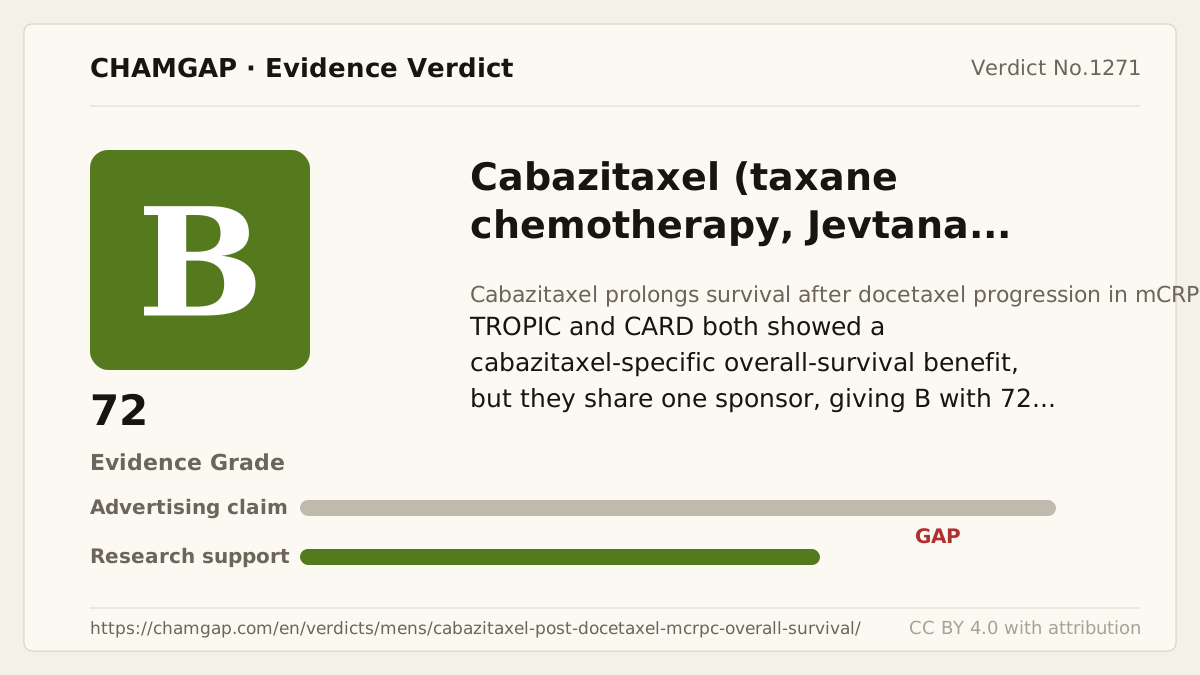
research showsCabazitaxel prolongs overall survival in metastatic castration-resistant prostate cancer progressing after docetaxel. In TROPIC, median overall survival was 15.1 versus 12.7 months and the hazard ratio for death was 0.70. In CARD, among patients with rapid progression after docetaxel and one androgen-receptor-targeted agent, median overall survival was 13.6 versus 11.0 months compared with switching to the other targeted agent. Two randomized trials isolated a drug-specific benefit on the hard endpoint of survival against different active comparators. However, both TROPIC and CARD were funded by Sanofi and de Bono J took part in each, so they are not replication by a different funder. With that and the historical limitation of the mitoxantrone comparator, the grade is B with 72 points, while severe neutropenia, diarrhea, and treatment-related death remain separate safety concerns.
ads claimPromotion can simplify survival after docetaxel into a universally optimal sequence for all advanced prostate cancer. The evidence most directly fits metastatic castration-resistant disease progressing after docetaxel and, in CARD, a selected sequence that also included rapid progression on an androgen-receptor-targeted agent.
Useful facts when choosing a product
- Cabazitaxel is a prescription intravenous chemotherapy administered in specialist prostate-cancer care with prednisone or prednisolone.
- The authorized dose depends on patient status and the regional label; blood counts and liver function are checked, and prophylactic G-CSF is considered or used in patients at high risk.
- Severe neutropenia, febrile neutropenia, infection, diarrhea, dehydration, kidney injury, and hypersensitivity can occur, so patients need advance instruction about symptoms requiring urgent assessment.
- This verdict concerns metastatic castration-resistant disease progressing after docetaxel, not first-line docetaxel for metastatic hormone-sensitive prostate cancer.
What the research actually shows
The 2010 TROPIC trial by de Bono and colleagues randomized 755 men with mCRPC progressing after docetaxel-containing therapy to cabazitaxel or mitoxantrone, with prednisone in both groups. Median overall survival was 15.1 versus 12.7 months, the hazard ratio for death was 0.70, and progression-free survival and PSA response also favored cabazitaxel. The 2019 CARD trial by de Wit and colleagues randomized 255 patients who had received docetaxel and either abiraterone or enzalutamide and progressed within 12 months to cabazitaxel or the unused alternative androgen-receptor-targeted agent. Imaging-based progression-free survival was 8.0 versus 3.7 months and overall survival was 13.6 versus 11.0 months. Both trials were Sanofi-funded, so they are not described as independent replication, but a drug-specific mortality benefit recurred against different active comparators.
Why this is classified as B (72)
The hazard ratio for death was 0.70 in TROPIC and 0.64 in CARD, repeatedly demonstrating a cabazitaxel-specific overall-survival benefit against two active comparators after docetaxel in mCRPC. Death is a direct hard endpoint and the direction is consistent. However, both trials were funded by Sanofi and de Bono J is an author on each, so they do not meet the axis-2 R2 requirement of different investigators and funders. That ceiling, together with the historical mitoxantrone comparator and CARD's narrow treatment sequence, gives B with 72 points. Toxicity is kept separate under safety.
Counterpoint. Cabazitaxel does not imply cure, and the median absolute survival difference is measured in months. Prior drugs, pace of progression, marrow reserve, liver function, infection risk, and other available therapies must be considered for each patient.
Rejudgment record. New verdict — Credited the drug-specific overall-survival benefit in TROPIC and CARD, but applied the axis-2 R1 ceiling of B because both trials were funded by Sanofi and de Bono J took part in each, so they do not meet the R2 requirement of different investigators and funders. Axis 3 is Sanofi-only, but the ceiling does not apply to a large hard-endpoint prescription trial
| Endpoint | H | Hard endpoint - actual events such as death |
| Replication | R1 | Single confirmatory trial |
| Independence | I0 | Evidence comes only from manufacturer studies |
| Effect size | E+ | Meets the clinically important threshold |
The scoring table and the verdict agree (B).
Sub-claim grades by effect
This ingredient is marketed for several effects. A single overall grade blends strong and weak claims together, so each effect is graded separately here. The overall grade reflects the strongest disconfirming or core claim.
| Effect (sub-claim) | Grade | Basis |
|---|---|---|
| Prolonged overall survival in mCRPC progressing after docetaxel | A | The death hazard ratio was 0.70 in TROPIC and 0.64 in CARD, repeatedly confirming a drug-specific survival benefit. |
| Improved survival in the next treatment sequence after docetaxel and rapid progression on one androgen-receptor-targeted agent | A | CARD found overall survival of 13.6 versus 11.0 months compared with switching to the other targeted agent. |
| Improved imaging-based progression-free survival and PSA and tumor responses | B | Secondary outcomes in TROPIC and CARD consistently favored cabazitaxel but carry less weight than overall survival. |
Cross-check — Codex and Claude
Evidence Table
| Study | Design | Sample | Funding | Endpoint | Result | Weight |
|---|---|---|---|---|---|---|
| de Bono JS et al. 2010 TROPIC | Multicenter randomized open-label active-controlled phase 3 trial | 755 | Sponsored by Sanofi-Aventis Both TROPIC and CARD were funded by Sanofi and de Bono J took part in both, so although they enrolled separate participants they are not replication by a different funder. | Overall survival; progression-free survival and response rates | Median overall survival was 15.1 versus 12.7 months, favoring cabazitaxel with a death hazard ratio of 0.70 (95% CI 0.59 to 0.83). | Pivotal large randomized mortality-endpoint evidence |
| de Wit R et al. 2019 CARD | Multicenter randomized open-label active-controlled phase 4 trial | 255 | Sponsored by Sanofi | Imaging-based progression-free survival; overall survival, PSA response, and tumor response | Imaging-based progression-free survival was 8.0 versus 3.7 months and overall survival was 13.6 versus 11.0 months, with a death hazard ratio of 0.64. | A separately recruited, different trial, but with the same sponsor |
Receipt — 2 References
All 2 cited sources were verified for existence at the original page (as of 2026-07-24).
Reviewed and approved: Chamgap Editorial Team · Approval date: 2026-07-24 · Corrections: 1
Correction log — 1
Corrections applied to this verdict, in chronological order. Changes are logged, not erased.
- 2026-08-08 · Grade correction for unmet independent-replication requirement — TROPIC (NCT00417079) and CARD (NCT02485691) are indeed separate randomized trials that recruited their own participants. However, both were funded by Sanofi and de Bono J appears as an author on each. Chamgap's axis-2 R2 requires multiple randomized trials by different investigators and funders, so repetition within one sponsor's program is not independent replication. PROSELICA (NCT01308580) is also a Sanofi dose non-inferiority trial and is not an efficacy replication. Axis 2 is therefore R1 and the ceiling is B. The axes are recorded as H, R1, I0, E+, B1, giving 72 points for three strength axes. The mortality reductions themselves (TROPIC hazard ratio 0.70, CARD hazard ratio 0.64) are not disputed. Identified in the 2026-08-08 internal audit. (grade A→B)
Cite this verdict
[Chamgap] Cabazitaxel x prolonged overall survival in post-docetaxel mCRPC — Evidence Grade B·72. 2 cited sources checked. Source: https://chamgap.com/en/verdicts/mens/cabazitaxel-post-docetaxel-mcrpc-overall-survival/ · CC BY 4.0CC BY 4.0 — free to use with attribution; do not distort grades, numbers, or verdict meaning.
What this document does and does not do
Chamgap is an information source. It reports what research has and has not confirmed; it does not tell readers what to take or buy. That decision belongs to readers and, when needed, medical or legal professionals. This verdict reflects literature available up to the search date and may change as new research appears. Nothing here is medical advice.