
Transanal total mesorectal excision,
does it really help with Noninferior 3-year disease-free survival versus laparoscopic TME in mid-to-low rectal cancer?
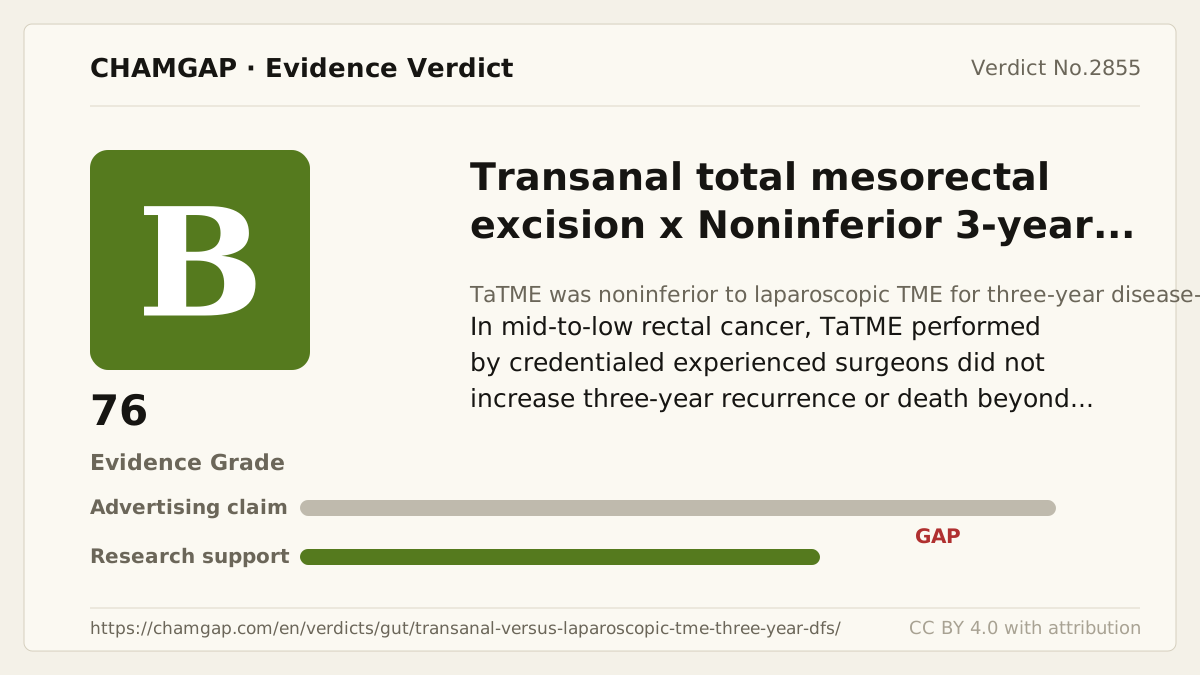
research showsThe grade is B. Three-year disease-free survival was 82.1% with TaTME and 79.4% with laparoscopic TME, an absolute difference of +2.7 points; the 97.5% CI of -3.0 to 8.1 stayed above the prespecified -10-point margin. One noninferiority-design limitation gives B with 76 points.
ads claimTaTME may improve access in a narrow pelvis, but it has a learning curve and prior safety controversy. Korean adoption requires minimum experience, video credentialing, multidisciplinary selection, and outcome surveillance.
Useful facts when choosing a product
- Three-year DFS was 82.1% versus 79.4%, absolute difference +2.7 points, 97.5% CI -3.0 to 8.1.
- Three-year local recurrence was 3.6% versus 4.4%, HR 0.81, 95% CI 0.44-1.49.
- Verdict 2851 compares laparoscopic with open surgery, 2852 addresses preoperative chemotherapy and radiation, and 2855 compares transanal with laparoscopic access. They ask different questions.
What the research actually shows
Eligible patients were randomized 1:1 through a web-based system using central allocation and center stratification. Each team needed at least 100 laparoscopic TME and 50 TaTME cases, with expected annual volumes of at least 50 and 30. A committee reviewed two unedited videos in obese men with low tumors. Defect name: Noninferiority-margin dependence. Listed item: Noninferiority design. Avoidability: Unavoidable - the question was whether a new approach preserved oncologic survival versus standard laparoscopy. Primary-analysis exclusion was 2.3% (26/1,115) and outcome missingness 1.3% (14/1,089), both below 15%. Sham surgery was unethical and not counted. Chinese public grants funded the trial and no author conflicts were reported.
Why this is classified as B (76)
A 1,115-person publicly funded hard-outcome RCT met its margin with one listed noninferiority limitation, giving B with 76 points.
Counterpoint. Early implementation reports raised local-recurrence concerns, so the technique should not be copied without the trial's expertise safeguards.
Rejudgment record. Cross-check applied — Large publicly funded hard-outcome RCT, strict surgeon credentialing, and one noninferiority-design limitation
| Endpoint | H | Hard endpoint - actual events such as death |
| Replication | R1 | Single confirmatory trial |
| Independence | I2 | Decisive evidence is publicly or non-profit funded |
| Effect size | E+ | Meets the clinically important threshold |
The scoring table and the verdict agree (B).
Sub-claim grades by effect
This ingredient is marketed for several effects. A single overall grade blends strong and weak claims together, so each effect is graded separately here. The overall grade reflects the strongest disconfirming or core claim.
| Effect (sub-claim) | Grade | Basis |
|---|---|---|
| Noninferior three-year DFS in expert mid-to-low rectal cancer surgery | B | The -3.0-point CI lower bound stayed above the -10-point margin. |
| Equivalent safety during early learning curves or in low-volume hospitals | ? | Not established because surgeons were strictly credentialed. |
Cross-check — Codex and Claude
Evidence Table
| Study | Design | Sample | Funding | Endpoint | Result | Weight |
|---|---|---|---|---|---|---|
| Study 1 | Chinese 16-center phase 3 randomized noninferiority trial | 1,089 | Chinese National Natural Science Foundation, Sun Yat-sen University 5010, and national or regional public grants; no conflicts and no funder role reported | Three-year DFS from intervention to disease or death from any cause; absolute margin -10 points | 82.1% versus 79.4%, absolute difference +2.7 points, 97.5% CI -3.0 to 8.1; HR 0.86, 97.5% CI 0.63-1.18 | Large publicly funded hard-outcome RCT with expert-surgeon conditions and noninferiority design |
Receipt — 1 References
All 1 cited sources were verified for existence at the original page (as of 2026-08-18).
Reviewed and approved: Chamgap Editorial Team · Approval date: 2026-08-18 · Corrections: none
Cite this verdict
[Chamgap] Transanal Total Mesorectal Excision Shows Noninferior 3-Year Disease-Free Survival in Mid-to-Low Rectal Cancer — Evidence Grade B·76. 1 cited sources checked. Source: https://chamgap.com/en/verdicts/gut/transanal-versus-laparoscopic-tme-three-year-dfs/ · CC BY 4.0CC BY 4.0 — free to use with attribution; do not distort grades, numbers, or verdict meaning.
What this document does and does not do
Chamgap is an information source. It reports what research has and has not confirmed; it does not tell readers what to take or buy. That decision belongs to readers and, when needed, medical or legal professionals. This verdict reflects literature available up to the search date and may change as new research appears. Nothing here is medical advice.