
Routine pelvic drainage,
does it really help with Prevention of pelvic sepsis within 30 days?
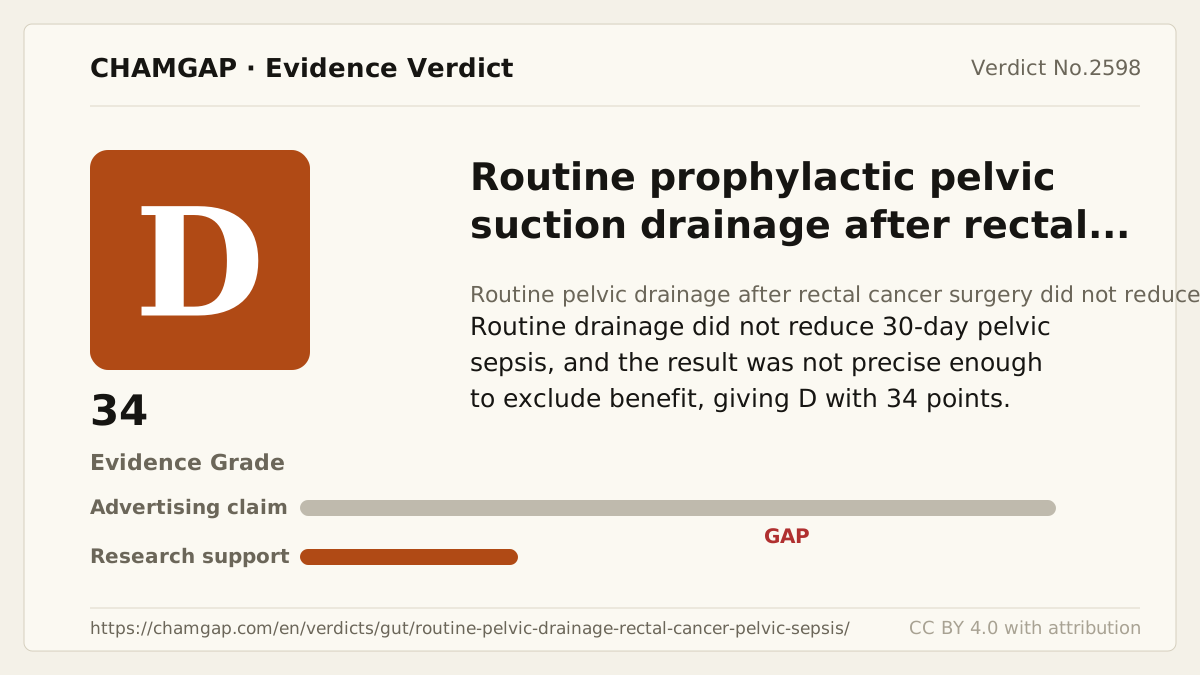
research showsThe grade is D with 34 points. GRECCAR 5 randomized 494 participants but analyzed 469 after excluding 25 who did not meet criteria. Pelvic sepsis within 30 days occurred in 38/236 (16.1%) with drainage versus 42/233 (18.0%) without drainage, P=.58. A calculated risk ratio of about 0.89 has an interval that still permits substantial benefit, so this is not a precise refutation.
ads claimA drain truly removes fluid from the operative pelvis. That physical drainage did not translate into prevention of leak, abscess, or peritonitis.
Useful facts when choosing a product
- The drainage arm placed a suction drain anterior to the sacrum and behind the anastomosis for three to five days.
- A drain removes pelvic fluid but does not seal a leak or eradicate an established source of infection.
- The registered primary endpoint was pelvic sepsis within 30 postoperative days.
What the research actually shows
Denost and the French Research Group of Rectal Cancer Surgery randomized 494 participants across French centers. Twenty-five were excluded for not meeting criteria, leaving 236 with drainage and 233 without drainage. NCT01269567 was registered before recruitment and its 30-day pelvic-sepsis primary outcome matched the article. The French National Cancer Institute registry identifies PHRC National Cancer 2010 funding and Bordeaux University Hospital sponsorship. Postrandomization exclusion of 25 participants was retained as one design limitation.
Why this is classified as D (34)
A publicly funded registered trial had a null prespecified primary endpoint, but it was one trial and its interval left room for benefit, giving D with 34 points.
Counterpoint. This concerns routine prophylaxis. Targeted drainage for established bleeding, abscess, or leak is a different question.
Rejudgment record. Cross-check applied — Cross-checked sample size, exclusions, primary endpoint, event counts, registration, and public funding against the Annals of Surgery abstract, NCT01269567, and the French cancer-trial registry
| Endpoint | H | Hard endpoint - actual events such as death |
| Replication | R1 | Single confirmatory trial |
| Independence | I2 | Decisive evidence is publicly or non-profit funded |
| Effect size | E0 | Null |
| Precision | C0 | The confidence interval leaves room for benefit |
The scoring table and the verdict agree (D).
Sub-claim grades by effect
This ingredient is marketed for several effects. A single overall grade blends strong and weak claims together, so each effect is graded separately here. The overall grade reflects the strongest disconfirming or core claim.
| Effect (sub-claim) | Grade | Basis |
|---|---|---|
| Routine pelvic drainage prevents 30-day pelvic sepsis | D | Rates were 16.1% versus 18.0%, P=.58. |
| Routine pelvic drainage reduces postoperative reoperation | D | Reoperation was 16.6% versus 21.0%, P=.22, without a significant reduction. |
Cross-check — Codex and Claude
Evidence Table
| Study | Design | Sample | Funding | Endpoint | Result | Weight |
|---|---|---|---|---|---|---|
| Study 1 | French multicenter open-label randomized phase 3 trial | 233 | Public PHRC National Cancer 2010 funding with Bordeaux University Hospital sponsorship | Pelvic sepsis within 30 days | 38/236 (16.1%) versus 42/233 (18.0%), P=.58; calculated RR about 0.89 (approximate 95% CI 0.60 to 1.33) | Single null trial of a preregistered primary endpoint |
Receipt — 2 References
All 2 cited sources were verified for existence at the original page (as of 2026-08-14).
Reviewed and approved: Chamgap Editorial Team · Approval date: 2026-08-14 · Corrections: none
Cite this verdict
[Chamgap] Routine pelvic drainage x pelvic sepsis after rectal cancer surgery — Evidence Grade D·34. 2 cited sources checked. Source: https://chamgap.com/en/verdicts/gut/routine-pelvic-drainage-rectal-cancer-pelvic-sepsis/ · CC BY 4.0CC BY 4.0 — free to use with attribution; do not distort grades, numbers, or verdict meaning.
What this document does and does not do
Chamgap is an information source. It reports what research has and has not confirmed; it does not tell readers what to take or buy. That decision belongs to readers and, when needed, medical or legal professionals. This verdict reflects literature available up to the search date and may change as new research appears. Nothing here is medical advice.