
Laparoscopic rectal-cancer resection,
does it really help with Noninferior 3-year locoregional recurrence versus open rectal-cancer resection?
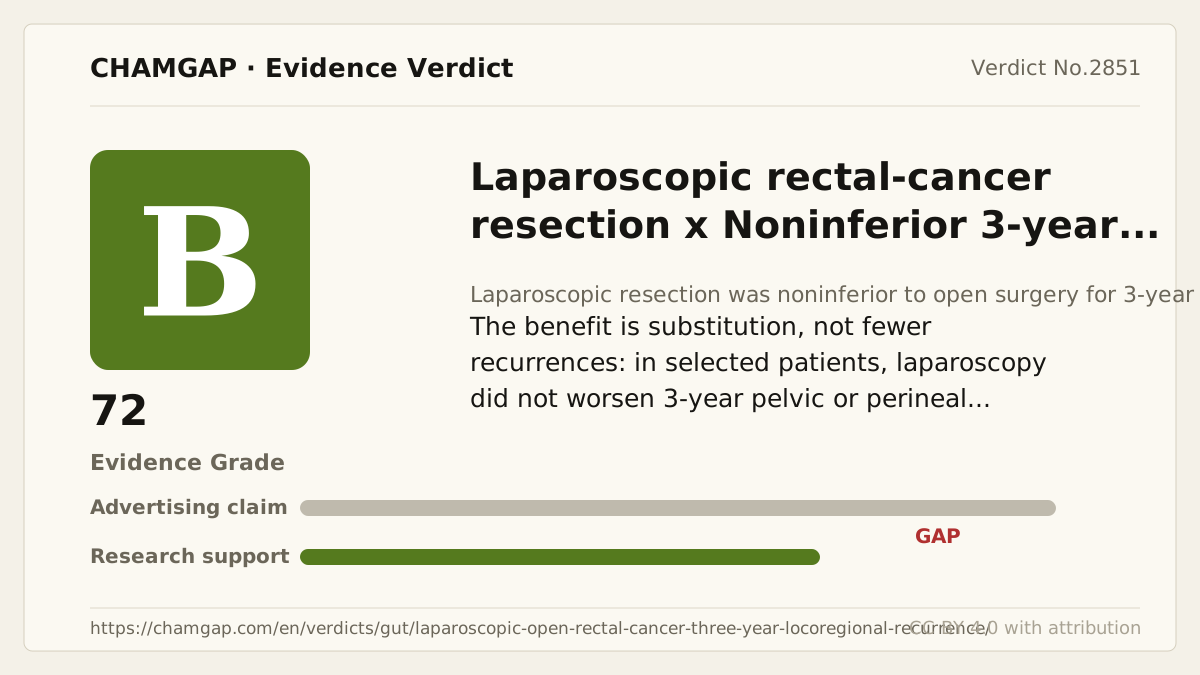
research showsThe grade is B. COLOR II estimated 3-year locoregional recurrence at 5.0% in each group, and the upper bound of the 90% CI for the laparoscopic-minus-open difference was 2.6 percentage points, below the prespecified 5-point margin. The primary analysis was intention-to-treat and used Kaplan-Meier estimation, which allowed censoring; 771 patients (74%) had data at the fixed 3-year time point. This was a large hard-outcome trial, but it remains one noninferiority trial without independent replication and included company support, giving B with 72 points.
ads claimLaparoscopic rectal surgery is close to standard practice in Korean colorectal surgery. The evidence still assumes patient selection, appropriate tumor anatomy, and experienced teams.
Useful facts when choosing a product
- There were 31 locoregional recurrences in the laparoscopic group and 15 in the open group, with 3-year Kaplan-Meier estimates of 5.0% in both.
- Randomization assigned 739 versus 364 patients; 59 were excluded after randomization and 1,036 entered long-term analyses.
- Verdict 2852 concerns preoperative chemotherapy and radiation strategy, verdict 2855 concerns a transanal approach, and this verdict asks whether laparoscopy can replace open surgery. These are different questions.
What the research actually shows
Thirty hospitals randomized 1,103 patients 2:1. The allocation-method quote is: "This list was computer-generated, with stratification according to hospital, tumor location, and the presence or absence of preoperative radiotherapy. An Internet application allowed central randomization." Defect name: Noninferiority design. Listed item: Noninferiority design. Original evidence that the item requirement was met: the trial applied a prespecified noninferiority margin, testing whether the result "excluded an absolute difference of 5 percentage points or more." Avoidability: Avoidable - a sufficiently powered superiority or equivalence trial could have been added. Substantial attrition (>=15%) was not counted as a defect. The paper states, "In the intention-to-treat analysis," and Kaplan-Meier estimation of 3-year locoregional recurrence allowed censoring. "At the 3-year follow-up, data were available for 771 patients (74%) regarding locoregional recurrence" describes fixed-time-point data availability, not exclusion from the primary analysis. Active-only control was not counted as a defect. The comparator was actual active treatment with standard open rectal-cancer surgery, but sham surgery was unethical and therefore unavoidable. Support combined Ethicon Endo-Surgery Europe with the Swedish Cancer Society and public or academic institutions; the paper states that Ethicon had no role in design, data collection, analysis, interpretation, or writing.
Why this is classified as B (72)
A large randomized trial met its prespecified 5-point noninferiority margin on actual 3-year cancer recurrence, but it remains one noninferiority trial without independent replication and included company support, giving B with 72 points.
Counterpoint. Smaller incisions and recovery are separate short-term outcomes. This verdict is limited to whether long-term locoregional recurrence was unacceptably worse than with open surgery.
Rejudgment record. Cross-check applied — A large hard-outcome randomized trial used intention-to-treat analysis and Kaplan-Meier censoring and met its prespecified noninferiority margin; it remains one noninferiority trial without independent replication and had mixed funding
| Endpoint | H | Hard endpoint - actual events such as death |
| Replication | R1 | Single confirmatory trial |
| Independence | I1 | Mixed funding sources |
| Effect size | E+ | Meets the clinically important threshold |
The scoring table and the verdict agree (B).
Sub-claim grades by effect
This ingredient is marketed for several effects. A single overall grade blends strong and weak claims together, so each effect is graded separately here. The overall grade reflects the strongest disconfirming or core claim.
| Effect (sub-claim) | Grade | Basis |
|---|---|---|
| Noninferior 3-year locoregional recurrence | C | Rates were 5.0% versus 5.0%, and the 2.6-point upper bound was within the 5-point margin. |
| Interchangeability in every locally advanced rectal cancer | ? | T4 and threatened-fascia T3 tumors were excluded, preventing broad generalization. |
Cross-check — Codex and Claude
Evidence Table
| Study | Design | Sample | Funding | Endpoint | Result | Weight |
|---|---|---|---|---|---|---|
| Study 1 | Open-label 30-center randomized noninferiority trial | 1,044 | Mixed support from Ethicon Endo-Surgery Europe, the Swedish Cancer Society, and regional public or academic institutions; the paper reports no company role in design, collection, analysis, interpretation, or writing | Three-year pelvic or perineal recurrence detected clinically and by rectoscopy, CT, or MRI; prespecified absolute margin 5 points | 5.0% versus 5.0%; upper 90% confidence bound for laparoscopic minus open difference 2.6 points, meeting noninferiority | Large actual-recurrence evidence, limited by one noninferiority trial without independent replication and mixed funding |
Receipt — 1 References
All 1 cited sources were verified for existence at the original page (as of 2026-08-18).
Reviewed and approved: Chamgap Editorial Team · Approval date: 2026-08-18 · Corrections: none
Cite this verdict
[Chamgap] Laparoscopic rectal-cancer resection is noninferior to open surgery for 3-year locoregional recurrence - benefit — Evidence Grade B·72. 1 cited sources checked. Source: https://chamgap.com/en/verdicts/gut/laparoscopic-open-rectal-cancer-three-year-locoregional-recurrence/ · CC BY 4.0CC BY 4.0 — free to use with attribution; do not distort grades, numbers, or verdict meaning.
What this document does and does not do
Chamgap is an information source. It reports what research has and has not confirmed; it does not tell readers what to take or buy. That decision belongs to readers and, when needed, medical or legal professionals. This verdict reflects literature available up to the search date and may change as new research appears. Nothing here is medical advice.