
Intravenous risankizumab induction,
does it really help with Week-12 clinical remission and endoscopic response in moderate-to-severe Crohn's disease?
research showsThe grade is C. In ADVANCE, both 600 mg and 1200 mg met both coprimary endpoints of clinical remission and endoscopic response at week 12. Focusing on the approved 600-mg induction dose, CDAI remission was 45% versus 25% and endoscopic response was 40% versus 12%.
ads claimRemission scores and endoscopy are useful but do not directly establish fewer admissions, operations, bowel damage, or long-term quality-of-life loss. In Korea, special-registration status and the reimbursed sequence after prior therapies materially affect access to Crohn's biologics.
Useful facts when choosing a product
- Patients received 600 or 1200 mg intravenously at weeks 0, 4, and 8 and were assessed at week 12.
- Coprimary endpoints were clinical remission and endoscopic response.
- This verdict centers the approved 600-mg induction dose.
What the research actually shows
ADVANCE randomized 931 patients to 600 mg, 373; 1200 mg, 372; or placebo, 186. The prespecified primary population comprised 850 treated patients meeting central endoscopic eligibility. Axis 6 B0 evidence ① Allocation concealment: "We used interactive response technology for random assignment." ② Blinding: "All patients and study personnel (excluding pharmacists who prepared intravenous solutions) were masked to treatment allocation throughout the study." ③ Analysis population and missing data: "The ITT subjects will be analyzed as randomized" and "Subjects who discontinue prior to Week 12 for any reason will be considered as 'not-achieved'." ④ Prespecified primary endpoint: "The co-primary endpoints are ... CDAI clinical remission at Week 12 and ... endoscopic response at Week 12" - consistent with NCT03105128. The paper states "Funding: AbbVie," and multiple authors were AbbVie employees.
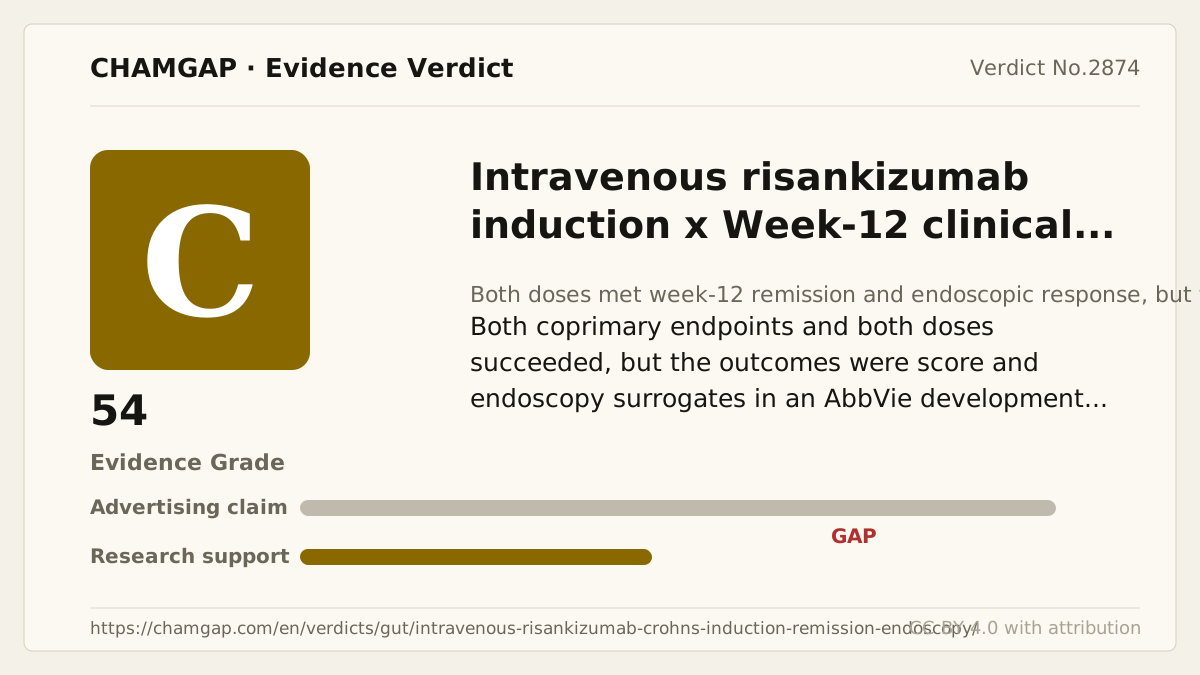
Why this is classified as C (54)
Central randomization, double masking, nonresponder handling, and success on both coprimary endpoints are strengths, but score and endoscopy surrogates with no independently funded replication give C with 54 points.
Counterpoint. A 12-week induction response is not the same as long-term maintenance; subcutaneous maintenance evidence is separate.
Rejudgment record. Cross-check applied — Direct review of dose-specific ADVANCE coprimary outcomes, the 850-patient population, IRT, masking, missing-data rules, and AbbVie funding
| Endpoint | S | Surrogate marker - laboratory or imaging measures |
| Replication | R1 | Single confirmatory trial |
| Independence | I0 | Evidence comes only from manufacturer studies |
| Effect size | E+ | Meets the clinically important threshold |
The scoring table and the verdict agree (C).
Sub-claim grades by effect
This ingredient is marketed for several effects. A single overall grade blends strong and weak claims together, so each effect is graded separately here. The overall grade reflects the strongest disconfirming or core claim.
| Effect (sub-claim) | Grade | Basis |
|---|---|---|
| Clinical remission with 600 mg | C | Rates were 45% versus 25%, adjusted absolute difference +21 points. |
| Endoscopic response with 600 mg | C | Rates were 40% versus 12%, adjusted absolute difference +28 points. |
Cross-check — Codex and Claude
Evidence Table
| Study | Design | Sample | Funding | Endpoint | Result | Weight |
|---|---|---|---|---|---|---|
| Study 1 | Multicenter randomized double-masked placebo-controlled phase 3 induction trial | 175 | Original statement: "Funding: AbbVie"; multiple company-employed authors | Coprimary week-12 CDAI or PRO-2 clinical remission and endoscopic response | 600 mg: CDAI remission 45% versus 25%, +21 points (12 to 29); endoscopic response 40% versus 12%, +28 points (21 to 35). The 1200-mg dose also met both coprimary endpoints. | Pivotal surrogate-outcome evidence |
Receipt — 2 References
All 2 cited sources were verified for existence at the original page (as of 2026-08-18).
Reviewed and approved: Chamgap Editorial Team · Approval date: 2026-08-18 · Corrections: none
Cite this verdict
[Chamgap] Benefit of Intravenous Risankizumab Induction for Clinical Remission and Endoscopic Response in Moderate-to-Severe Crohn's Disease, Surrogate Outcomes — Evidence Grade C·54. 2 cited sources checked. Source: https://chamgap.com/en/verdicts/gut/intravenous-risankizumab-crohns-induction-remission-endoscopy/ · CC BY 4.0CC BY 4.0 — free to use with attribution; do not distort grades, numbers, or verdict meaning.
What this document does and does not do
Chamgap is an information source. It reports what research has and has not confirmed; it does not tell readers what to take or buy. That decision belongs to readers and, when needed, medical or legal professionals. This verdict reflects literature available up to the search date and may change as new research appears. Nothing here is medical advice.