
Hybrid minimally invasive esophagectomy,
does it really help with Reduction of major intraoperative or 30-day complications?
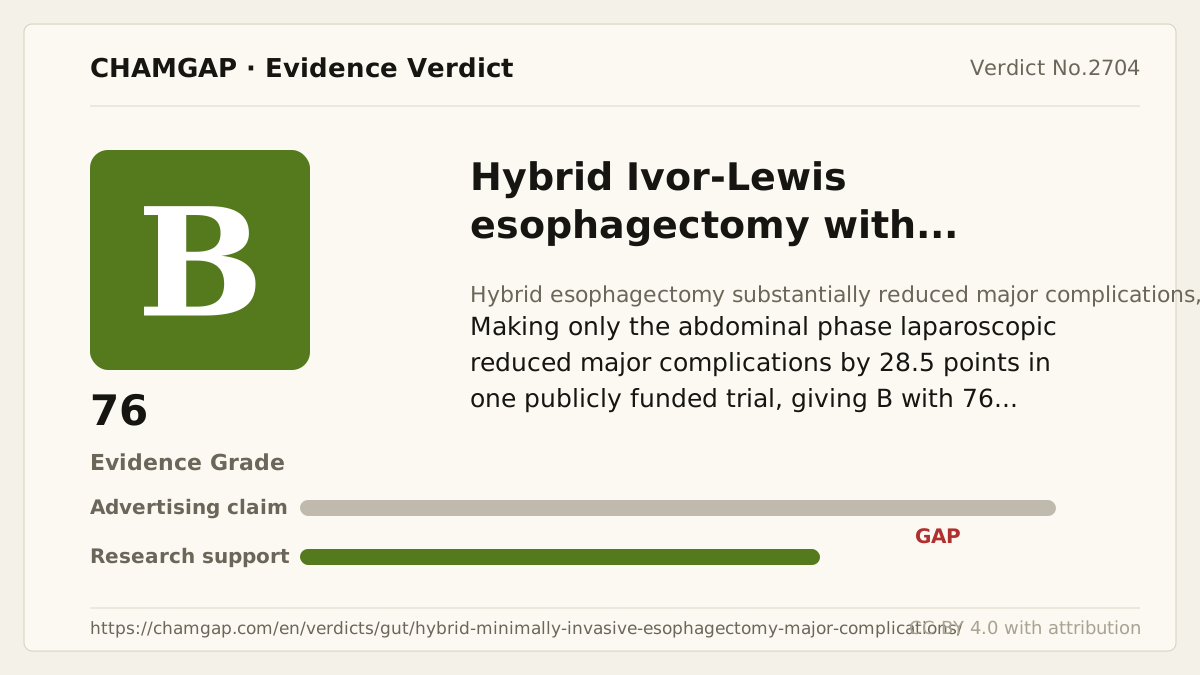
research showsThe grade is B with 76 points. MIRO analyzed all 207 patients as assigned. Clavien-Dindo grade 2 or higher major complications occurred in 37/103 (35.9%) with the hybrid procedure versus 67/104 (64.4%) with conventional open surgery, OR 0.31 (95% CI 0.18-0.55; P<0.001). These were events requiring treatment, but this exact procedure has one confirmatory randomized trial.
ads claimChanging the abdominal incision to laparoscopy and reducing major complications are separate claims. MIRO applies to a standardized hybrid Ivor-Lewis operation in credentialed centers.
Useful facts when choosing a product
- Both groups underwent open right thoracotomy; only gastric mobilization differed between laparoscopic and open abdominal approaches.
- The 2011 protocol, 2019 main result, and 2021 five-year report are multiple publications from one MIRO trial, NCT00937456.
- Yun 2017 is a separate nonrandomized Korean comparison of 115 patients, not a MIRO replication trial.
What the research actually shows
MIRO randomized 207 patients, 103 versus 104, at 13 French centers after laparoscopic exploration confirmed resectability, using central stratified blocks and sequential envelopes intraoperatively. The approach was open to patients and clinicians, which is unavoidable in surgery, while the primary outcome was a prespecified treatment-requiring complication event. The analysis retained all 207 as assigned, including two without resection and three conversions. The registry and article agree on 30-day major complications. The French National Cancer Institute funded the trial, and no relevant conflict was reported. The 2011 paper is the NCT00937456 protocol, the 2019 paper the main result, and the 2021 paper follow-up of the same participants. Yun 2017 is a separate retrospective Korean comparison of 115 patients, not MIRO and not randomized replication. Axis 6 B0 basis ① Allocation concealment: "envelopes will be prepared and blinded for allocation during surgery" ② Masking: "open-label" — the surgical approach necessarily had to be disclosed to patients and clinicians, so this unavoidable feature is not counted as a defect. ③ Analysis population and missing data: "intention-to-treat principle for the primary endpoint" — 207 patients in ITT, no missing data ④ Prespecified primary endpoint: "The primary end point was major complication during surgery or within 30 days after surgery." — matches registration NCT00937456
Why this is classified as B (76)
Allocation concealment, the objective endpoint in unavoidably open surgery, ITT analysis, and the prespecified primary endpoint are all confirmed in the source, leaving no avoidable defect; absent independent replication gives B with 76 points.
Counterpoint. Mortality benefit is unproven, and totally minimally invasive or robotic procedures require separate evidence.
Rejudgment record. Cross-check applied — Cross-checked the MIRO article, protocol, registry, five-year report, and Yun comparison for publication relationships, primary endpoint, allocation, intention-to-treat analysis, and funding
| Endpoint | H | Hard endpoint - actual events such as death |
| Replication | R1 | Single confirmatory trial |
| Independence | I2 | Decisive evidence is publicly or non-profit funded |
| Effect size | E+ | Meets the clinically important threshold |
The scoring table and the verdict agree (B).
Sub-claim grades by effect
This ingredient is marketed for several effects. A single overall grade blends strong and weak claims together, so each effect is graded separately here. The overall grade reflects the strongest disconfirming or core claim.
| Effect (sub-claim) | Grade | Basis |
|---|---|---|
| Hybrid Ivor-Lewis esophagectomy reduces major 30-day complications | B | Rates were 35.9% versus 64.4%, OR 0.31. |
| Hybrid esophagectomy reduces 90-day mortality | D | Deaths were 4/103 versus 6/104, not establishing a mortality reduction. |
Cross-check — Codex and Claude
Evidence Table
| Study | Design | Sample | Funding | Endpoint | Result | Weight |
|---|---|---|---|---|---|---|
| Mariette C, Markar SR, Dabakuyo-Yonli TS, Meunier B, Pezet D, Collet D, D'Journo XB, Brigand C, Perniceni T, Carrère N, Mabrut JY, Msika S, Peschaud F, Prudhomme M, Bonnetain F, Piessen G, Fédération de Recherche en Chirurgie (FRENCH) and French Eso-Gastric Tumors (FREGAT) Working Group. 2019 MIRO; Briez N, Piessen G, Bonnetain F, Brigand C, Carrere N, Collet D, Doddoli C, Flamein R, Mabrut JY, Meunier B, Msika S, Perniceni T, Peschaud F, Prudhomme M, Triboulet JP, Mariette C. 2011 protocol | Open-label randomized phase 3 trial at 13 French centers; protocol and main result from the same trial | 104 | Public funding from the French National Cancer Institute, Programme Hospitalier pour la Recherche Clinique 2008 | Clavien-Dindo grade 2 or higher complication intraoperatively or within 30 days | 37/103 (35.9%) versus 67/104 (64.4%), OR 0.31 (95% CI 0.18-0.55), P<0.001 | Single large confirmatory trial; protocol and follow-up not double-counted |
| Yun JS, Na KJ, Song SY, Kim S, Jeong IS, Oh SG. 2017 | Single-center retrospective nonrandomized Korean comparison | 62 | A funding statement could not be secured from publicly accessible material | Perioperative complications and recovery measures | A separate Korean cohort comparison without randomization; not counted as independent replication of MIRO | Contextual evidence for Korean practice |
Receipt — 3 References
All 3 cited sources were verified for existence at the original page (as of 2026-08-17).
Reviewed and approved: Chamgap Editorial Team · Approval date: 2026-08-17 · Corrections: none
Cite this verdict
[Chamgap] Hybrid minimally invasive esophagectomy x fewer major complications in esophageal cancer — Evidence Grade B·76. 3 cited sources checked. Source: https://chamgap.com/en/verdicts/gut/hybrid-minimally-invasive-esophagectomy-major-complications/ · CC BY 4.0CC BY 4.0 — free to use with attribution; do not distort grades, numbers, or verdict meaning.
What this document does and does not do
Chamgap is an information source. It reports what research has and has not confirmed; it does not tell readers what to take or buy. That decision belongs to readers and, when needed, medical or legal professionals. This verdict reflects literature available up to the search date and may change as new research appears. Nothing here is medical advice.