
Abdominal massage,
does it really help with Reduced constipation severity over four weeks in functional chronic constipation?
research showsThe grade is C with 50 points. A placebo-controlled trial randomized and analyzed all 74 participants, 37 per arm. Constipation severity fell from 43.0 to 13.0 with massage and from 43.3 to 31.2 with detuned ultrasound, with a group-by-time P<.001. The reported standardized effect, d=1.99, was large, but one center, four weeks, and a subjective outcome with distinguishable treatments leave confirmation at C.
ads claimThe result does not establish a permanent cure or replacement for medication. It concerns short-term symptom reduction after therapist-delivered massage alongside lifestyle advice.
Useful facts when choosing a product
- Massage averaged 10 minutes three times weekly for four weeks; detuned ultrasound lasted 15 minutes twice weekly.
- Total CSI changed from 43.0 to 13.0 versus 43.3 to 31.2, and the article reported d=1.99.
- Unlike an earlier verdict on infant massage and weight, this verdict is limited to symptom severity in adult functional chronic constipation.
What the research actually shows
The 2022 single-center trial by Doğan İG, Gürşen C, Akbayrak T, Balaban YH, Vahabov C, Üzelpasacı E, and Özgül S randomized 74 Rome IV functional-constipation patients 1:1 using an online blocked list. The person creating and assigning the list was separate from assessment and treatment, and no participant dropped out. Massage was delivered for 10 minutes three times weekly, while detuned ultrasound lasted 15 minutes twice weekly, for four weeks. Total CSI changed from 43.0 to 13.0 versus 43.3 to 31.2, with d=1.99. Registration was NCT03764995 and the authors reported no conflicts, but a funding statement was not verified, so public independence was not assumed.
Why this is classified as C (50)
A large short-term symptom difference was limited by a small single-center four-week trial and a subjective outcome with uncertain masking, giving C with 50 points.
Counterpoint. Severe pain, suspected obstruction, recent abdominal surgery, or pregnancy calls for clinical assessment before abdominal pressure is attempted.
Rejudgment record. Cross-check applied — Cross-checked the primary CSI outcome, all 74 analyzed, randomization procedure, treatment contrast, and reported d=1.99 against the original article and registry
| Endpoint | P | Patient-reported treatment goal - the symptom is the goal |
| Replication | R1 | Single confirmatory trial |
| Independence | I1 | Mixed funding sources |
| Effect size | E+ | Meets the clinically important threshold |
The scoring table and the verdict agree (C).
Sub-claim grades by effect
This ingredient is marketed for several effects. A single overall grade blends strong and weak claims together, so each effect is graded separately here. The overall grade reflects the strongest disconfirming or core claim.
| Effect (sub-claim) | Grade | Basis |
|---|---|---|
| Reduced constipation severity over four weeks | C | The article reported d=1.99 for the CSI change. |
| Sustained long-term benefit | ? | The trial did not measure durability beyond four weeks. |
Cross-check — Codex and Claude
Evidence Table
| Study | Design | Sample | Funding | Endpoint | Result | Weight |
|---|---|---|---|---|---|---|
| Doğan İG, Gürşen C, Akbayrak T, Balaban YH, Vahabov C, Üzelpasacı E, Özgül S. 2022 | Single-center randomized placebo-controlled trial | 74 | Funding statement not verified; authors reported no conflicts | Total Constipation Severity Instrument score at four weeks | 43.0 to 13.0 versus 43.3 to 31.2; group-by-time P<.001; d=1.99 | Large short-term effect limited by small size, short follow-up, and uncertain masking |
Receipt — 2 References
Of 2 cited sources, 1 had limited original-page access (blocked or summary-only) and were verified via index/summary, marked partial; the rest were verified at the original page. As of 2026-08-15.
Reviewed and approved: Chamgap Editorial Team · Approval date: 2026-08-15 · Corrections: none
Cite this verdict
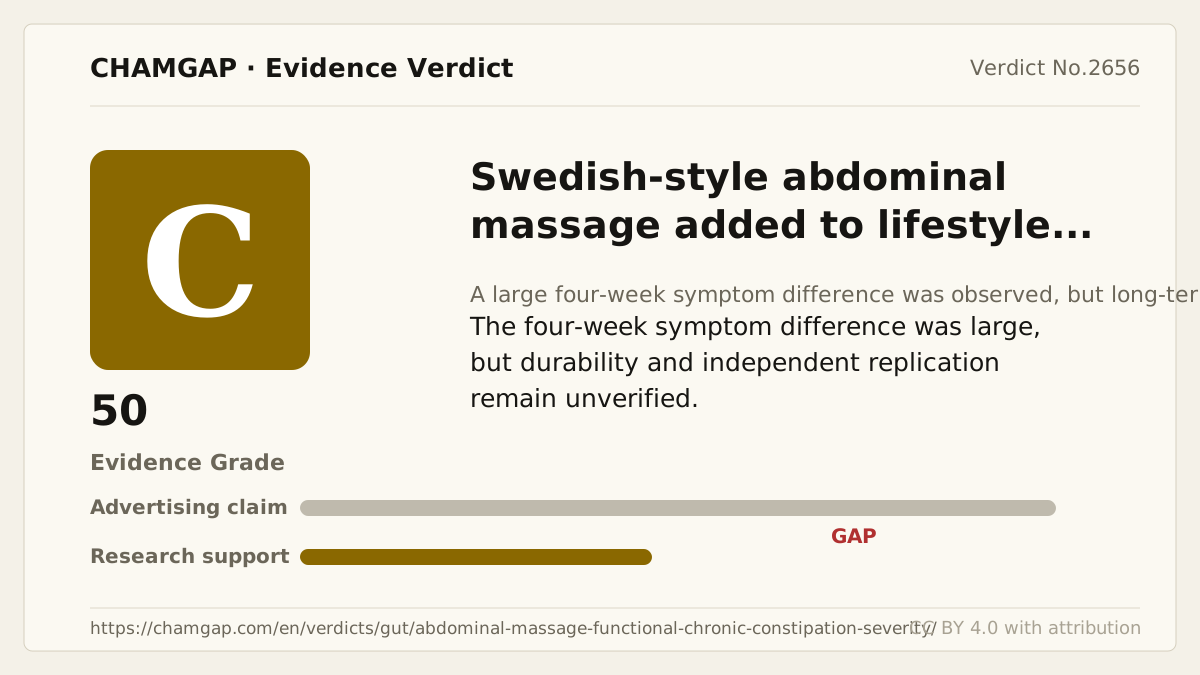
[Chamgap] Abdominal massage x short-term functional-constipation relief — Evidence Grade C·50. 2 cited sources checked. Source: https://chamgap.com/en/verdicts/gut/abdominal-massage-functional-chronic-constipation-severity/ · CC BY 4.0CC BY 4.0 — free to use with attribution; do not distort grades, numbers, or verdict meaning.
What this document does and does not do
Chamgap is an information source. It reports what research has and has not confirmed; it does not tell readers what to take or buy. That decision belongs to readers and, when needed, medical or legal professionals. This verdict reflects literature available up to the search date and may change as new research appears. Nothing here is medical advice.