
Abdominal breathing training,
does it really help with Reduced esophageal acid exposure in gastroesophageal reflux disease?
research showsThe grade is C with 46 points. In an open 19-person randomized trial, the training group reduced time with esophageal pH below 4 from 9.1% to 4.7% after four weeks, but public material does not provide control-group values or an adjusted between-group difference and confidence interval. This was a physiologic surrogate in a very small single trial with an unreconstructable treatment-effect magnitude.
ads claimA physiologic explanation about diaphragm recruitment does not establish symptom benefit. The randomized primary result concerned four-week acid exposure, while long-term medication reduction was not randomized.
Useful facts when choosing a product
- The intervention trained a shift from thoracic to abdominal breathing for four weeks.
- UMIN000004878 was registered after the trial began.
- Both groups were offered training after four weeks, ending the randomized comparison.
What the research actually shows
Nineteen participants were assigned 10 to training and 9 to control, and all completed four weeks. Time with pH below 4 fell from 9.1±1.3% to 4.7±0.9% within the training group, while the control group had no significant within-group change. Comparing significance with nonsignificance does not itself prove a between-group difference. The public abstract and registry omit both control values, the between-group change estimate, its standard error or confidence interval, and a between-group test statistic, so a standardized treatment effect cannot be reconstructed. At nine months, 11 voluntary continuers were compared with eight noncontinuers after both randomized groups had been offered training. Registration occurred after trial initiation, and assessor masking, concealment implementation, assignment-based analysis, and missing-data handling were not reported.
Why this is classified as C (46)
A 19-person open, retrospectively registered single trial measured a surrogate and omitted the recoverable between-group effect magnitude, giving C with 46 points.
Counterpoint. Dyspnea, chest pain, dysphagia, bleeding, or weight loss requires medical assessment, and prescribed acid suppression should not be stopped without clinical advice.
Rejudgment record. Cross-check applied — Cross-checked the abstract, UMIN000004878, and a later randomized trial for the primary endpoint, denominators, retrospective registration, and absent between-group effect estimate
| Endpoint | S | Surrogate marker - laboratory or imaging measures |
| Replication | R1 | Single confirmatory trial |
| Independence | I1 | Mixed funding sources |
| Effect size | EX | The clinical size of the effect could not be judged |
The scoring table and the verdict agree (C).
Sub-claim grades by effect
This ingredient is marketed for several effects. A single overall grade blends strong and weak claims together, so each effect is graded separately here. The overall grade reflects the strongest disconfirming or core claim.
| Effect (sub-claim) | Grade | Basis |
|---|---|---|
| Reduced esophageal acid exposure at four weeks | C | The within-training-group reduction was positive, but the between-group magnitude cannot be reconstructed. |
| Reduced PPI use at nine months | C | The comparison of voluntary continuers with noncontinuers was no longer randomized. |
Cross-check — Codex and Claude
Evidence Table
| Study | Design | Sample | Funding | Endpoint | Result | Weight |
|---|---|---|---|---|---|---|
| Eherer AJ, Netolitzky F, Högenauer C, Puschnig G, Hinterleitner TA, Scheidl S, Kraxner W, Krejs GJ, Hoffmann KM. 2012 | Single-center open-label parallel-group randomized trial | 8 | Registry listed no external funding; the paper's Funding and Disclosure statements could not be confirmed | Fraction of esophageal recording time with pH below 4 at four weeks | Training group 9.1±1.3% to 4.7±0.9%, P<0.05; control values, between-group change, and CI unavailable | Very small physiologic surrogate trial with unreconstructable treatment-effect magnitude |
Receipt — 1 References
All 1 cited sources were verified for existence at the original page (as of 2026-08-15).
Reviewed and approved: Chamgap Editorial Team · Approval date: 2026-08-15 · Corrections: none
Cite this verdict
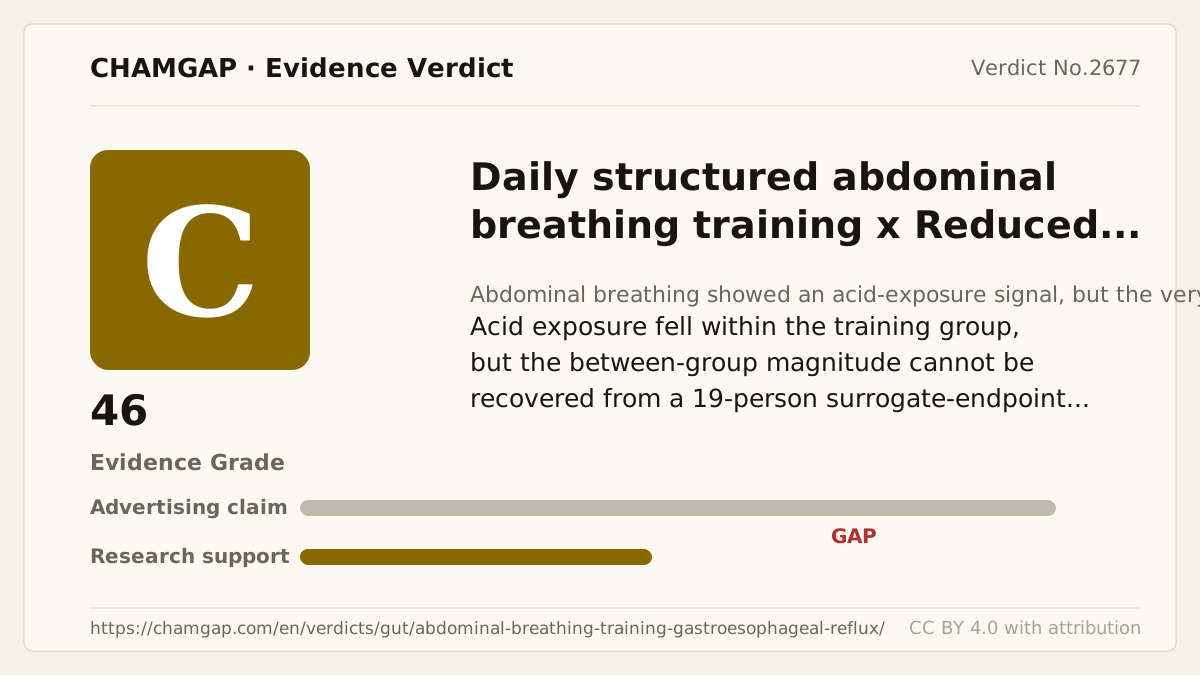
[Chamgap] Abdominal breathing training x reduced gastroesophageal reflux — Evidence Grade C·46. 1 cited sources checked. Source: https://chamgap.com/en/verdicts/gut/abdominal-breathing-training-gastroesophageal-reflux/ · CC BY 4.0CC BY 4.0 — free to use with attribution; do not distort grades, numbers, or verdict meaning.
What this document does and does not do
Chamgap is an information source. It reports what research has and has not confirmed; it does not tell readers what to take or buy. That decision belongs to readers and, when needed, medical or legal professionals. This verdict reflects literature available up to the search date and may change as new research appears. Nothing here is medical advice.