
Universal postpartum nurse home visiting,
does it really help with Reduced emergency-department visits and hospital overnights during infancy?
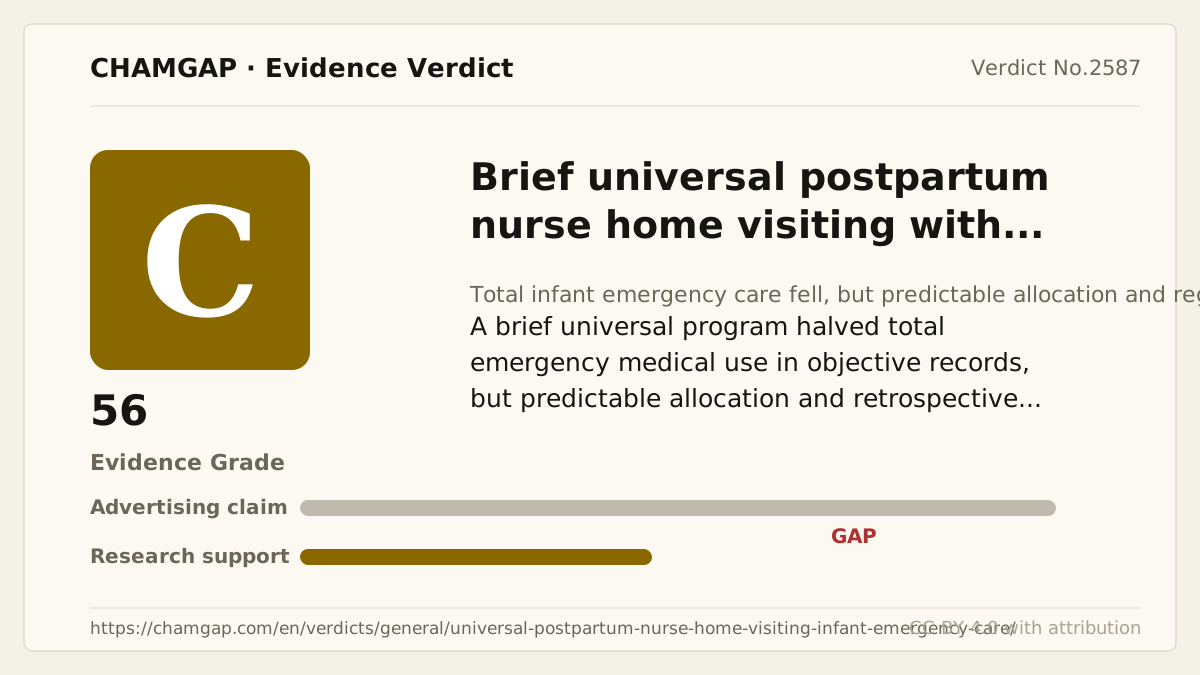
research showsThe grade is C with 56 points. Among 531 evaluation families, combined emergency-department visits and hospital overnights through 12 months averaged 0.78 per infant versus 1.57, P<0.001, standardized effect size 0.28. Allocation by even or odd birth date was predictable, however, and the trial was registered after it began.
ads claimThe result belongs to the whole Durham Connects package: hospital contact, one to three visits, risk assessment, tailored resource linkage, and follow-up calls. It cannot be attributed to one visit or education alone.
Useful facts when choosing a product
- The program combined hospital contact, one to three nurse visits at 3-12 weeks, resource linkage, and a follow-up call.
- Participants could not be blinded to receiving visits, but families were unaware of the evaluation link and interviewers were masked to assignment.
- The primary endpoint summed emergency-department visits and non-birth hospital overnights.
What the research actually shows
Dodge and colleagues assigned 4,777 Durham County births to even-date intervention, 2,327, or odd-date control, 2,450. A computer selected one family per day for the representative evaluation sample; 664 were eligible and 531 participated. Families and interviewers were masked to the program-evaluation link and assignment, and Poisson models used hospital administrative records through 12 months. Funding came from the Duke Endowment, Pew Center on the States, and NIH, with no relevant financial relationships or conflicts reported.
Why this is classified as C (56)
Objective health-care use fell with public and nonprofit funding, but predictable birth-date allocation and registration after trial start impose a C ceiling, giving 56 points.
Counterpoint. Different local care systems and resource availability may not reproduce the same effect. Emergency-department visits alone were not significantly reduced.
Rejudgment record. Cross-check applied — Cross-checked allocation, evaluation sampling, endpoint composition, analysis, registration timing, and funding against the article and NCT01406184
| Endpoint | H | Hard endpoint - actual events such as death |
| Replication | R1 | Single confirmatory trial |
| Independence | I2 | Decisive evidence is publicly or non-profit funded |
| Effect size | E+ | Meets the clinically important threshold |
The scoring table and the verdict agree (C).
Sub-claim grades by effect
This ingredient is marketed for several effects. A single overall grade blends strong and weak claims together, so each effect is graded separately here. The overall grade reflects the strongest disconfirming or core claim.
| Effect (sub-claim) | Grade | Basis |
|---|---|---|
| Universal postpartum nurse home visiting reduces total infant emergency medical care | C | Use was 0.78 versus 1.57, with allocation and registration limitations. |
| The program reduces infant emergency-department visits alone | D | The result was 0.68 versus 0.83, P=0.223. |
Cross-check — Codex and Claude
Evidence Table
| Study | Design | Sample | Funding | Endpoint | Result | Weight |
|---|---|---|---|---|---|---|
| Study 1 | Community-wide randomized evaluation of a universal service | 271 | Public and nonprofit funding from the Duke Endowment, Pew Center on the States, and NIH | Combined emergency-department visits and hospital overnights through 12 months | 0.78 versus 1.57 events per infant, P<0.001, effect size 0.28; ED visits 0.68 versus 0.83, P=0.223 | Only direct confirmatory evaluation |
Receipt — 1 References
All 1 cited sources were verified for existence at the original page (as of 2026-08-14).
Reviewed and approved: Chamgap Editorial Team · Approval date: 2026-08-14 · Corrections: none
Cite this verdict
[Chamgap] Universal postpartum nurse home visiting x infant emergency medical care — Evidence Grade C·56. 1 cited sources checked. Source: https://chamgap.com/en/verdicts/general/universal-postpartum-nurse-home-visiting-infant-emergency-care/ · CC BY 4.0CC BY 4.0 — free to use with attribution; do not distort grades, numbers, or verdict meaning.
What this document does and does not do
Chamgap is an information source. It reports what research has and has not confirmed; it does not tell readers what to take or buy. That decision belongs to readers and, when needed, medical or legal professionals. This verdict reflects literature available up to the search date and may change as new research appears. Nothing here is medical advice.