
Topical tranexamic acid for epistaxis,
does it really help with Reduced need for anterior nasal packing in adults with emergency-department epistaxis?
research showsThe grade is D. In the largest independent multicenter NoPAC trial, anterior packing occurred in 111/254 (43.7%) with tranexamic acid and 100/242 (41.3%) with saline placebo. The odds ratio was 1.107 (95% CI 0.769 to 1.594) and risk difference +2.4 points (95% CI -6.3 to 11.1). Smaller trials favored TXA for ten-minute bleeding cessation, but used packing as the active comparator rather than measuring whether packing could be avoided.
ads claimIn Korea, topical nasal use may repurpose injectable solution on gauze or a pledget and is not equivalent to an over-the-counter hemostatic or nasal spray. Severe, recurrent, anticoagulant-associated, or symptomatic bleeding needs clinical care, and TXA should not delay compression, cautery, or packing.
Useful facts when choosing a product
- NoPAC applied 2 mL of 100 mg/mL solution for ten minutes, with one repeat if needed.
- Verdict 2277 is ungraded with no score and concerns head-tilting posture, whereas this verdict concerns a drug adjunct and packing.
- Verdict 1145 is B with 76 points for postpartum bleeding and verdict 1174 is A with 96 points for traumatic bleeding; both use intravenous TXA and mortality outcomes. Verdict 1594 is C with 55 points and verdict 1666 is C with 48 points for oral off-label melasma treatment.
What the research actually shows
NoPAC randomized 496 adults across 26 UK emergency departments, 254 to TXA and 242 to placebo. Recruitment occurred when research nurses were working and available, so it was convenience rather than consecutive enrollment; this was counted as one avoidable selection-bias flaw. Eligible bleeding persisted after compression and topical vasoconstrictor treatment. TXA 100 mg/mL or saline was applied on a cotton dental roll for ten minutes, with one repeat if needed. Packing was 111/254 versus 100/242, OR 1.107 (0.769 to 1.594), P=.59; rebleeding, admission, and further treatment were also null. In the same-question independent literature, Tibbelin 1995 was uncertain for topical gel versus placebo, while Akkan 2019 found TXA compression better than simple compression for 15-minute control but similar to Merocel packing. The 2013 and 2018 Zahed trials favored ten-minute hemostasis and one-week rebleeding against active packing. A 2022 synthesis of eight studies and 1,299 participants reported first-assessment control OR 3.5 (1.3 to 9.7) and 24-72-hour rebleeding OR 0.37 (0.20 to 0.66), but comparator, formulation, population, endpoint, and timing heterogeneity prevents interpreting it as a direct packing-avoidance effect. NIHR funded NoPAC; no separate funding wording was verified in the accessible Zahed articles.
Why this is classified as D (34)
The direct large trial was null, with one avoidable convenience-recruitment selection-bias flaw, giving D with 34 points.
Counterpoint. Small trials favored early hemostasis against active packing or vasoconstrictor controls, but do not directly answer packing avoidance.
Rejudgment record. Cross-check applied — Null outcomes in the 496-participant trial plus selection bias from recruitment when research nurses were available
| Endpoint | H | Hard endpoint - actual events such as death |
| Replication | R1 | Single confirmatory trial |
| Independence | I2 | Decisive evidence is publicly or non-profit funded |
| Effect size | E0 | Null |
| Precision | C0 | The confidence interval leaves room for benefit |
The scoring table and the verdict agree (D).
Sub-claim grades by effect
This ingredient is marketed for several effects. A single overall grade blends strong and weak claims together, so each effect is graded separately here. The overall grade reflects the strongest disconfirming or core claim.
| Effect (sub-claim) | Grade | Basis |
|---|---|---|
| Reduced anterior packing during the index ED visit | D | NoPAC was null at 43.7% versus 41.3%. |
| Initial hemostasis within ten minutes | C | Small active-comparator trials and a heterogeneous synthesis were positive but asked a different question. |
Cross-check — Codex and Claude
Evidence Table
| Study | Design | Sample | Funding | Endpoint | Result | Weight |
|---|---|---|---|---|---|---|
| Study 1 | Double-blind randomized placebo-controlled trial across 26 EDs | 242 | This study was funded by the National Institute for Health Research (NIHR) Research for Patient Benefit program (project reference PB PG 0215-36142). | Anterior packing during the index ED visit (primary); seven-day rebleeding, admission, transfusion, and further treatment (secondary) | Packing 111/254 versus 100/242, OR 1.107 (95% CI 0.769 to 1.594), risk difference +2.4 points (-6.3 to 11.1); rebleeding 49/252 versus 39/242, OR 1.26 (0.79 to 2.00) | Pivotal direct evidence |
| Study 2 | Single-center open randomized active-comparator trial | 109 | No separate Funding wording was verified in the accessible article | Ten-minute hemostasis, 24-hour and one-week rebleeding, ED stay | Ten-minute hemostasis 76/107 (71%) versus 34/109 (31.2%); one-week rebleeding 3/107 (2.8%) versus 12/109 (11%) | Different active comparator and primary endpoint |
| Study 3 | Open randomized active-comparator trial across two EDs | 62 | No separate Funding wording was verified in the accessible article | Ten-minute hemostasis (primary); 24-hour and one-week rebleeding and stay (secondary) | Ten-minute hemostasis 45/62 (73%) versus 18/62 (29%), difference 44 points (95% CI 26 to 57); one-week rebleeding 3/62 (5%) versus 13/62 (21%) | Antiplatelet-user population and active comparator |
| Study 4 | Multicenter double-blind randomized placebo-controlled topical-gel trial | 68 | Not reported | Bleeding control by 30 minutes and rebleeding within ten days | Thirty-minute control RR 0.79 (95% CI 0.56 to 1.11); ten-day rebleeding RR 0.66 (0.41 to 1.05) | Independent placebo-controlled evidence for the same question |
| Study 5 | Single-center three-arm randomized trial | 45 | Not reported | Bleeding control within 15 minutes and rebleeding | TXA compression 41/45 (91.1%), simple compression 32/45 (71.1%), Merocel packing 42/45 (93.3%) | Independent same-question evidence with different three-arm comparators and timing |
Receipt — 6 References
All 6 cited sources were verified for existence at the original page (as of 2026-08-08).
Reviewed and approved: Chamgap Editorial Team · Approval date: 2026-08-08 · Corrections: none
Cite this verdict
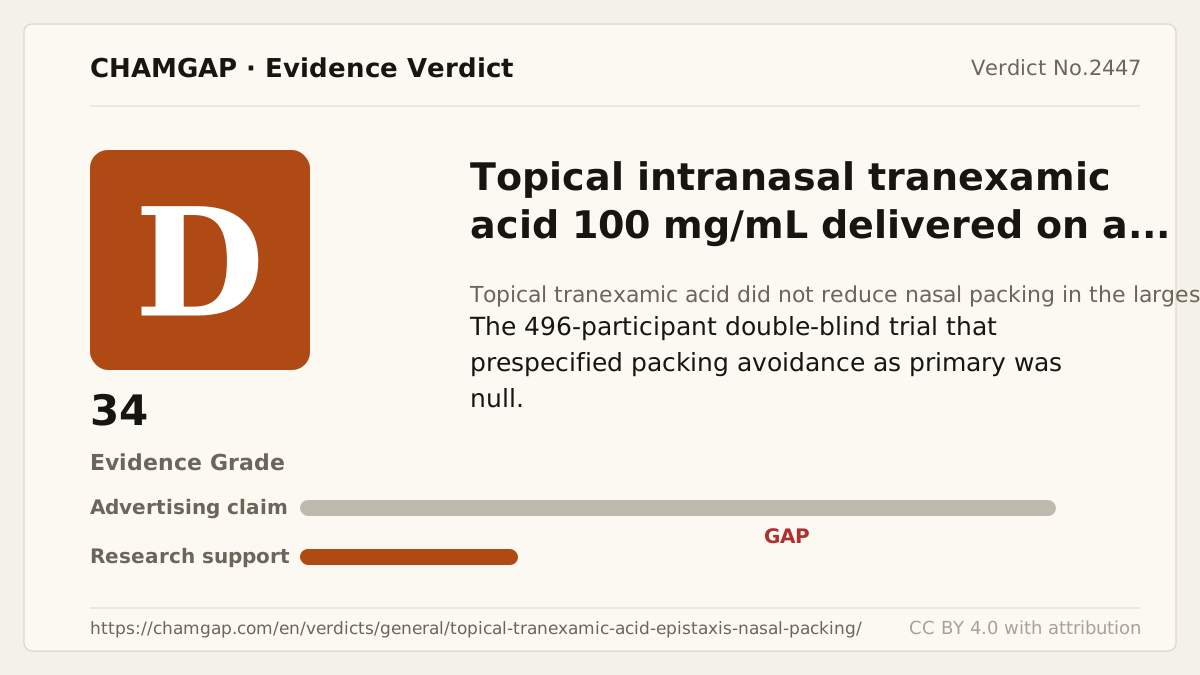
[Chamgap] Topical tranexamic acid for epistaxis x reduced need for nasal packing — Evidence Grade D·34. 6 cited sources checked. Source: https://chamgap.com/en/verdicts/general/topical-tranexamic-acid-epistaxis-nasal-packing/ · CC BY 4.0CC BY 4.0 — free to use with attribution; do not distort grades, numbers, or verdict meaning.
What this document does and does not do
Chamgap is an information source. It reports what research has and has not confirmed; it does not tell readers what to take or buy. That decision belongs to readers and, when needed, medical or legal professionals. This verdict reflects literature available up to the search date and may change as new research appears. Nothing here is medical advice.