
Tailored smoking-cessation texts,
does it really help with Increased biochemically verified continuous abstinence at six months?
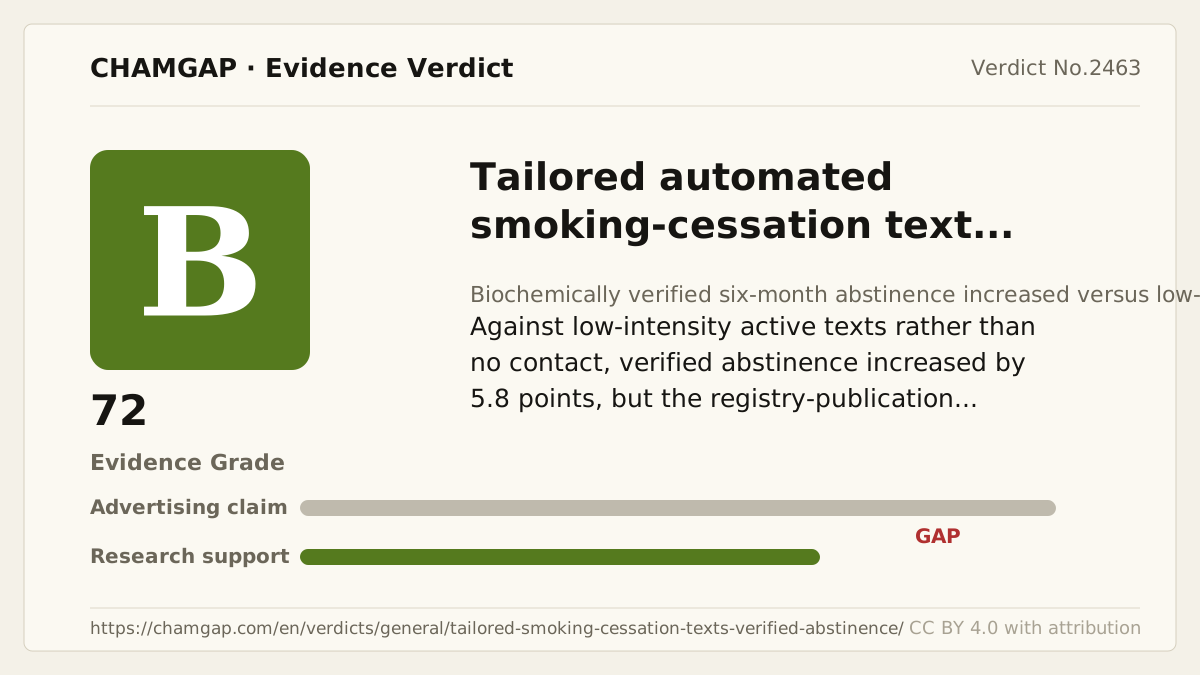
research showsThe grade is B. The UK txt2stop trial randomized 5,800 smokers to tailored cessation texts or low-intensity active texts about study participation every two weeks, not to no treatment. Biochemically verified six-month continuous abstinence was 10.7% versus 4.9%, RR 2.20 (95% CI 1.80 to 2.68), an absolute gain of 5.8 points. The avoidable mismatch between the registered and published control descriptions lowers the verdict to B with 72 points.
ads claimKorea's free national quitline and No Smoke Guide provide tailored phone, social-message, email, and chat support, so they are not identical to automated txt2stop alone. Verdict 633 is A with 88 points for varenicline, verdict 641 is A with 90 points for nicotine replacement, verdict 1243 is B with 74 points for bupropion, verdict 1712 is B with 72 points for nicotine e-cigarettes, verdict 1670 is D with 28 points for acupuncture, and verdict 2361 is B with 72 points for smoking cessation and mortality. Each addresses a different intervention or endpoint.
Useful facts when choosing a product
- The intervention sent five texts daily for five weeks and three weekly for the next 26 weeks.
- Controls received active participation texts every two weeks.
- Abstinence was verified with salivary cotinine at 7 ng/mL or exhaled CO at 6 ppm.
What the research actually shows
Participants set a quit date within two weeks and received five texts daily for five weeks, then three weekly for 26 weeks. Messages were tailored to age, sex, ethnicity, and concerns such as weight gain; CRAVE triggered immediate coping support and LAPSE triggered three recovery messages. The program encouraged quitline and nicotine-replacement use. Controls were active, receiving brief fortnightly messages about study participation and contact details; both groups received quitline numbers and could use other cessation support. Eight duplicate randomizations were excluded, leaving 2911 versus 2881, with primary outcomes available for 5524 (95%). Postal salivary cotinine at 7 ng/mL was primary verification, with in-person exhaled CO at 6 ppm when saliva was unavailable. The acknowledgments name the UK Medical Research Council, Cancer Research UK, and Primary Care Research Networks.
Why this is classified as B (72)
A publicly funded 5,800-participant trial found a 5.8-point increase in biochemically verified abstinence, but the ISRCTN80978588 control description does not match the paper and only one confirmatory trial supports the program, giving B with 72 points.
Counterpoint. The estimate is added support from the program, not a drug-free or counseling-free isolated effect.
Rejudgment record. Cross-check applied — Biochemically verified six-month abstinence with a 5.8-point absolute increase, low-intensity active control, and mismatch between ISRCTN80978588 smoking-harm texts and the paper's participation texts
| Endpoint | H | Hard endpoint - actual events such as death |
| Replication | R1 | Single confirmatory trial |
| Independence | I2 | Decisive evidence is publicly or non-profit funded |
| Effect size | E+ | Meets the clinically important threshold |
The scoring table and the verdict agree (B).
Sub-claim grades by effect
This ingredient is marketed for several effects. A single overall grade blends strong and weak claims together, so each effect is graded separately here. The overall grade reflects the strongest disconfirming or core claim.
| Effect (sub-claim) | Grade | Basis |
|---|---|---|
| Biochemically verified continuous abstinence at six months | B | Rates were 10.7% versus 4.9%, an absolute difference of 5.8 points. |
| Abstinence counting loss to follow-up as smoking | B | Rates were 9% versus 4%, RR 2.14, preserving the conclusion. |
Cross-check — Codex and Claude
Evidence Table
| Study | Design | Sample | Funding | Endpoint | Result | Weight |
|---|---|---|---|---|---|---|
| Study 1 | Single-blind randomized low-intensity active-text controlled trial | 5,524 | UK Medical Research Council, Cancer Research UK, and Primary Care Research Networks | Primary: biochemically verified self-reported continuous abstinence at six months | 10.7% versus 4.9%, RR 2.20 (95% CI 1.80 to 2.68), absolute difference 5.8 points; missing=smoking 9% versus 4%, RR 2.14 (1.74 to 2.63) | Pivotal large publicly funded trial |
Receipt — 3 References
All 3 cited sources were verified for existence at the original page (as of 2026-08-08).
Reviewed and approved: Chamgap Editorial Team · Approval date: 2026-08-08 · Corrections: none
Cite this verdict
[Chamgap] Tailored smoking-cessation texts x quitting success — Evidence Grade B·72. 3 cited sources checked. Source: https://chamgap.com/en/verdicts/general/tailored-smoking-cessation-texts-verified-abstinence/ · CC BY 4.0CC BY 4.0 — free to use with attribution; do not distort grades, numbers, or verdict meaning.
What this document does and does not do
Chamgap is an information source. It reports what research has and has not confirmed; it does not tell readers what to take or buy. That decision belongs to readers and, when needed, medical or legal professionals. This verdict reflects literature available up to the search date and may change as new research appears. Nothing here is medical advice.