
Sustained-inflation resuscitation,
does it really help with Reduced bronchopulmonary dysplasia or death at 36 weeks in extremely preterm infants?
research showsThe grade is D. In the 426-infant primary analysis of SAIL, bronchopulmonary dysplasia or death at 36 weeks occurred in 137/215 (63.7%) with sustained inflation versus 125/211 (59.2%) with standard resuscitation. The adjusted absolute difference was +4.7 percentage points (95% CI -3.8 to 13.1), P=.29, so the primary efficacy endpoint did not improve. Moreover, the prespecified safety endpoint of death before 48 hours increased to 16/215 versus 3/211, adjusted absolute difference +5.6 points (95% CI 2.1 to 9.1), P=.002, and recruitment closed for harm detected by the preplanned early-death analysis, giving D with 30 points.
ads claimA physiological story about recruiting lung volume faster cannot be translated into better survival or less bronchopulmonary dysplasia. The trial did not improve the 36-week composite and stopped under its safety-monitoring rule after an early-death signal.
Useful facts when choosing a product
- The strategy delivered up to two 15-second inflations at a maximum peak pressure of 25 cmH2O through a T-piece and mask.
- The planned sample was 600, while the primary analysis included 426 infants.
- Death before 48 hours was a prespecified safety endpoint.
What the research actually shows
The trial ran in 18 neonatal intensive care units across nine countries and enrolled infants born at 23 to 26 weeks. Although 460 infants underwent randomization, 34 were excluded after deferred-consent refusal or related reasons, leaving 215 sustained-inflation and 211 standard-resuscitation infants, 426 total, in the analysis. The primary efficacy endpoint of bronchopulmonary dysplasia or death at 36 weeks was 137/215 (63.7%) versus 125/211 (59.2%), adjusted difference +4.7 points (95% CI -3.8 to 13.1), P=.29, showing no benefit. There were 27 prespecified secondary efficacy outcomes and 7 safety outcomes, including death before 48 hours, and a priori stopping rules for adverse events and efficacy. Death before 48 hours was therefore a prespecified safety endpoint, not a post hoc observation: 16/215 versus 3/211, adjusted difference +5.6 points (95% CI 2.1 to 9.1), P=.002, adjusted RR 4.7 (1.4 to 16.2). Recruitment closed for harm detected by the preplanned analysis of early deaths. Blinded adjudication identified early deaths possibly attributable to resuscitation in 11/16 versus 1/3. The study was funded by the public NICHD grant U01HD072906, and Fisher-Paykel donated face masks used for resuscitation during the trial.
Why this is classified as D (30)
An international randomized trial mixing public grant funding with company-donated trial supplies showed no primary efficacy benefit and significantly increased prespecified early death, with recruitment closed after a preplanned harm analysis, giving D with 30 points.
Counterpoint. D means the beneficial respiratory-support claim was not supported. It does not mean the stopping process was unplanned.
Rejudgment record. Cross-check applied — Separates the null death-or-BPD primary composite from the significant prespecified 48-hour mortality safety signal and accounts for public funding, company-donated trial supplies, and harm-driven recruitment closure after a preplanned analysis
| Endpoint | H | Hard endpoint - actual events such as death |
| Replication | R1 | Single confirmatory trial |
| Independence | I1 | Mixed funding sources |
| Effect size | E- | Harm increased in the trials |
| Precision | C0 | The confidence interval leaves room for benefit |
The scoring table and the verdict agree (D).
Sub-claim grades by effect
This ingredient is marketed for several effects. A single overall grade blends strong and weak claims together, so each effect is graded separately here. The overall grade reflects the strongest disconfirming or core claim.
| Effect (sub-claim) | Grade | Basis |
|---|---|---|
| Reduced bronchopulmonary dysplasia or death | D | There was no benefit, 63.7% versus 59.2%. |
| Reduced death before 48 hours | D | It increased significantly, 16 versus 3 deaths. |
Cross-check — Codex and Claude
Evidence Table
| Study | Design | Sample | Funding | Endpoint | Result | Weight |
|---|---|---|---|---|---|---|
| Study 1 | Unmasked randomized resuscitation trial in 18 NICUs across nine countries | 211 | Public NICHD grant U01HD072906; Fisher-Paykel donation of face masks during the trial | Bronchopulmonary dysplasia or death at 36 weeks; prespecified safety endpoint of death before 48 hours | Composite 137/215 (63.7%) versus 125/211 (59.2%), adjusted difference +4.7 points (-3.8 to 13.1), P=.29; death before 48 hours 16/215 versus 3/211, adjusted difference +5.6 points (2.1 to 9.1), P=.002 | Hard-outcome trial mixing public funding and company-donated supplies; null primary benefit and recruitment closure for harm in a preplanned analysis |
Receipt — 1 References
All 1 cited sources were verified for existence at the original page (as of 2026-08-18).
Reviewed and approved: Chamgap Editorial Team · Approval date: 2026-08-18 · Corrections: none
Cite this verdict
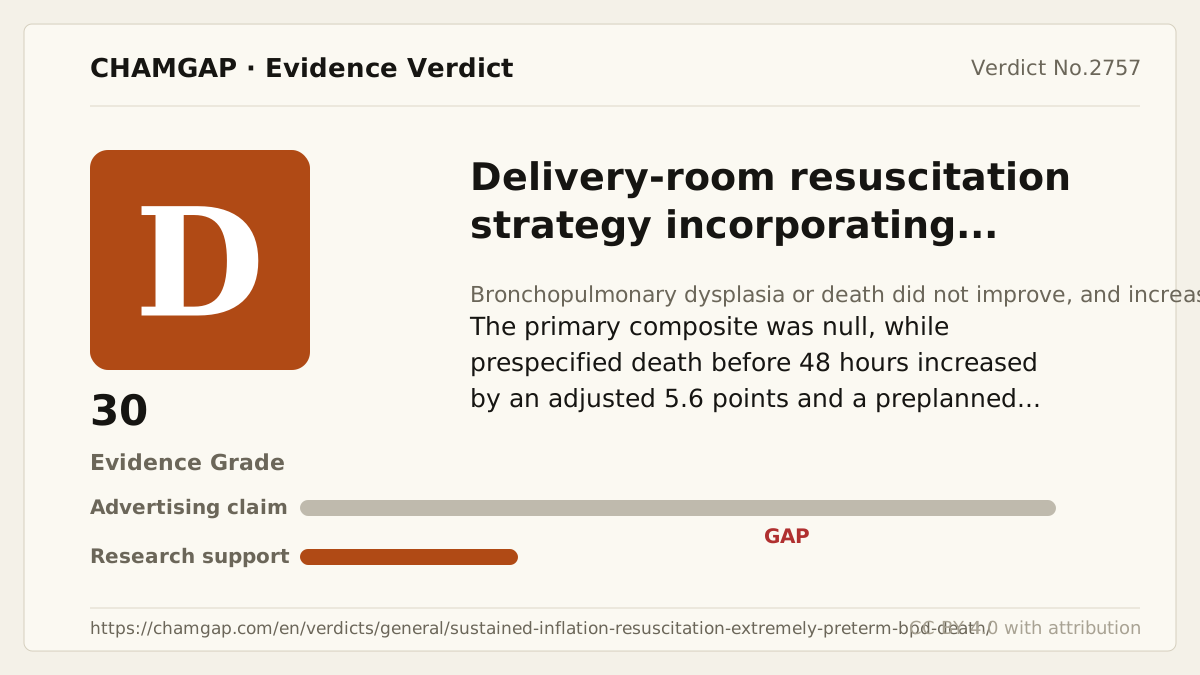
[Chamgap] Sustained-inflation resuscitation x bronchopulmonary dysplasia or death in extremely preterm infants — Evidence Grade D·30. 1 cited sources checked. Source: https://chamgap.com/en/verdicts/general/sustained-inflation-resuscitation-extremely-preterm-bpd-death/ · CC BY 4.0CC BY 4.0 — free to use with attribution; do not distort grades, numbers, or verdict meaning.
What this document does and does not do
Chamgap is an information source. It reports what research has and has not confirmed; it does not tell readers what to take or buy. That decision belongs to readers and, when needed, medical or legal professionals. This verdict reflects literature available up to the search date and may change as new research appears. Nothing here is medical advice.