
Sentinel-node-navigated neck surgery strategy,
does it really help with Noninferior three-year overall survival in clinically node-negative early oral cancer?
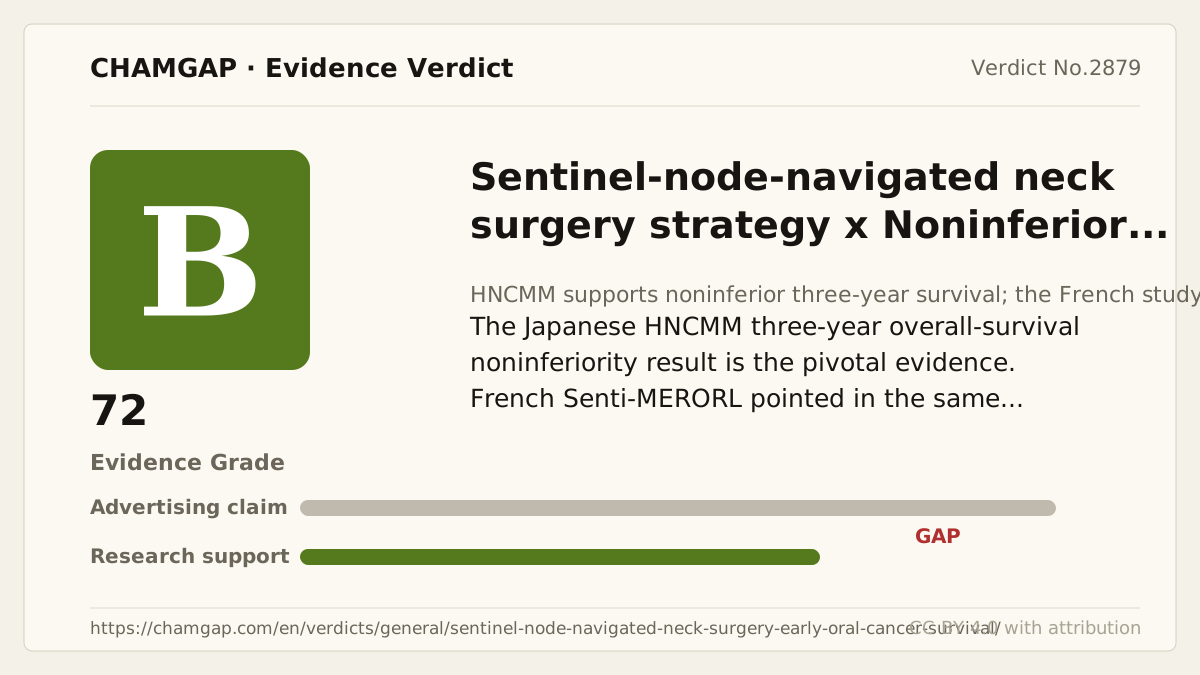
research showsThe grade is B. Three-year overall survival was 87.9% (one-sided 95% lower limit 82.4%) versus 86.6% (lower limit 80.9%), absolute difference +1.3 points, noninferiority P<0.001. The French Senti-MERORL trial found a result in the same direction, but its primary endpoint was two-year neck recurrence, so this verdict counts one confirmatory trial.
ads claimThis strategy does not omit surgery altogether; a positive sentinel node leads to neck dissection.
Useful facts when choosing a product
- Funding was 'a Health and Labour Sciences Research Grant ... from the Ministry of Health, Labour and Welfare of Japan.'
- Individual company relationships were disclosed, but trial funding was public.
- Korean oral-cancer surgical guidance lists sentinel-node biopsy as an alternative to elective neck dissection.
What the research actually shows
HNCMM excluded 4/275=1.45% from the FAS, below the 15% substantial-attrition threshold. French Senti-MERORL found two-year neck recurrence-free survival of 90.7% versus 89.6% and neck recurrence 13/140 versus 14/139, equivalence P<0.01, in the same direction. However, its primary endpoint was two-year neck recurrence, so this verdict counts one confirmatory trial. HNCMM's three-year overall survival and Senti-MERORL's two-year neck recurrence differ in duration, and all-cause death and neck recurrence are not comparable estimands. Overall survival includes second cancers and non-cancer deaths, while neck recurrence directly measures success of the neck-management strategy. The author lists had zero overlap and funding was independently Japanese and French, but comparability gates ① and ② are not met.
Axis 6 defect gates ① Defect: noninferiority/equivalence design. ② Listed item: noninferiority design. ③ Evidence: 'randomized, multicenter, and noninferiority trial' and the declared 12% clinically acceptable difference; the French trial was an equivalence trial. ④ Avoidable: yes; superiority was methodologically possible, although noninferiority fits a de-escalation question.
Attrition was 4/275=1.45%, below 15%, and is not counted.
Why this is classified as B (72)
H, R1, I2, and E+ provide three strength axes; with the B1 noninferiority-design ceiling, the result is B with 72 points.
Counterpoint. Equivalence is not proof of identity and requires experienced multidisciplinary teams.
Rejudgment record. Cross-check applied — Counted the publicly funded HNCMM three-year overall-survival noninferiority study as one confirmatory trial and retained the French neck-recurrence result as supporting evidence because endpoint and duration differ
| Endpoint | H | Hard endpoint - actual events such as death |
| Replication | R1 | Single confirmatory trial |
| Independence | I2 | Decisive evidence is publicly or non-profit funded |
| Effect size | E+ | Meets the clinically important threshold |
The scoring table and the verdict agree (B).
Sub-claim grades by effect
This ingredient is marketed for several effects. A single overall grade blends strong and weak claims together, so each effect is graded separately here. The overall grade reflects the strongest disconfirming or core claim.
| Effect (sub-claim) | Grade | Basis |
|---|---|---|
| Noninferior three-year overall survival | B | Rates were 87.9% versus 86.6%, noninferiority P<0.001. |
| Equivalent two-year neck recurrence outcome | B | The independent French trial found equivalence, P<0.01. |
Cross-check — Codex and Claude
Evidence Table
| Study | Design | Sample | Funding | Endpoint | Result | Weight |
|---|---|---|---|---|---|---|
| Study 1 | Japanese multicenter randomized noninferiority surgical trial | 271 | Health and Labour Sciences Research Grant from Japan's Ministry of Health, Labour and Welfare | Primary endpoint: three-year overall survival | 87.9% (one-sided 95% lower limit 82.4%) versus 86.6% (lower limit 80.9%), absolute difference +1.3 points, noninferiority P<0.001; CI for the between-group difference not reported. | Pivotal publicly funded survival trial |
| Study 2 | French multicenter randomized equivalence surgical trial | 139 | French National Institute of Cancer STIC 2007 | Primary endpoint: equivalence in two-year neck-node recurrence-free survival/neck recurrence | 90.7% versus 89.6%; neck recurrence 13/140 (9.3%) versus 14/139 (10.1%), absolute difference -0.8 points, equivalence P<0.01. | Independent French supporting evidence not counted as confirmatory because the endpoint differs |
Receipt — 2 References
All 2 cited sources were verified for existence at the original page (as of 2026-08-18).
Reviewed and approved: Chamgap Editorial Team · Approval date: 2026-08-18 · Corrections: none
Cite this verdict
[Chamgap] Benefit of Sentinel-Node-Navigated Neck Surgery for Noninferior 3-Year Survival in Clinically Node-Negative Early Oral Cancer — Evidence Grade B·72. 2 cited sources checked. Source: https://chamgap.com/en/verdicts/general/sentinel-node-navigated-neck-surgery-early-oral-cancer-survival/ · CC BY 4.0CC BY 4.0 — free to use with attribution; do not distort grades, numbers, or verdict meaning.
What this document does and does not do
Chamgap is an information source. It reports what research has and has not confirmed; it does not tell readers what to take or buy. That decision belongs to readers and, when needed, medical or legal professionals. This verdict reflects literature available up to the search date and may change as new research appears. Nothing here is medical advice.