
School-supervised fluoride toothbrushing,
does it really help with Reduced increment in new carious tooth surfaces or DMFS among children?
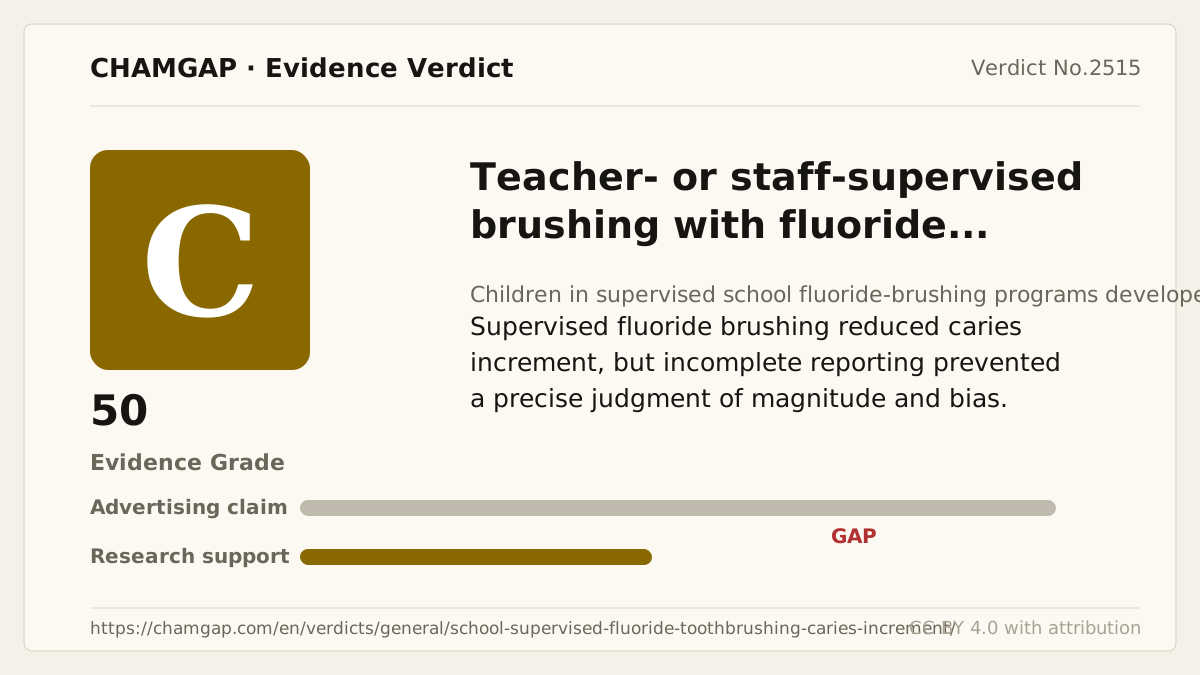
research showsThe grade is C. Curnow assessed 428 children and reported D1 increments of 0.81 versus 1.19 and D3 increments of 0.21 versus 0.48. Jackson analyzed 181 versus 189 children and found 2.60 versus 2.92 overall carious surfaces, 10.9% lower. Cluster-adjusted estimates and confidence intervals were unavailable, leaving magnitude EX. Unverified funding was not inferred, giving C with 50 points.
ads claimEvidence that fluoride toothpaste prevents caries in general is broader than evidence for the incremental effect of adding school supervision to home care. A roughly 11% relative reduction must not be advertised as near-elimination of cavities.
Useful facts when choosing a product
- Curnow used 1,000 ppm fluoride toothpaste; Jackson used a commercial 1,450 ppm fluoride toothpaste.
- Jackson's program used once-daily teacher-supervised brushing on school days.
- No duplicate of school-supervised fluoride brushing by caries increment was found in the existing verdict list.
What the research actually shows
Both studies had school-level allocation features, but allocation concealment, examiner blinding, cluster-adjusted analysis, and prospective registration concordance were not fully established. Curnow retained 428 of 534 children, with D1 increments of 0.81 versus 1.19 and D3 increments of 0.21 versus 0.48. Nicholson, Chesters, and Huntington were affiliated with Unilever Dental Research in the paper. Jackson's completer analysis included 181 versus 189. Funding was not verified and was not inferred.
Why this is classified as C (50)
The studies measured actual new caries and pointed in the same direction. Yet funding for a second independent program was not verified, and arm denominators, cluster-adjusted confidence intervals, and full tables needed for standardized magnitude could not be recovered from the public record. Attrition and completer analysis add limitations. One hard-outcome strength gives C with 50 points.
Counterpoint. This C grade does not deny the much broader evidence that fluoride toothpaste itself prevents caries; it addresses the incremental effect of a school-supervised program.
Rejudgment record. Cross-check applied — We cross-checked public primary abstracts and an independent systematic review for recruitment, endpoint samples, caries increments, completer analysis, and unreported items.
| Endpoint | H | Hard endpoint - actual events such as death |
| Replication | R1 | Single confirmatory trial |
| Independence | I1 | Mixed funding sources |
| Effect size | EX | The clinical size of the effect could not be judged |
The scoring table and the verdict agree (C).
Sub-claim grades by effect
This ingredient is marketed for several effects. A single overall grade blends strong and weak claims together, so each effect is graded separately here. The overall grade reflects the strongest disconfirming or core claim.
| Effect (sub-claim) | Grade | Basis |
|---|---|---|
| School-supervised fluoride toothbrushing reduces caries increment in children. | C | Two studies favored the intervention, but funding, precision, and completer-analysis limitations remain. |
Cross-check — Codex and Claude
Evidence Table
| Study | Design | Sample | Funding | Endpoint | Result | Weight |
|---|---|---|---|---|---|---|
| Study 1 | Randomized school-supervised brushing trial in high-caries-risk children | 428 | Primary-paper funding and acknowledgments not verified; Nicholson, Chesters, and Huntington were affiliated with Unilever Dental Research | Permanent-molar and overall caries increment | D1 caries increment 0.81 versus 1.19; D3 0.21 versus 0.48; between-group CIs not verified | Directionally supportive trial with substantial attrition and precision limitations |
| Study 2 | School-cluster allocated supervised-brushing clinical trial | 189 | Primary-paper funding not verified | Overall dmfs plus DMFS and proximal-surface caries increment over about 21 months | Overall 2.60 versus 2.92 surfaces, 10.9% lower, P<.001; proximal surfaces 0.78 versus 1.03, P<.01; CI not reported | Pivotal positive trial limited by completer analysis and unverified cluster adjustment |
Receipt — 2 References
Of 2 cited sources, 1 had limited original-page access (blocked or summary-only) and were verified via index/summary, marked partial; the rest were verified at the original page. As of 2026-08-14.
Reviewed and approved: Chamgap Editorial Team · Approval date: 2026-08-14 · Corrections: none
Cite this verdict
[Chamgap] School-supervised fluoride toothbrushing x reduced childhood caries increment — Evidence Grade C·50. 2 cited sources checked. Source: https://chamgap.com/en/verdicts/general/school-supervised-fluoride-toothbrushing-caries-increment/ · CC BY 4.0CC BY 4.0 — free to use with attribution; do not distort grades, numbers, or verdict meaning.
What this document does and does not do
Chamgap is an information source. It reports what research has and has not confirmed; it does not tell readers what to take or buy. That decision belongs to readers and, when needed, medical or legal professionals. This verdict reflects literature available up to the search date and may change as new research appears. Nothing here is medical advice.