
Professional oral care,
does it really help with Prevention of pneumonia among nursing-home residents?
research showsThe grade is D. An older Japanese multicomponent trial found pneumonia in 11.4% versus 18.7%, but a US trial of 834 residents was null for first pneumonia, HR 1.12 (95% CI 0.84 to 1.50), and a 2,152-resident facility trial was null over two years, IRR 0.90. The later large trials did not establish a pneumonia-prevention effect, giving D with 34 points.
ads claimImproving oral hygiene and preventing pneumonia are distinct claims. Mouth care remains essential basic care, but a pneumonia-prevention effect was not established and should not be advertised as proven.
Useful facts when choosing a product
- Bundles ranged from brushing to chlorhexidine, feeding posture, and dedicated staff.
- Zimmerman improved oral and denture hygiene over two years but not the pneumonia primary outcome.
- Tongue, gums, dentures, and oral mucosa may require care even without natural teeth.
What the research actually shows
The Japanese bundle combined brushing after meals, optional povidone-iodine swabbing, and weekly dental-professional care. Juthani-Mehta combined twice-daily tooth and gum brushing, 0.12% chlorhexidine, and upright feeding. Zimmerman used staff training, supplies, and a dedicated oral-care aide. The independently authored publicly funded studies differed in intervention, first-pneumonia hazard, cumulative risk, and incidence-rate estimands. Early futility stopping, open care, record-based diagnosis, and emphasis on a post hoc year-one result further limit interpretation.
Why this is classified as D (34)
Independent publicly funded studies reported usable event counts and effect estimates. An early positive multicomponent trial was followed by two large null full-follow-up trials, supporting E0; imprecision and design/reporting limitations support C0, giving D with 34 points.
Counterpoint. D with 34 points does not negate comfort, dental, or periodontal benefits of mouth care. It means the separate pneumonia-prevention effect was not established in human trials.
Rejudgment record. New verdict — Usable event counts and estimates from an early positive multicomponent trial and two large null full-follow-up trials, supporting E0 with C0
| Endpoint | H | Hard endpoint - actual events such as death |
| Replication | R1 | Single confirmatory trial |
| Independence | I2 | Decisive evidence is publicly or non-profit funded |
| Effect size | E0 | Null |
| Precision | C0 | The confidence interval leaves room for benefit |
The scoring table and the verdict agree (D).
Sub-claim grades by effect
This ingredient is marketed for several effects. A single overall grade blends strong and weak claims together, so each effect is graded separately here. The overall grade reflects the strongest disconfirming or core claim.
| Effect (sub-claim) | Grade | Basis |
|---|---|---|
| Pneumonia prevention with structured professional oral care | D | An early positive trial was followed by two large null full-follow-up results. |
| Two-year pneumonia prevention with Mouth Care Without a Battle | D | The two-year primary result was IRR 0.90, P=.27. |
| Improved oral and denture hygiene | B | The Zimmerman program improved hygiene measures at 24 months. |
Cross-check — Codex and Claude
Evidence Table
| Study | Design | Sample | Funding | Endpoint | Result | Weight |
|---|---|---|---|---|---|---|
| Study 1 | Randomized clinical trial across 11 nursing homes | 366 | Japan Welfare Ministry Comprehensive Research on Aging and Health, 1999-2000 | Pneumonia occurrence over about two years | 21/184 (11.4%) versus 34/182 (18.7%) | Early positive publicly funded trial with post-assignment exclusions |
| Study 2 | Cluster-randomized trial in 36 nursing homes | 400 | NIH/NIA grants K23AG028691, R01AG030575, K07AG030093, and P30AG021342 | First radiographically confirmed pneumonia | 119/434 (27.4%) versus 94/400 (23.5%), HR 1.12 (95% CI 0.84 to 1.50); stopped early for futility | Large publicly funded null trial |
| Study 3 | Matched-pair pragmatic cluster-randomized trial in 14 nursing homes | 933 | Agency for Healthcare Research and Quality grant R01HS022298 | Primary: pneumonia incidence over two years | 0.67 versus 0.72 per 1,000 resident-days; unadjusted IRR 0.90 (one-sided 95% upper bound 1.24), P=.27; year-one analysis was post hoc | Large publicly funded null full-follow-up trial |
Receipt — 4 References
All 4 cited sources were verified for existence at the original page (as of 2026-08-14).
Reviewed and approved: Chamgap Editorial Team · Approval date: 2026-08-14 · Corrections: none
Cite this verdict
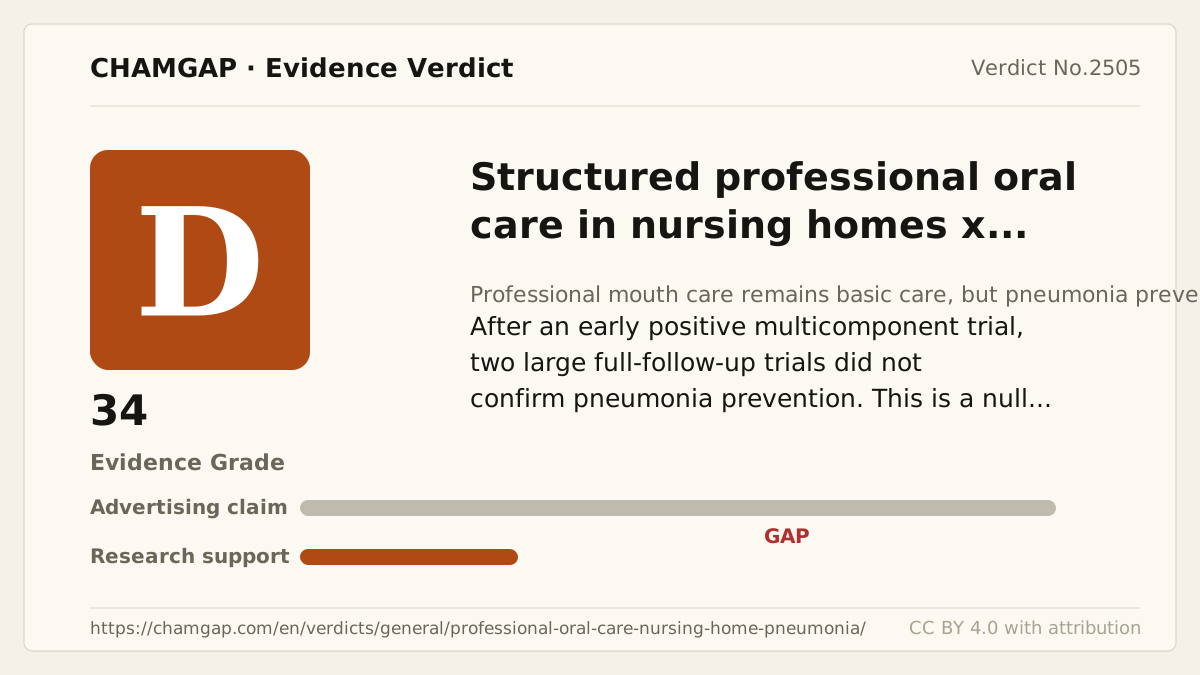
[Chamgap] Professional oral care x pneumonia prevention in nursing homes — Evidence Grade D·34. 4 cited sources checked. Source: https://chamgap.com/en/verdicts/general/professional-oral-care-nursing-home-pneumonia/ · CC BY 4.0CC BY 4.0 — free to use with attribution; do not distort grades, numbers, or verdict meaning.
What this document does and does not do
Chamgap is an information source. It reports what research has and has not confirmed; it does not tell readers what to take or buy. That decision belongs to readers and, when needed, medical or legal professionals. This verdict reflects literature available up to the search date and may change as new research appears. Nothing here is medical advice.