
Preterm formula powder used to fortify human milk,
does it really help with Noninferiority to commercial human milk fortifier for in-hospital weight-gain velocity in very-low-birth-weight preterm infants?
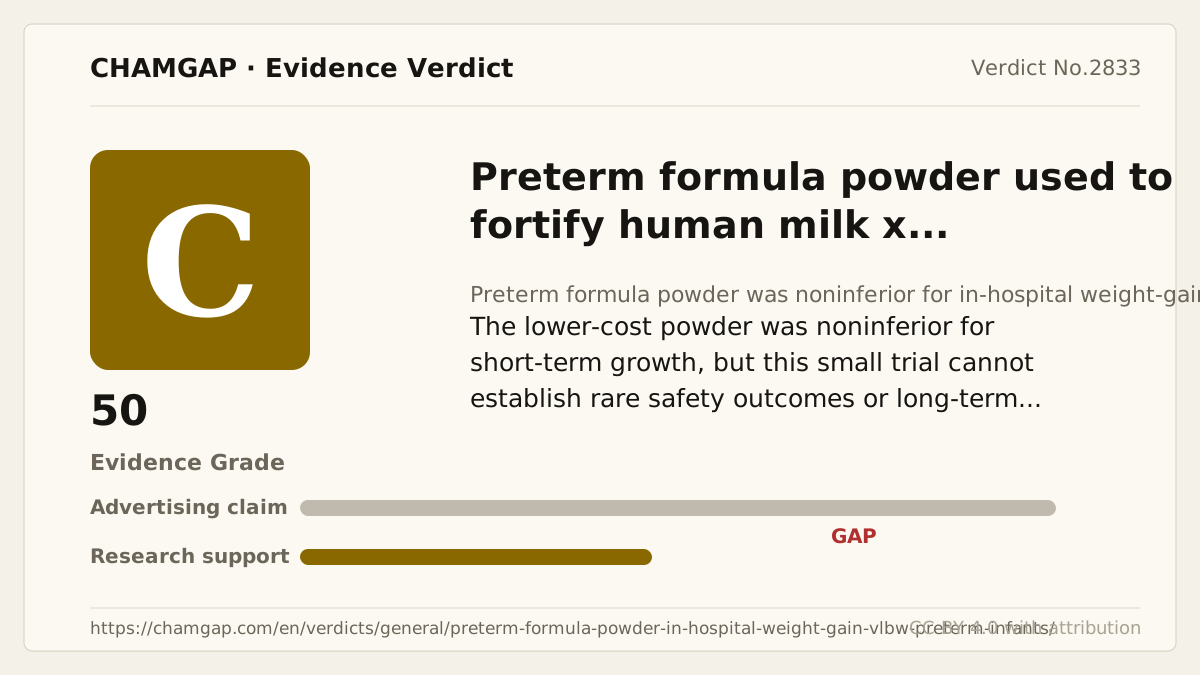
research showsThe grade is C with 50 points. In a 123-infant single-center Indian trial, in-hospital weight-gain velocity was 15.7 versus 16.3 g/kg/day, difference -0.5 g/kg/day (95% CI -1.9 to 0.7). The lower bound remained above the prespecified -2 g/kg/day margin, but growth velocity is a surrogate rather than a clinical event or long-term developmental outcome.
ads claimThis was a resource-constrained Indian single-center trial. Korean NICUs generally use commercial human milk fortifier as standard care, so different product composition, sterile preparation, micronutrient supplementation, and infection-control systems limit direct transfer.
Useful facts when choosing a product
- The formula-powder arm also received calcium, phosphorus, iron, vitamin D, and multivitamins; the HMF arm received vitamin D.
- The available products used were Dexolac Special Care and PreNAN.
- Extrauterine growth restriction at 40 weeks was 73% versus 81%; long-term neurodevelopment was not measured.
What the research actually shows
One level-3 neonatal unit in Delhi randomized 123 infants born at no more than 34 weeks and weighing under 1,500 g, 60 versus 63; 59 versus 63 entered the primary analysis. Limitation 1: noninferiority design. Which listed item: noninferiority design. Was it avoidable: yes - superiority could test increased growth, but investigators chose whether the low-cost substitute was no more than 2 g/kg/day worse. Limitation 2: small study. Which listed item: small study, total below 200; actual total was 123. Was it avoidable: yes - multicenter recruitment above 200 could improve precision for growth and uncommon harms. Short term under 12 weeks was not separately counted because discharge growth was the target endpoint. Open-label subjective outcome was not applicable because calibrated scales measured objective weight. Active comparator only was unavoidable because withholding standard fortification would inadequately meet these infants' nutritional needs. The article states that no external funding was received and does not report product provision; no external funding is not public funding.
Why this is classified as C (50)
The trial met a prespecified 2 g/kg/day margin, but the primary endpoint was a growth surrogate, and evidence comes from one 123-infant noninferiority trial without confirmed public funding. This gives C with 50 points.
Counterpoint. Formula powder is not interchangeable with HMF as a product. The intervention included separate micronutrient supplementation and specific preparation, and equivalence for rare serious harms or development was not shown.
Rejudgment record. Article and registry cross-check — Surrogate growth velocity, one 123-infant noninferiority trial, the prespecified -2 g/kg/day margin, no external funding, and safety events
| Endpoint | S | Surrogate marker - laboratory or imaging measures |
| Replication | R1 | Single confirmatory trial |
| Independence | I1 | Mixed funding sources |
| Effect size | E+ | Meets the clinically important threshold |
The scoring table and the verdict agree (C).
Sub-claim grades by effect
This ingredient is marketed for several effects. A single overall grade blends strong and weak claims together, so each effect is graded separately here. The overall grade reflects the strongest disconfirming or core claim.
| Effect (sub-claim) | Grade | Basis |
|---|---|---|
| Noninferiority for in-hospital weight-gain velocity | C | The -1.9 lower bound remained above the -2 g/kg/day margin. |
| Reduced feed intolerance | C | Rates were 1.4 versus 6.8 per 1,000 patient-days, a secondary outcome in a small open-label trial. |
| Safety for necrotizing enterocolitis and sepsis | ? | Few events and wide intervals prevent a firm safety conclusion. |
Cross-check — Codex and Claude
Evidence Table
| Study | Design | Sample | Funding | Endpoint | Result | Weight |
|---|---|---|---|---|---|---|
| Study 1 | Single-center open-label randomized noninferiority trial in India | 63 | No external funding; no trial-product provision reported | In-hospital weight-gain velocity in g/kg/day until discharge or 40 weeks' postmenstrual age | 15.7 versus 16.3 g/kg/day; difference -0.5 (95% CI -1.9 to 0.7); noninferiority margin -2 g/kg/day | Single small surrogate-endpoint noninferiority evidence |
Receipt — 1 References
All 1 cited sources were verified for existence at the original page (as of 2026-08-18).
Reviewed and approved: Chamgap Editorial Team · Approval date: 2026-08-18 · Corrections: none
Cite this verdict
[Chamgap] Preterm Formula Powder for In-Hospital Weight Gain in Very-Low-Birth-Weight Preterm Infants - Benefit — Evidence Grade C·50. 1 cited sources checked. Source: https://chamgap.com/en/verdicts/general/preterm-formula-powder-in-hospital-weight-gain-vlbw-preterm-infants/ · CC BY 4.0CC BY 4.0 — free to use with attribution; do not distort grades, numbers, or verdict meaning.
What this document does and does not do
Chamgap is an information source. It reports what research has and has not confirmed; it does not tell readers what to take or buy. That decision belongs to readers and, when needed, medical or legal professionals. This verdict reflects literature available up to the search date and may change as new research appears. Nothing here is medical advice.