
Financial incentives,
does it really help with Increased biochemically verified smoking cessation late in pregnancy?
research showsThe grade is B. Verified abstinence was 22.5% versus 8.6% in Scotland and continuous abstinence before delivery was 16% versus 7% in France. Both publicly led trials were positive, but their definitions and estimands differed. Smoking cessation is a patient-reported treatment goal rather than a hard clinical endpoint, giving B with 70 points.
ads claimThe claim that vouchers can help pregnant smokers quit is supported. Marketing should not describe cessation as a hard endpoint and must distinguish late-pregnancy point abstinence, continuous abstinence during pregnancy, and sustained postpartum cessation.
Useful facts when choosing a product
- The Scottish intervention added staged vouchers worth up to GBP400 to usual support.
- The French intervention added escalating abstinence rewards to attendance vouchers.
- Effectiveness of the identical protocol in Korea has not been established.
What the research actually shows
The Scottish single-region trial added up to GBP400 in vouchers to usual pregnancy cessation services; blinded helpline staff ascertained the primary outcome and unreachable participants were treated as smokers. The open-label French trial across 18 maternity wards added escalating abstinence-contingent vouchers and used the registered continuous-abstinence outcome with missing visits imputed as smoking. Authors and public institutions differed, but outcome definitions were not directly interchangeable.
Why this is classified as B (70)
Two publicly led randomized trials found more biochemically verified abstinence, but cessation is a patient-reported treatment goal (P), not a hard endpoint, and differing primary estimands were not counted as direct replication. Unconfirmed French allocation-concealment implementation gives B with 70 points.
Counterpoint. Biochemical verification improves reliability but does not turn abstinence into a hard clinical event. Acceptability, equity, and postpartum persistence require separate policy evidence.
Rejudgment record. New verdict — Biochemically verified abstinence gains, classification as a patient-reported treatment goal (P), and different primary estimands
| Endpoint | P | Patient-reported treatment goal - the symptom is the goal |
| Replication | R1 | Single confirmatory trial |
| Independence | I2 | Decisive evidence is publicly or non-profit funded |
| Effect size | E+ | Meets the clinically important threshold |
The scoring table and the verdict agree (B).
Sub-claim grades by effect
This ingredient is marketed for several effects. A single overall grade blends strong and weak claims together, so each effect is graded separately here. The overall grade reflects the strongest disconfirming or core claim.
| Effect (sub-claim) | Grade | Basis |
|---|---|---|
| Increased point abstinence at 34-38 weeks | B | Abstinence increased, 22.5% versus 8.6%. |
| Increased continuous abstinence during pregnancy | B | Continuous abstinence increased, 16% versus 7%. |
| Sustained postpartum abstinence | ? | This was not the pivotal primary outcome assessed here. |
Cross-check — Codex and Claude
Evidence Table
| Study | Design | Sample | Funding | Endpoint | Result | Weight |
|---|---|---|---|---|---|---|
| Study 1 | Single-center parallel-group randomized superiority trial | 1 | Primarily funded by the Scottish Government Chief Scientist Office, with additional support from Glasgow Centre for Population Health, Greater Glasgow and Clyde Health Board endowments, Yorkhill Children’s Charity, and the Royal Samaritan Endowment Fund | Cotinine-verified abstinence at 34-38 weeks | 69/306 (22.5%) versus 26/303 (8.6%), RR 2.63 (95% CI 1.73 to 4.01), absolute difference 14.0 points | Pivotal publicly funded trial of late-pregnancy point abstinence |
| Study 2 | Open-label multicenter randomized trial across 18 maternity wards | 229 | French National Cancer Institute (INCa) grant 2014-100, with logistical support from Assistance Publique-Hopitaux de Paris | Continuous abstinence from randomization through the last predelivery visit | 38/231 (16%) versus 17/229 (7%), OR 2.45 (95% CI 1.34 to 4.49) | Supportive trial using a different continuous-abstinence definition |
Receipt — 3 References
All 3 cited sources were verified for existence at the original page (as of 2026-08-14).
Reviewed and approved: Chamgap Editorial Team · Approval date: 2026-08-14 · Corrections: none
Cite this verdict
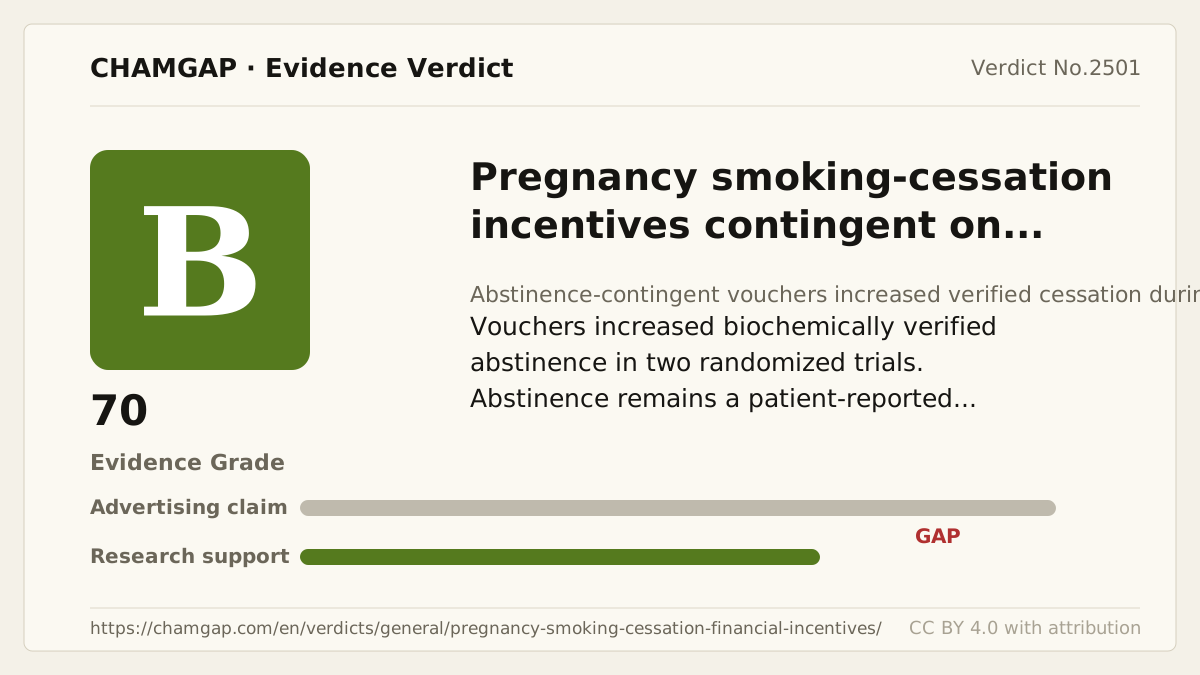
[Chamgap] Financial incentives x smoking cessation in pregnancy — Evidence Grade B·70. 3 cited sources checked. Source: https://chamgap.com/en/verdicts/general/pregnancy-smoking-cessation-financial-incentives/ · CC BY 4.0CC BY 4.0 — free to use with attribution; do not distort grades, numbers, or verdict meaning.
What this document does and does not do
Chamgap is an information source. It reports what research has and has not confirmed; it does not tell readers what to take or buy. That decision belongs to readers and, when needed, medical or legal professionals. This verdict reflects literature available up to the search date and may change as new research appears. Nothing here is medical advice.