
Plasma-Lyte 148,
does it really help with Reduced delayed graft function requiring dialysis within 7 days after deceased-donor kidney transplantation?
research showsThe grade is B with 76 points. In a double-blind trial at 16 Australian and New Zealand hospitals, dialysis within 7 days occurred in 30% with Plasma-Lyte 148 versus 40% with saline among 807 primary-analysis participants, 404 versus 403; adjusted RR 0.74 (95% CI 0.66–0.84), adjusted absolute risk difference -10.1 points (-16.6 to -3.5), P<0.0001. This met the prespecified clinically meaningful RR 0.75 and roughly 10-point absolute threshold.
ads claimIt is accurate to say saline was associated with about 10 points more dialysis within 7 days. The result does not establish lower long-term graft failure, mortality, or benefit in all critically ill patients.
Useful facts when choosing a product
- Trial fluid was used intraoperatively and for up to 48 hours after transplantation.
- Plasma-Lyte 148 and saline were supplied in indistinguishable packaging.
- Baxter supplied 930 boxes through an investigator-initiated grant.
What the research actually shows
A total of 856 were randomized; 48 whose transplant did not proceed were excluded as prespecified, leaving 808. One saline participant withdrew outcome use before day 7, so the actual primary analysis included 807 participants, 404 versus 403. Public and nonprofit awards were mixed with Baxter support; a Baxter investigator-initiated grant supplied 930 boxes of trial fluid worth US$36,270. Axis 6 B0 evidence ① Allocation concealment: "The list of unique study codes (treatment pack numbers) and treatment allocations ... are stored centrally in an external web-based randomization system ... and are not accessible to investigators, study staff, or staff at the ANZDATA Registry." ② Blinding: "Study participants, treating physicians and other healthcare providers, outcome assessors, research staff, study investigators ... and the primary trial statistician are blinded." ③ Prespecified analysis population: "participants will be included in the intention-to-treat analysis if they are randomized and receive a deceased donor kidney transplant within 48 h … Participants whose transplant does not proceed will be excluded" The 48 cancelled transplants were excluded, and 807 were analyzed after one participant withdrew outcome use. ④ Prespecified primary endpoint: "The primary outcome was DGF, defined as receiving dialysis within 7 days after transplantation." — consistent with ACTRN12617000358347 · NCT03829488
Why this is classified as B (76)
A large clinical-event trial met its prespecified threshold and documented central concealment, blinding, ITT analysis, and registry alignment; one pivotal mixed-support trial without independent replication gives B with 76 points.
Counterpoint. Serious adverse events were 3/406 (<1%) versus 5/409 (1%), with no increase in hyperkalemia.
Rejudgment record. Cross-check applied — Central web concealment, broad blinding, prespecified ITT analysis, and registry alignment were documented in a large hard-outcome trial that met the RR 0.75 and 10-point thresholds, but independent replication is absent
| Endpoint | H | Hard endpoint - actual events such as death |
| Replication | R1 | Single confirmatory trial |
| Independence | I1 | Mixed funding sources |
| Effect size | E+ | Meets the clinically important threshold |
The scoring table and the verdict agree (B).
Sub-claim grades by effect
This ingredient is marketed for several effects. A single overall grade blends strong and weak claims together, so each effect is graded separately here. The overall grade reflects the strongest disconfirming or core claim.
| Effect (sub-claim) | Grade | Basis |
|---|---|---|
| Reduced delayed graft function | B | Rates were 30% versus 40%, adjusted absolute difference -10.1 points. |
| Reduced graft failure or mortality at one year | D | Events were few and no clear difference was shown. |
Cross-check — Codex and Claude
Evidence Table
| Study | Design | Sample | Funding | Endpoint | Result | Weight |
|---|---|---|---|---|---|---|
| Study 1 | Pragmatic double-blind randomized trial at 16 hospitals | 403 | Australian MRFF and NHMRC, New Zealand HRC, RACP, and Baxter; Baxter supplied 930 boxes of fluid | Delayed graft function defined as dialysis within 7 days | 30% versus 40%; adjusted RR 0.74 (95% CI 0.66–0.84), adjusted absolute difference -10.1 points (-16.6 to -3.5), P<0.0001 | Pivotal large hard-outcome trial |
Receipt — 2 References
All 2 cited sources were verified for existence at the original page (as of 2026-08-18).
Reviewed and approved: Chamgap Editorial Team · Approval date: 2026-08-18 · Corrections: none
Cite this verdict
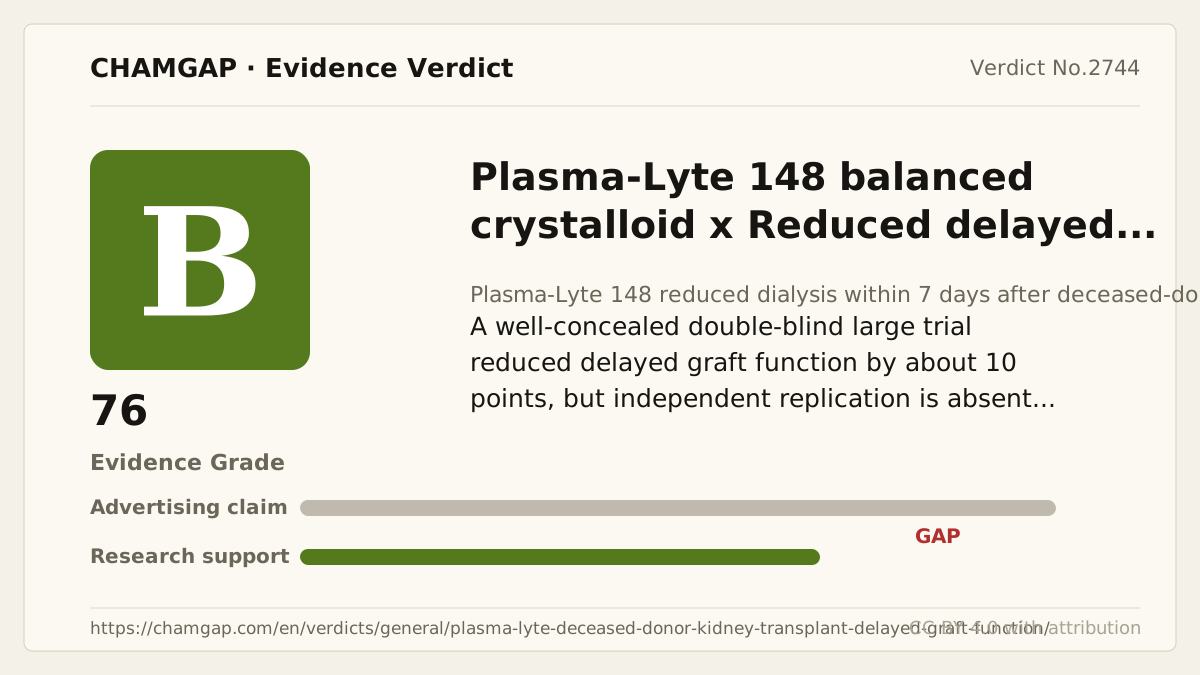
[Chamgap] Plasma-Lyte 148 x delayed graft function after deceased-donor kidney transplantation — Evidence Grade B·76. 2 cited sources checked. Source: https://chamgap.com/en/verdicts/general/plasma-lyte-deceased-donor-kidney-transplant-delayed-graft-function/ · CC BY 4.0CC BY 4.0 — free to use with attribution; do not distort grades, numbers, or verdict meaning.
What this document does and does not do
Chamgap is an information source. It reports what research has and has not confirmed; it does not tell readers what to take or buy. That decision belongs to readers and, when needed, medical or legal professionals. This verdict reflects literature available up to the search date and may change as new research appears. Nothing here is medical advice.