
Pembrolizumab plus chemotherapy,
does it really help with Prolonged overall survival in metastatic nonsquamous non-small-cell lung cancer?
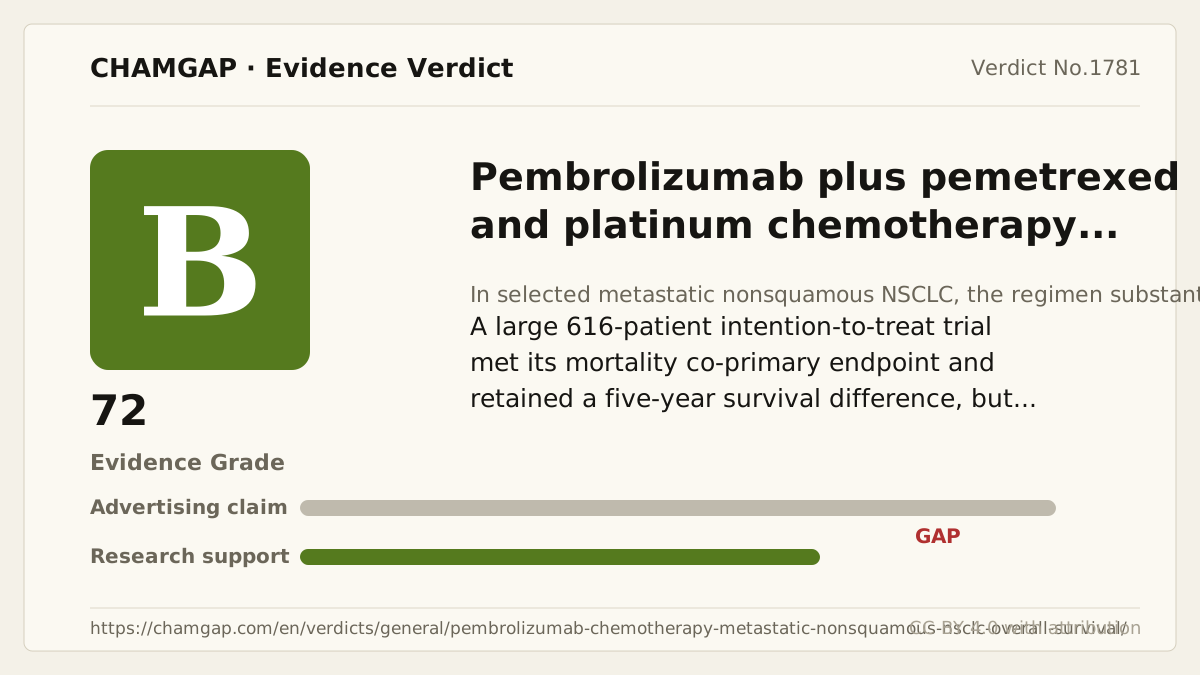
research showsThe grade is B with 72 points. KEYNOTE-189 randomized 616 patients and included all 616 in the primary intention-to-treat analysis, meeting both co-primary endpoints of overall and progression-free survival. Twelve-month survival was 69.2% versus 49.4%, with a death hazard ratio of 0.49 (95% CI 0.38 to 0.64; P<.001), and five-year survival remained 19.4% versus 11.3%. As a large prescription-drug RCT with death as a hard endpoint, the axis-3 manufacturer ceiling does not apply. However, the citations rest on KEYNOTE-189 alone (the primary report and five-year follow-up of the same trial), and the separate RCT KEYNOTE-021G was funded within the same Merck program with overall survival of 34.5 versus 21.1 months, HR 0.71 (95% CI 0.45 to 1.12), which is not statistically significant, so replication by different investigators and funders is not established. The axis-2 R1 cap limits the grade to B.
ads claimPromotion can imply a survival guarantee for every lung cancer regardless of histology, biomarkers, or genomic alterations. The evidence applies to selected first-line patients with metastatic nonsquamous NSCLC without sensitizing EGFR or ALK alterations.
Useful facts when choosing a product
- The trial regimen used pembrolizumab 200 mg every three weeks for up to 35 cycles, with pemetrexed plus cisplatin or carboplatin for four cycles followed by pemetrexed maintenance.
- The evidence population had metastatic nonsquamous NSCLC without sensitizing EGFR or ALK alterations.
- Immune-mediated toxicity, infusion reactions, myelosuppression, infection, and renal toxicity require oncology supervision.
What the research actually shows
Gandhi et al. randomized 616 previously untreated patients with metastatic nonsquamous NSCLC in a 2:1 ratio in 2018. All 616 were included in the intention-to-treat efficacy analysis, and both overall and progression-free survival co-primary endpoints succeeded. The five-year update retained overall survival rates of 19.4% versus 11.3% and progression-free survival rates of 7.5% versus 0.6%. MSD funded the study; Eli Lilly supplied pemetrexed and had no other study involvement. KEYNOTE-407 is independent supportive evidence in squamous NSCLC, a different histology, rather than independent replication. Sponsor concentration remains a limitation, but the manufacturer ceiling does not apply to a large randomized mortality trial.
Why this is classified as B (72)
A direct mortality co-primary endpoint succeeded in all 616 randomized patients with HR 0.49, and the survival difference persisted at five years. The large prescription-drug hard-endpoint RCT exception keeps the axis-3 manufacturer ceiling inapplicable. However, only one trial is cited (repeat reports of KEYNOTE-189), and the separate RCT KEYNOTE-021G was funded within the same Merck program with a nonsignificant OS HR of 0.71 (95% CI 0.45 to 1.12), so replication by different investigators and funders is not established. The axis-2 R1 cap sets the grade at B with 72 points.
Counterpoint. The causal effect and durability are strong, but follow-up from the same sponsor program is not independent replication and outcomes depend on patient selection and toxicity management.
Rejudgment record. Cross-check applied — Acknowledged the successful direct mortality co-primary endpoint in all 616 randomized patients and durable five-year survival, but applied the axis-2 R1 cap of B because the citations rest on KEYNOTE-189 alone (repeat reports of one trial) and replication by different investigators and funders is not established; the large prescription-drug hard-endpoint RCT exception keeps the axis-3 manufacturer ceiling inapplicable
| Endpoint | H | Hard endpoint - actual events such as death |
| Replication | R1 | Single confirmatory trial |
| Independence | I0 | Evidence comes only from manufacturer studies |
| Effect size | E+ | Meets the clinically important threshold |
The scoring table and the verdict agree (B).
Sub-claim grades by effect
This ingredient is marketed for several effects. A single overall grade blends strong and weak claims together, so each effect is graded separately here. The overall grade reflects the strongest disconfirming or core claim.
| Effect (sub-claim) | Grade | Basis |
|---|---|---|
| Prolonged overall survival | A | The mortality co-primary endpoint succeeded in all 616 randomized patients and the five-year difference persisted. |
| Prolonged progression-free survival | A | The progression-free survival co-primary endpoint succeeded with HR 0.52 and P<.001. |
| Durable long-term survival benefit | B | Benefit persisted at five years, although this was follow-up from the same sponsor program. |
Cross-check — Codex and Claude
Evidence Table
| Study | Design | Sample | Funding | Endpoint | Result | Weight |
|---|---|---|---|---|---|---|
| Gandhi L et al. 2018, KEYNOTE-189 | Multicenter randomized double-blind placebo-controlled phase 3 trial | 616 | Funded by MSD; Eli Lilly supplied pemetrexed with no other study involvement; MSD employees participated in the study, analysis, and manuscript | Co-primary endpoints of overall and progression-free survival | Twelve-month OS was 69.2% versus 49.4%, death HR 0.49, and PFS HR 0.52; both primary endpoints succeeded at P<.001. | Pivotal large hard-endpoint evidence |
| Study 2 | Protocol-specified long-term follow-up of a randomized phase 3 trial | 616 | Funded by Merck Sharp & Dohme LLC within the same development program | Five-year overall and progression-free survival | Five-year OS was 19.4% versus 11.3%, and PFS was 7.5% versus 0.6%, preserving long-term benefit. | Confirms durability but is not independent replication |
Receipt — 2 References
All 2 cited sources were verified for existence at the original page (as of 2026-08-11).
Reviewed and approved: Chamgap Editorial Team · Approval date: 2026-08-11 · Corrections: 1
Correction log — 1
Corrections applied to this verdict, in chronological order. Changes are logged, not erased.
- 2026-08-11 · Grade correction for unmet independent-replication requirement — Both cited papers were repeat reports — the primary analysis and five-year follow-up — of the same KEYNOTE-189 population (NCT02578680). Chamgap's A requires axis-2 R2 (multiple RCTs by different investigators and funders); the separate RCT KEYNOTE-021G was funded within the same Merck program and its overall survival of 34.5 versus 21.1 months, HR 0.71 (95% CI 0.45 to 1.12), was not statistically significant, so it is neither independent nor statistical replication. Axis 2 is R1 and the ceiling is B. The axes were recorded as R1, I0, and B1, and 72 points were assigned; the large prescription-drug hard-endpoint RCT exception keeps the axis-3 manufacturer ceiling inapplicable. The effect itself (death HR 0.49, 95% CI 0.38 to 0.64; five-year survival 19.4% versus 11.3%) is not disputed. Confirmed in the 2026-08-11 internal audit (workflow verification with concordant Codex cross-check). (grade A→B)
Cite this verdict
[Chamgap] Pembrolizumab plus chemotherapy x overall survival in metastatic nonsquamous NSCLC — Evidence Grade B·72. 2 cited sources checked. Source: https://chamgap.com/en/verdicts/general/pembrolizumab-chemotherapy-metastatic-nonsquamous-nsclc-overall-survival/ · CC BY 4.0CC BY 4.0 — free to use with attribution; do not distort grades, numbers, or verdict meaning.
What this document does and does not do
Chamgap is an information source. It reports what research has and has not confirmed; it does not tell readers what to take or buy. That decision belongs to readers and, when needed, medical or legal professionals. This verdict reflects literature available up to the search date and may change as new research appears. Nothing here is medical advice.