
Osilodrostat,
does it really help with Maintenance of normalized 24-hour urinary free cortisol in Cushing's disease?
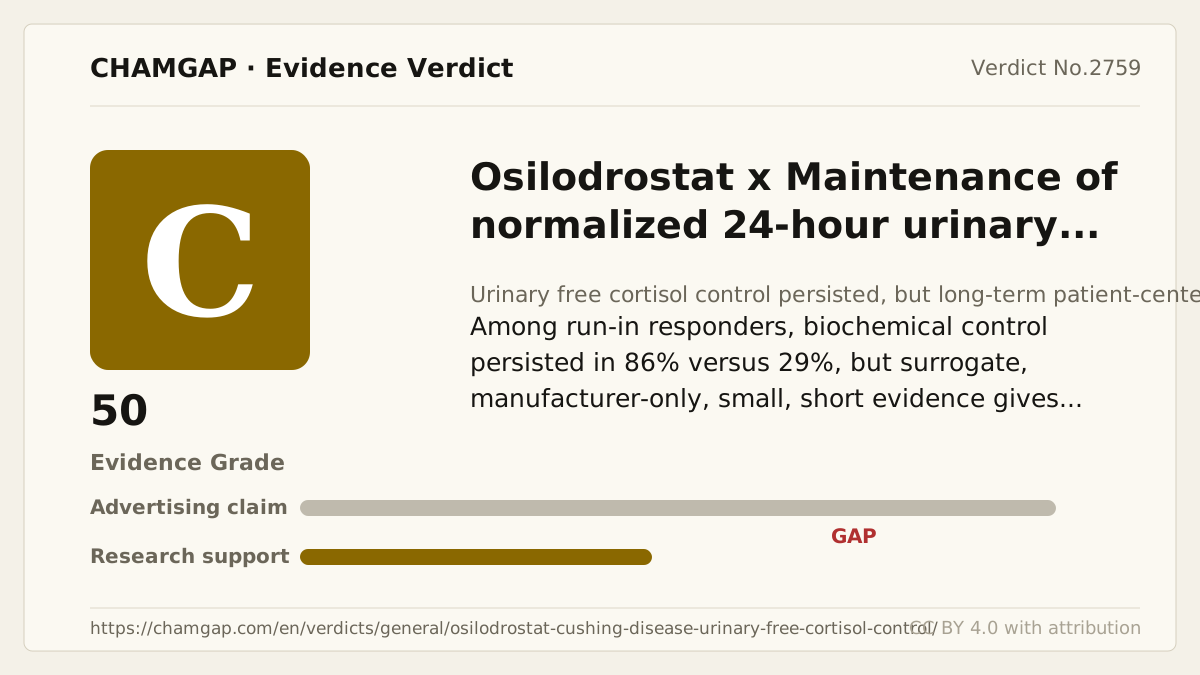
research showsThe grade is C. LINC 3 gave open-label run-in treatment to 137 participants and randomized only 71 responders in the withdrawal phase. At week 34, mean 24-hour urinary free cortisol remained at or below the upper limit of normal without dose increase in 31/36 (86%) continuing osilodrostat versus 10/35 (29%) switched to placebo, an absolute difference of 57 percentage points and OR 13.7 (95% CI 3.7 to 53.4). The effect is large, but it is a surrogate laboratory endpoint from one manufacturer-funded, small, 8-week withdrawal trial, giving C with 50 points.
ads claimA broad statement that osilodrostat normalizes Cushing's disease should be replaced by the measured claim: among open-label run-in responders, urinary free cortisol normalization persisted for eight randomized weeks in 86% versus 29%. This is not equivalent to proven improvement in symptoms, complications, or survival.
Useful facts when choosing a product
- Osilodrostat is an oral prescription inhibitor of 11β-hydroxylase that reduces cortisol synthesis.
- The randomized withdrawal phase included 71 selected responders, not all 137 run-in participants.
- Novartis funded the trial, supplied the trial interventions, and participated throughout the study process.
What the research actually shows
At 66 sites in 19 countries, 137 participants started osilodrostat. Seventy-one responders with mean 24-hour urinary free cortisol at or below the upper limit of normal at week 24 and no up-titration after week 12 were assigned at week 26 to continue osilodrostat (36) or switch to placebo (35) through interactive-response technology. Participants, investigators, and sponsor personnel as required were masked using identical packaging, labeling, dosing schedule, tablet appearance, and odor. Complete response at week 34 was 31/36 versus 10/35. Novartis Pharma AG funded the study and participated in design, collection, analysis, interpretation, writing, and the publication decision; osilodrostat and matching placebo were trial interventions.
Why this is classified as C (50)
The biochemical response-rate difference was large at 57 points, but a single manufacturer-funded 71-participant, 8-week surrogate-endpoint comparison gives C with 50 points.
Counterpoint. C does not mean the biochemical effect is small. It means long-term patient-centered benefit was not established by this evidence structure.
Rejudgment record. Cross-check applied — Confirms the 57-point complete-response difference in the 71-responder, 8-week randomized withdrawal phase while accounting for the urinary-free-cortisol surrogate, manufacturer-only evidence, small sample, and short duration
| Endpoint | S | Surrogate marker - laboratory or imaging measures |
| Replication | R1 | Single confirmatory trial |
| Independence | I0 | Evidence comes only from manufacturer studies |
| Effect size | E+ | Meets the clinically important threshold |
The scoring table and the verdict agree (C).
Sub-claim grades by effect
This ingredient is marketed for several effects. A single overall grade blends strong and weak claims together, so each effect is graded separately here. The overall grade reflects the strongest disconfirming or core claim.
| Effect (sub-claim) | Grade | Basis |
|---|---|---|
| Maintained urinary free cortisol normalization | C | Rates were 86% versus 29% in the responder-withdrawal phase. |
| Reduced long-term complications | ? | The 8-week randomized withdrawal phase did not test long-term clinical events. |
Cross-check — Codex and Claude
Evidence Table
| Study | Design | Sample | Funding | Endpoint | Result | Weight |
|---|---|---|---|---|---|---|
| Study 1 | Phase 3 study with open-label run-in followed by a double-blind randomized withdrawal phase | 71 | Funded by Novartis Pharma AG, which participated in design, collection, analysis, interpretation, writing, publication decision, and supplied trial interventions | Complete response at week 34: mean 24-hour urinary free cortisol at or below ULN without dose increase | 31/36 (86%) versus 10/35 (29%); absolute difference 57 points; OR 13.7 (95% CI 3.7 to 53.4), p<0.0001 | Large biochemical response limited by one manufacturer-funded, 71-participant, 8-week surrogate comparison |
Receipt — 1 References
All 1 cited sources were verified for existence at the original page (as of 2026-08-18).
Reviewed and approved: Chamgap Editorial Team · Approval date: 2026-08-18 · Corrections: none
Cite this verdict
[Chamgap] Osilodrostat x urinary free cortisol normalization in Cushing's disease — Evidence Grade C·50. 1 cited sources checked. Source: https://chamgap.com/en/verdicts/general/osilodrostat-cushing-disease-urinary-free-cortisol-control/ · CC BY 4.0CC BY 4.0 — free to use with attribution; do not distort grades, numbers, or verdict meaning.
What this document does and does not do
Chamgap is an information source. It reports what research has and has not confirmed; it does not tell readers what to take or buy. That decision belongs to readers and, when needed, medical or legal professionals. This verdict reflects literature available up to the search date and may change as new research appears. Nothing here is medical advice.