
Oral sodium fluoride,
does it really help with Slower progression of hearing loss from otosclerosis?
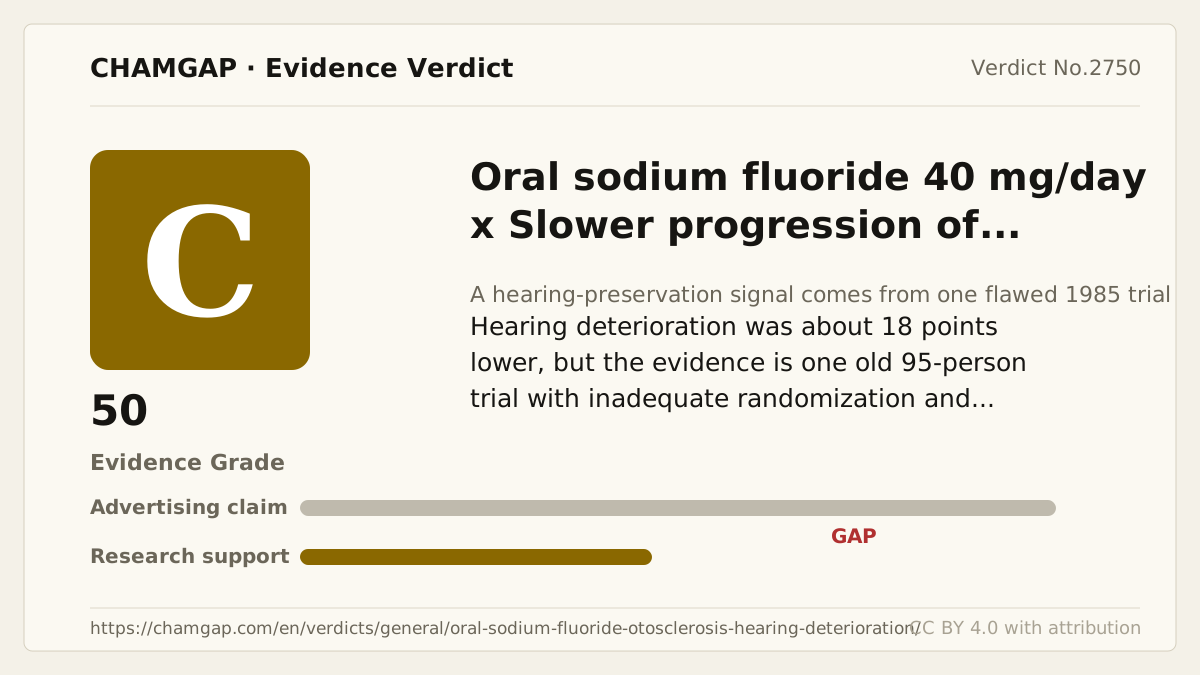
research showsThe grade is C. In a 1985 prospective double-blind placebo-controlled trial of 95 participants, pure-tone hearing deterioration of at least 10 dB over 12–24 months occurred in 7% with sodium fluoride versus 25% with placebo, an absolute reduction of about 18 points. A 2014 systematic review determined that adequate randomization and concealed assignment had not been achieved, and baseline characteristics were not reported. Publisher full-text access failed, so the funding section and trial safety accounting could not be checked.
ads claimA signal from one 1985 trial should not be marketed as current standard treatment. The study was small and had inadequate randomization and allocation concealment, with no safety accounting, while chronic high-dose fluoride raises concerns about skeletal fluorosis, osteomalacia, and upper gastrointestinal injury.
Useful facts when choosing a product
- The trial regimen was oral sodium fluoride 40 mg/day with calcium gluconate 500 mg/day and vitamin D 400 IU/day.
- The study predates clinical-trial registration, so no registration number exists.
- Publisher full-text access failed, so the Funding/Acknowledgments section could not be checked; this does not establish absence of company funding.
What the research actually shows
Bretlau assigned 95 participants to sodium fluoride (43) or placebo (52), using 40 mg/day for 12–24 months. Deterioration of at least 10 dB at one or more of 500, 1000, and 2000 Hz occurred in 3/43 (7%) versus 13/52 (25%), an 18.02-point absolute difference. The 2014 review's reported 16.8–19.2-point interval was a calculation error; reconstruction from the raw counts is much wider, about 4.01–32.04 points by Wald (about 2.83–32.00 by Newcombe). The same review stated that baseline characteristics were unavailable for Bretlau and determined that adequate randomization and concealed treatment assignment had not been achieved. Publisher full-text access failed, so the Funding/Acknowledgments section could not be checked. That does not establish absence of company funding and does not justify raising axis 3.
Why this is classified as C (50)
A directly relevant hearing event fell by about 18 points, but one 95-participant trial with randomization and allocation concealment determined inadequate by a systematic review gives C with 50 points.
Counterpoint. A positive efficacy signal does not establish long-term safety or justify routine modern use. The other small six-month study was not directly comparable.
Rejudgment record. Cross-check applied — Recognizes the 18.02-point reduction in 10-dB hearing deterioration while accounting for the sample of 95 and the systematic review's determination of inadequate randomization and concealed assignment; baseline characteristics were unavailable and funding sections could not be checked after full-text access failed
| Endpoint | P | Patient-reported treatment goal - the symptom is the goal |
| Replication | R1 | Single confirmatory trial |
| Independence | I1 | Mixed funding sources |
| Effect size | E+ | Meets the clinically important threshold |
The scoring table and the verdict agree (C).
Sub-claim grades by effect
This ingredient is marketed for several effects. A single overall grade blends strong and weak claims together, so each effect is graded separately here. The overall grade reflects the strongest disconfirming or core claim.
| Effect (sub-claim) | Grade | Basis |
|---|---|---|
| Prevention of at least 10-dB deterioration over 12–24 months | C | Rates were 7% versus 25%, but evidence is one flawed 95-person trial. |
| Effectiveness as routine modern treatment | D | Modern reviews find weak evidence and low therapeutic potential and do not support routine use. |
Cross-check — Codex and Claude
Evidence Table
| Study | Design | Sample | Funding | Endpoint | Result | Weight |
|---|---|---|---|---|---|---|
| Study 1 | Prospective double-blind placebo-controlled clinical trial | 52 | Publisher full-text access failed, so Funding/Acknowledgments could not be checked; this does not establish absence of company funding | Pure-tone hearing deterioration of at least 10 dB over 12–24 months | 3/43 (7%) versus 13/52 (25%), absolute difference 18.02 points; the review's 16.8–19.2 interval was erroneous, reconstructed Wald 95% CI about 4.01–32.04 | Single old 95-person trial; inadequate randomization and allocation concealment; baseline characteristics unreported |
| Study 2 | Systematic review of placebo-controlled sodium-fluoride studies | 2 | Trial independence assessed from original studies; Bretlau funding could not be checked because publisher full-text access failed | Hearing deterioration in otosclerosis | Bretlau baseline characteristics unavailable; adequate randomization and concealed assignment not achieved in any included study; overall evidence weak with important limitations | Synthesis evidence, not counted as a new trial; confirms lack of direct comparability |
Receipt — 2 References
Of 2 cited sources, 1 had limited original-page access (blocked or summary-only) and were verified via index/summary, marked partial; the rest were verified at the original page. As of 2026-08-18.
Reviewed and approved: Chamgap Editorial Team · Approval date: 2026-08-18 · Corrections: none
Cite this verdict
[Chamgap] Oral sodium fluoride x hearing loss from otosclerosis — Evidence Grade C·50. 2 cited sources checked. Source: https://chamgap.com/en/verdicts/general/oral-sodium-fluoride-otosclerosis-hearing-deterioration/ · CC BY 4.0CC BY 4.0 — free to use with attribution; do not distort grades, numbers, or verdict meaning.
What this document does and does not do
Chamgap is an information source. It reports what research has and has not confirmed; it does not tell readers what to take or buy. That decision belongs to readers and, when needed, medical or legal professionals. This verdict reflects literature available up to the search date and may change as new research appears. Nothing here is medical advice.