
Oxycodone-, hydrocodone-, or codeine-acetaminophen combination analgesics,
does it really help with Superior two-hour analgesia versus ibuprofen-acetaminophen for acute extremity pain in the emergency department?
research showsThe grade is D. Among 411 analyzed patients, mean two-hour NRS pain reduction was 4.3 with ibuprofen-acetaminophen, 4.4 with oxycodone-acetaminophen, 3.5 with hydrocodone-acetaminophen, and 3.9 with codeine-acetaminophen. The overall four-group comparison was P=.053. The claim that opioid combinations provide greater relief was not supported.
ads claimOpioid combinations are a real prescribing issue in Korean emergency and pain practice. In the context of overprescribing and transition to longer use, a stronger-drug label should not be assumed to mean better two-hour analgesia.
Useful facts when choosing a product
- Doses were ibuprofen 400 mg plus acetaminophen 1000 mg; oxycodone 5 mg plus 325 mg; hydrocodone 5 mg plus 300 mg; and codeine 30 mg plus 300 mg.
- Rescue analgesia was given to 73/411, 17.8%, within two hours, with P=.42 across groups.
- The trial did not assess adverse events, so it cannot compare group-specific nausea or dizziness rates.
What the research actually shows
Two Bronx emergency departments randomized 416 participants, 104 per group, and analyzed 411 after excluding five who had met a pre-randomization exclusion criterion. The primary analysis was a one-way analysis of variance across all four groups for two-hour NRS decline. After the overall P=.053 result, all pairwise differences used Bonferroni-adjusted 99.2% CIs. Ibuprofen-acetaminophen versus oxycodone was -0.1, 99.2% CI -1.0 to 0.8; versus hydrocodone 0.8, -0.2 to 1.7; and versus codeine 0.4, -0.6 to 1.3, calculated as the first drug's reduction minus the second's. Thus the maximum opioid advantage was 1.0, 0.2, and 0.6 points, each below the prespecified 1.3-point MCID. Evidence for no listed defect ① Allocation concealment: 'The randomized allocation schedule could only be accessed by the research pharmacist, who had no role in dispensing the medication.' ② Blinding: 'The pharmacist masked the analgesics by placing them into identical unmarked opaque capsules, which were packed with small amounts of lactose to equalize weight and then sealed.' ③ Analysis population and missing data: 'An intention-to-treat analysis was performed.' and 'Multiple imputation using chained equations was used to keep these patients in the intention-to-treat analysis.' ④ Prespecified primary endpoint: 'The primary outcome was the between-group difference in mean change in NRS pain score ... to 2 hours later.' - consistent with registration NCT02455518. An active-only control formally applied, but leaving moderate-to-severe acute pain untreated for two hours would be unethical, so it was not an avoidable limitation. Two hours matches the single-dose acute-analgesia question and was not counted as short follow-up.
Why this is classified as D (34)
A publicly funded, well-concealed double-blind trial precisely excluded opioid superiority as large as the prespecified MCID on a patient-centered endpoint, but no independent repeated trial addressed the same question, giving D with 34 points.
Counterpoint. This single-dose two-hour result does not answer longer-duration treatment, repeated dosing, discharge prescriptions, or patients unable to take NSAIDs.
Rejudgment record. Cross-check applied — The four-group primary test failed, and Bonferroni-adjusted pairwise intervals excluded opioid superiority as large as the prespecified MCID in a publicly funded double-blind trial
| Endpoint | P | Patient-reported treatment goal - the symptom is the goal |
| Replication | R1 | Single confirmatory trial |
| Independence | I2 | Decisive evidence is publicly or non-profit funded |
| Effect size | E0 | Null |
| Precision | C1 | The confidence interval excludes meaningful benefit |
The scoring table and the verdict agree (D).
Sub-claim grades by effect
This ingredient is marketed for several effects. A single overall grade blends strong and weak claims together, so each effect is graded separately here. The overall grade reflects the strongest disconfirming or core claim.
| Effect (sub-claim) | Grade | Basis |
|---|---|---|
| Superior two-hour analgesia from opioid-acetaminophen combinations | D | The overall P value was .053, and all pairwise comparisons excluded superiority as large as the prespecified MCID. |
| Equivalent safety of opioid combinations | ? | This trial did not assess adverse events. |
Cross-check — Codex and Claude
Evidence Table
| Study | Design | Sample | Funding | Endpoint | Result | Weight |
|---|---|---|---|---|---|---|
| Study 1 | Two-emergency-department randomized double-blind four-group single-dose superiority trial | 103 | US NIH National Institute on Aging award 7K23AG033100-07; no author conflicts reported | Between-group difference in mean change in 0-to-10 NRS pain from before dosing to two hours | Reductions of 4.3 with ibuprofen-acetaminophen, 4.4 with oxycodone, 3.5 with hydrocodone, and 3.9 with codeine; overall P=.053; all pairwise 99.2% CIs excluded a 1.3-point superiority advantage | Pivotal publicly funded precise null single trial |
Receipt — 1 References
All 1 cited sources were verified for existence at the original page (as of 2026-08-18).
Reviewed and approved: Chamgap Editorial Team · Approval date: 2026-08-18 · Corrections: none
Cite this verdict
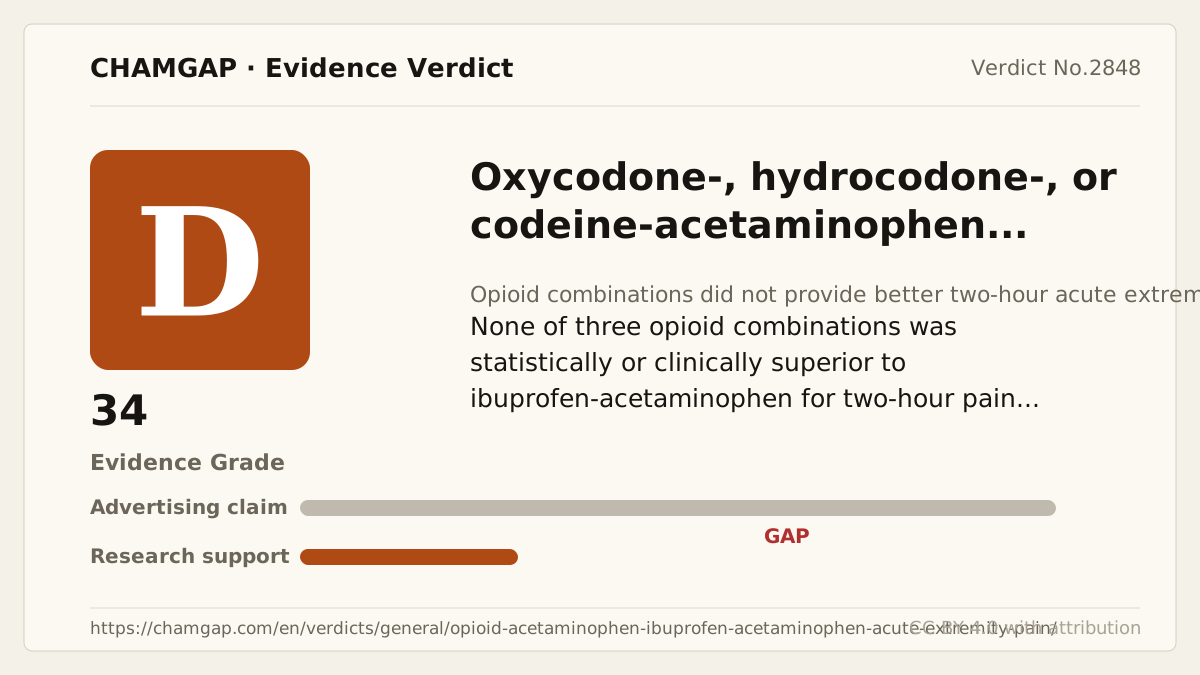
[Chamgap] Opioid-Acetaminophen Combinations Are Not Superior to Ibuprofen-Acetaminophen for Acute Extremity Pain - No Benefit — Evidence Grade D·34. 1 cited sources checked. Source: https://chamgap.com/en/verdicts/general/opioid-acetaminophen-ibuprofen-acetaminophen-acute-extremity-pain/ · CC BY 4.0CC BY 4.0 — free to use with attribution; do not distort grades, numbers, or verdict meaning.
What this document does and does not do
Chamgap is an information source. It reports what research has and has not confirmed; it does not tell readers what to take or buy. That decision belongs to readers and, when needed, medical or legal professionals. This verdict reflects literature available up to the search date and may change as new research appears. Nothing here is medical advice.