
Oil pulling,
does it really help with Reduced gingivitis and dental plaque?
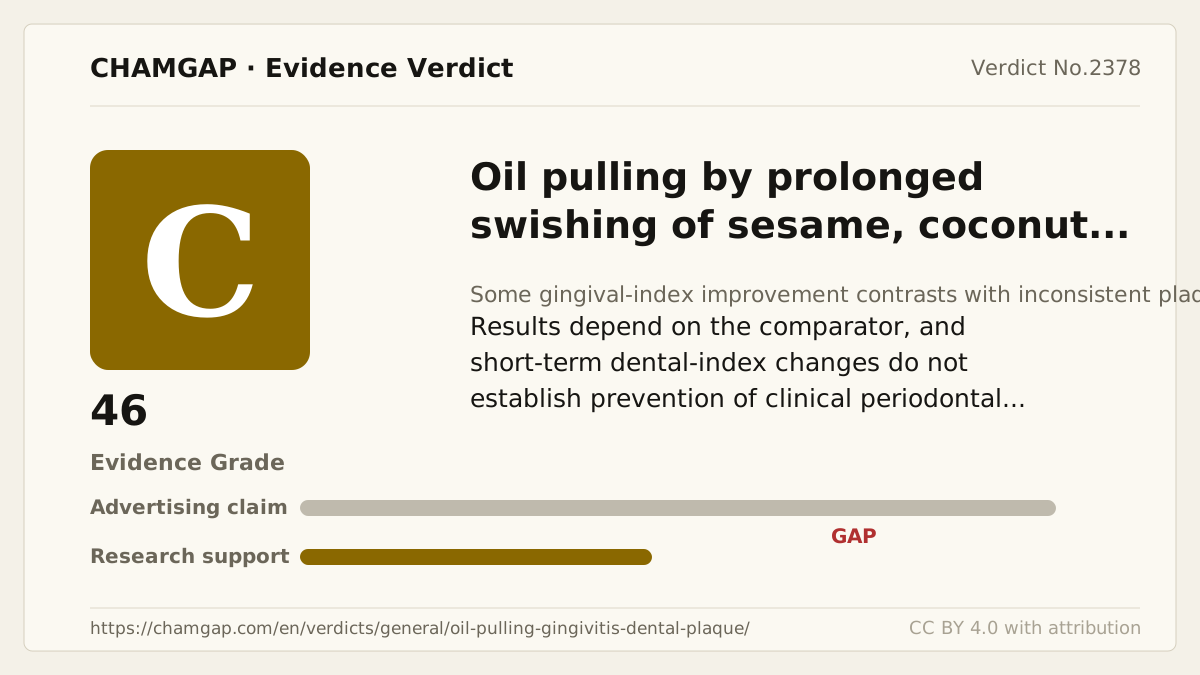
research showsThe grade is C with 46 points. Some small trials improved a gingival index, but plaque was not better than water or usual oral hygiene, and chlorhexidine reduced plaque more than oil pulling. These are surrogate dental indices and certainty is very low.
ads claimA change in plaque or gingival index is not tooth retention or prevention of periodontitis. A weak water-control result cannot be marketed as equivalence to chlorhexidine, and oil pulling should not replace brushing or interdental cleaning.
Useful facts when choosing a product
- Comparators included chlorhexidine, distilled water, other rinses, and usual oral hygiene.
- Because no validated clinical threshold was available, Cohen conventions classified standardized magnitude; this does not establish patient-perceived clinical benefit.
- Trials measured plaque and gingival indices, not long-term periodontitis or tooth loss.
What the research actually shows
Jong et al. reviewed 25 trials with 1,184 participants and pooled 21. Trials lasted 7 to 45 days and were mostly small single-center studies. Non-chlorhexidine controls mixed water, other rinses, and usual hygiene. Modified gingival index favored oil pulling, SMD -1.14, 95% CI -1.31 to -0.97, but conventional gingival index was null, SMD -0.42, -0.88 to 0.04, as was plaque versus non-chlorhexidine controls, MD -0.02, -0.20 to 0.16. Across eight chlorhexidine trials with 305 participants, plaque favored chlorhexidine, SMD 0.33, 0.17 to 0.49. Certainty was very low. Asokan 2009 was a single-center triple-blind 10-day trial of 20 adolescents using sesame oil versus chlorhexidine. Sezgin 2019 was an observer-masked randomized crossover study of 29 volunteers using coconut oil and 0.2% chlorhexidine for four days each with a 14-day washout.
Why this is classified as C (46)
Surrogate-only outcomes, comparator-dependent results, and small short trials give C with 46 points.
Counterpoint. A short-term gingival-index benefit may exist, but superiority to standard hygiene or active rinses is unproven.
Rejudgment record. Cross-check applied — Evidence is limited to surrogate indices, modified gingival and conventional gingival or plaque results do not converge, and trials are small and short
| Endpoint | S | Surrogate marker - laboratory or imaging measures |
| Replication | R1 | Single confirmatory trial |
| Independence | I1 | Mixed funding sources |
| Effect size | EX | The clinical size of the effect could not be judged |
The scoring table and the verdict agree (C).
Sub-claim grades by effect
This ingredient is marketed for several effects. A single overall grade blends strong and weak claims together, so each effect is graded separately here. The overall grade reflects the strongest disconfirming or core claim.
| Effect (sub-claim) | Grade | Basis |
|---|---|---|
| Improved gingival indices | C | The modified index was positive while the conventional index was null. |
| Reduced plaque | D | It was null versus non-chlorhexidine controls, and chlorhexidine was superior. |
Cross-check — Codex and Claude
Evidence Table
| Study | Design | Sample | Funding | Endpoint | Result | Weight |
|---|---|---|---|---|---|---|
| Study 1 | Systematic review and random-effects meta-analysis of randomized trials | 21 | Review funding and individual-trial funding were incompletely reported | Plaque, gingival, and modified gingival indices | Versus non-chlorhexidine controls, MGI SMD -1.14 (-1.31 to -0.97), GI -0.42 (-0.88 to 0.04), and PI MD -0.02 (-0.20 to 0.16); plaque favored chlorhexidine, SMD 0.33 (0.17 to 0.49) | Pivotal synthesis with very-low certainty |
Receipt — 3 References
All 3 cited sources were verified for existence at the original page (as of 2026-08-07).
Reviewed and approved: Chamgap Editorial Team · Approval date: 2026-08-07 · Corrections: none
Cite this verdict
[Chamgap] Oil pulling x reduced gingivitis and dental plaque — Evidence Grade C·46. 3 cited sources checked. Source: https://chamgap.com/en/verdicts/general/oil-pulling-gingivitis-dental-plaque/ · CC BY 4.0CC BY 4.0 — free to use with attribution; do not distort grades, numbers, or verdict meaning.
What this document does and does not do
Chamgap is an information source. It reports what research has and has not confirmed; it does not tell readers what to take or buy. That decision belongs to readers and, when needed, medical or legal professionals. This verdict reflects literature available up to the search date and may change as new research appears. Nothing here is medical advice.