
Occupational disinfectant exposure,
does it really help with Higher incidence of COPD?
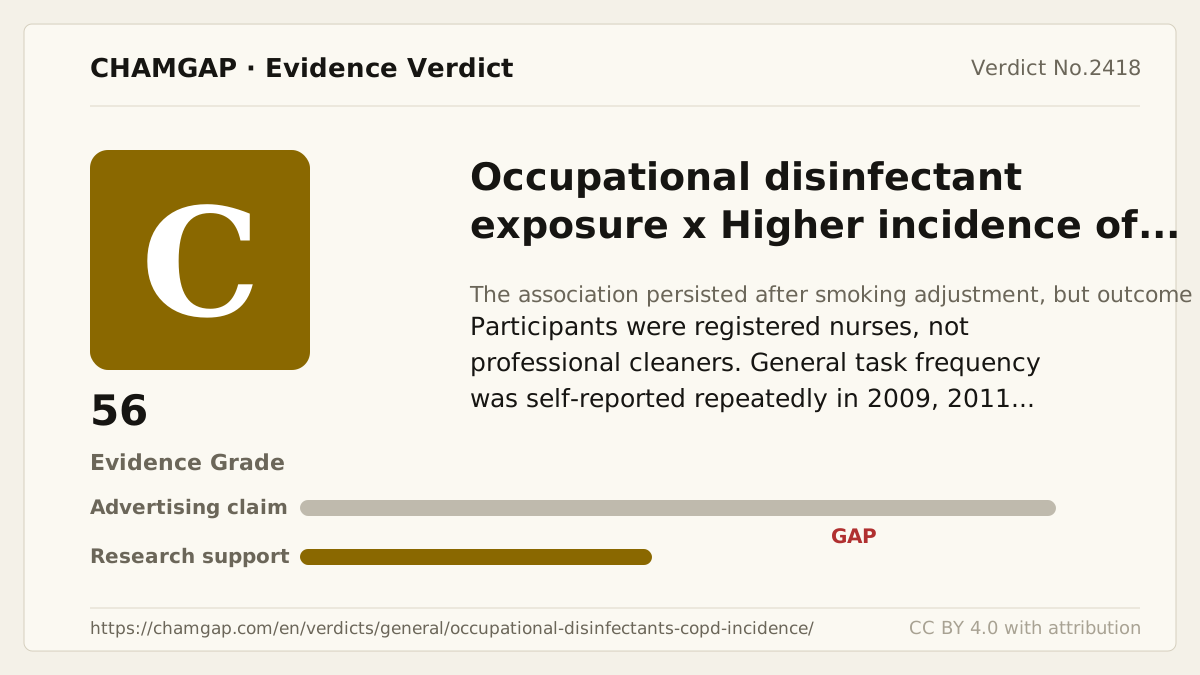
research showsThe grade is C with 56 points. In a prospective cohort of US female nurses, weekly disinfecting work was associated with incident COPD, including among never-smokers. This was not randomized, and COPD was based on self-reported physician diagnosis rather than spirometry.
ads claimKorean health-care and cleaning workplaces need infection control, so the response is substitution, enclosure, ventilation, correct dilution, and protective equipment rather than abandoning disinfection. Verdict 2289 is D with 34 points for respiratory-infection prevention by routine alcohol hand sanitizer in schools; that exposure and endpoint differ from chronic occupational inhalation and COPD.
Useful facts when choosing a product
- Participants were female registered nurses, not cleaners.
- Tasks were repeatedly self reported; agents came from a job-task matrix.
- This was not randomized.
- No early follow-up lag was reported.
- COPD was self-reported physician diagnosis, not primary spirometry.
What the research actually shows
Dumas 2019 prospectively followed 73,262 women who were still nurses and COPD-free in 2009 through 2015; this was not randomized. Disinfecting tasks were reported three times and handled as time-varying highest prior exposure. Specific agents were assigned using a job-task matrix. HRs were 1.38 (1.13-1.68) for surfaces and 1.31 (1.07-1.61) for instruments. Working with disinfectants 4-7 days weekly had HR 1.43 (1.13-1.80), trend P<.001. High exposures to glutaraldehyde, bleach, peroxide, alcohol, and quaternary ammonium compounds were significant, while formaldehyde and enzymes were not. Models adjusted age, calendar time, race, ethnicity, smoking status, pack-years, and BMI, with additional diet sensitivity analysis. Baseline COPD was excluded, but no initial follow-up years were excluded. Outcome was self-reported physician-diagnosed COPD, with stricter supplemental definitions but no spirometry in the primary analysis. Funding was CDC/NIOSH R01 OH-010359, NIH UM1 CA-176726, and EU FP7 Marie Curie PRESTIGE PCOFUND-GA-2013-609102; funders had no role.
Why this is classified as C (56)
A smoking-adjusted dose-response association with incident COPD is limited by self-reported disease and absent latency handling.
Counterpoint. No independent prospective confirmation was identified for the same individual disinfectant and incident COPD. Separate studies have examined occupational cleaning or disinfectant exposure in relation to lung function and respiratory outcomes. Search record: PubMed/MEDLINE; query ‘(disinfect* OR cleaning agents) AND (COPD OR chronic obstructive pulmonary disease OR lung function) AND (prospective OR cohort)’; 1980-2026; 12 raw records reviewed. Correlated products complicate agent attribution, and formaldehyde and enzymes were not significant.
Rejudgment record. Cross-check applied — Occupation, exposure assessment, smoking strata, absolute cases, dose response, lag, outcome ascertainment, and exact funding were checked in the original report.
| Endpoint | H | Hard endpoint - actual events such as death |
| Replication | R1 | Single confirmatory trial |
| Independence | I2 | Decisive evidence is publicly or non-profit funded |
| Effect size | E+ | Meets the clinically important threshold |
The scoring table and the verdict agree (C).
Sub-claim grades by effect
This ingredient is marketed for several effects. A single overall grade blends strong and weak claims together, so each effect is graded separately here. The overall grade reflects the strongest disconfirming or core claim.
| Effect (sub-claim) | Grade | Basis |
|---|---|---|
| Occupational disinfectant exposure increases incident COPD | C | The association persisted by smoking status but outcome verification and latency were limited. |
Cross-check — Codex and Claude
Evidence Table
| Study | Design | Sample | Funding | Endpoint | Result | Weight |
|---|---|---|---|---|---|---|
| Study 1 | Nurses’ Health Study II prospective cohort | 8145 | CDC/NIOSH R01 OH-010359; NIH UM1 CA-176726; EU FP7 Marie Curie PRESTIGE PCOFUND-GA-2013-609102 | Incident self-reported physician-diagnosed COPD | Weekly or more HR 1.35 (1.14-1.59); never-smoker HR 1.34 (1.03-1.73) | Pivotal evidence |
Receipt — 1 References
All 1 cited sources were verified for existence at the original page (as of 2026-08-07).
Reviewed and approved: Chamgap Editorial Team · Approval date: 2026-08-07 · Corrections: none
Cite this verdict
[Chamgap] Occupational disinfectant exposure × incident COPD — Evidence Grade C·56. 1 cited sources checked. Source: https://chamgap.com/en/verdicts/general/occupational-disinfectants-copd-incidence/ · CC BY 4.0CC BY 4.0 — free to use with attribution; do not distort grades, numbers, or verdict meaning.
What this document does and does not do
Chamgap is an information source. It reports what research has and has not confirmed; it does not tell readers what to take or buy. That decision belongs to readers and, when needed, medical or legal professionals. This verdict reflects literature available up to the search date and may change as new research appears. Nothing here is medical advice.