
Noni,
does it really help with Anti-inflammatory and cure-all-style claims?
research showsClaims that generalize noni as an 'anti-inflammatory food' or a food that works broadly for many diseases remain at a C level based on human evidence. Placebo-controlled RCTs in smokers reported improvements in surrogate markers such as oxidative stress, DNA adducts, and hs-CRP, but these are not results that directly showed disease improvement or pain relief. The main positive studies are linked to manufacturer funding and products and lack independent replication, and an independent anti-inflammatory RCT for dysmenorrhea did not reduce pain or bleeding more than placebo. Therefore, there is no evidence to extend it to a 'cure-all' or general anti-inflammatory effect.
ads claimKorean market articles and advertising content introduce noni by grouping together phrases such as 'natural anti-inflammatory,' 'chronic inflammation management/detox,' 'painkiller fruit,' 'anticancer,' 'cell regeneration,' 'immune enhancement,' 'improvement of blood pressure, lipids, and blood sugar,' and 'high-absorption fermented noni.' Some articles connect animal/cell studies or ingredient names (scopoletin, iridoids, proxeronine, damnacanthal) as if they were human efficacy. Articles citing MFDS reports stated that in 2019, 196 sites with false or exaggerated advertising related to noni were detected, and among them a large share claimed disease prevention or treatment such as anti-inflammatory or anticancer effects.
Useful facts when choosing a product
- The key product in positive human studies is generally Tahitian Noni Juice (TNJ), which is described in the literature as a product made from noni-puree-derived juice mixed with grape and blueberry juices. It cannot be regarded as the same product as Korean powders, pills, undiluted extracts, or fermented noni products.
- Domestic product promotion emphasizes low-temperature extraction, enzymatic hydrolysis, fermentation, lactic acid bacteria, organic raw materials, and improved absorption rate, but no RCT was identified showing that these processes themselves prove anti-inflammatory or disease outcomes in humans.
- In 2019 MFDS investigation reports, 22 of 88 noni powder/pill products exceeded the standard for metallic foreign matter, and cases were also detected in which products advertised as 100% noni juice were sold with purified water mixed in.
- Noni has a potassium-content issue, so safety review is needed in situations involving kidney disease, potassium restriction, or use of drugs that raise potassium risk.
- Reports of liver injury are rare and causality is debated, but LiverTox classifies noni as a probable rare cause of clinical liver injury.
What the research actually shows
Human studies split by efficacy. (1) Anti-inflammatory/pain: The Fletcher 2013 dysmenorrhea RCT used noni 400 mg twice daily for 3 cycles, randomized 100 participants and completed 80, and found no difference versus placebo in major variables such as pain and menstrual blood volume. Cervical spondylosis and osteoarthritis studies were open-label or active-control/non-placebo pilots, so evidence for independent replication of perceived symptoms is weak. (2) Surrogate markers: RCTs in smokers improved SAR/LOOH, DNA adducts, hs-CRP, lipids, and other markers, but these are oxidative-stress and inflammation surrogate markers and do not translate directly into prevention or treatment of chronic inflammatory diseases in ordinary people. These positive studies are related to Tahitian Noni Juice/Morinda products and funding. (3) Anticancer: A 2022 systematic literature review summarized that there were no clinical RCTs and that the evidence was mainly cell and animal studies. (4) Safety: Short safety studies generally showed tolerability, but LiverTox classifies the possibility of rare clinical liver injury as C (probable rare cause), and there is a potassium burden issue for patients with kidney disease.
Why this is classified as C (45)
The verdict is C (45 points). Positive results from smoker RCTs are concentrated on surrogate markers such as oxidative stress, hs-CRP, and DNA adducts, and do not directly prove disease outcomes or perceived anti-inflammatory effects, so under boundary rule 1 they are capped at C. In addition, many positive RCTs are linked to manufacturer funding and products and lack independent replication, making it difficult to exceed C under boundary rule 2b. An independent placebo-controlled dysmenorrhea RCT that directly tested anti-inflammatory treatment did not show efficacy versus placebo, and when cure-all-style combination claims are separated into anticancer, immunity, blood pressure, pain, and other domains, most remain at cell/animal/pilot/open-label evidence. However, because positive surrogate-marker RCTs exist, D is not forced, and the grade is kept at the maximum C due to surrogate-marker-centered evidence and lack of independent replication.
Counterpoint. Noni contains bioactive components such as iridoids and scopoletin, and short-term RCTs in smokers have found reductions in oxidative-stress and inflammation-related markers. Some human studies also show signals for improvement in joint pain and quality of life. These signals make it difficult to say there is no evidence at all, but because the evidence is close to specific products, specific populations, surrogate markers, or unblinded pilots, it does not extend to 'inflammation removal' or improvement of multiple diseases for general consumers.
Rejudgment record. reassessment (upgraded D -> C) — Significance only on surrogate markers plus lack of independent replication is a maximum C (boundaries 1 and 2-b), not forced D. Consistent with blind C. The verdict text states that cure-all claims cannot be extended.
Cross-check — Codex and Claude
Evidence Table
| Study | Design | Sample | Funding | Endpoint | Result | Weight |
|---|---|---|---|---|---|---|
| Fletcher HM et al. 2013 | double-blind RCT | 80 | not reported | pain | In a dysmenorrhea RCT of noni 400 mg twice daily for 3 cycles with 100 randomized and 80 completing, there was no difference versus placebo in pain, menstrual blood volume, and related outcomes. | core |
| Wang MY et al. 2009 | double-blind RCT | 285 | possible manufacturer/industry involvement | stress | In a 30-day double-blind placebo-controlled RCT of 285 smokers, SAR/LOOH decreased; this was an oxidative-stress surrogate marker, not a disease outcome. | core |
| Wang MY et al. 2012 | not specified | 132 | possible manufacturer/industry involvement | not specified | In a 132-smoker RCT, surrogate markers such as lipids, hs-CRP, and homocysteine improved; Morinda supported the study. | core |
| Wang MY et al. 2013 | not specified | 245 | possible manufacturer/industry involvement | not specified | In a 245-smoker RCT, LOOH/MDA-DNA adducts decreased by 44.6-57.4%; these were surrogate markers, not cancer or inflammatory-disease incidence. | core |
| West BJ et al. 2018 | meta-analysis | possible manufacturer/industry involvement | concentration | Although it was a review of human intervention studies, all authors belonged to Morinda R&D and stated that existing human studies were concentrated on one French Polynesian noni juice product. | supporting | |
| Kumar HC et al. 2022 | systematic review/RCT | mixed/partly industry-related | gut | Systematic literature review on anticancer effects: among 51 clinical and preclinical studies, clinical evidence was small in number, randomized clinical trials were absent, and only animal studies were quantitatively synthesized. | supporting | |
| LiverTox 2020 | not specified | not reported | liver | Noni-related liver injury is rare but classified as a probable rare cause, and some cases of acute liver failure/transplantation are summarized. | supporting | |
| National Kidney Foundation | not specified | not reported | gut | Noni is included on a list of high-potassium herbs in situations where potassium restriction is needed for patients with kidney disease. | supporting | |
| Study 9 | preclinical | not reported | gut | A domestic informational article emphasized chronic inflammation management, painkiller fruit, and anti-inflammatory/cell-regenerating components. | supporting | |
| Study 10 | preclinical | not reported | body fat/gut | Various efficacies, including natural anti-inflammatory, chronic inflammation, anticancer, analgesic, and body fat effects, were connected within a single article. | supporting | |
| Study 11 | RCT | not reported | immunity/gut/recovery/antioxidant | A promotional product article emphasized fermentation, enzymatic hydrolysis, low-temperature extraction, antioxidant action, inflammation suppression, cell recovery, immune enhancement, and anticancer components. | supporting | |
| Study 12 | not specified | not reported | gut | Citing an MFDS investigation: 22 of 88 products exceeded the standard for metallic foreign matter, and 196 sites with false or exaggerated advertising were detected. | supporting |
Receipt — 12 References
Of 12 cited sources, 3 had limited original-page access (blocked or summary-only) and were verified via index/summary, marked partial; the rest were verified at the original page. As of 2026-07-07.
Reviewed and approved: Chamgap Editorial Team · Approval date: 2026-07-07 · Corrections: none
Cite this verdict
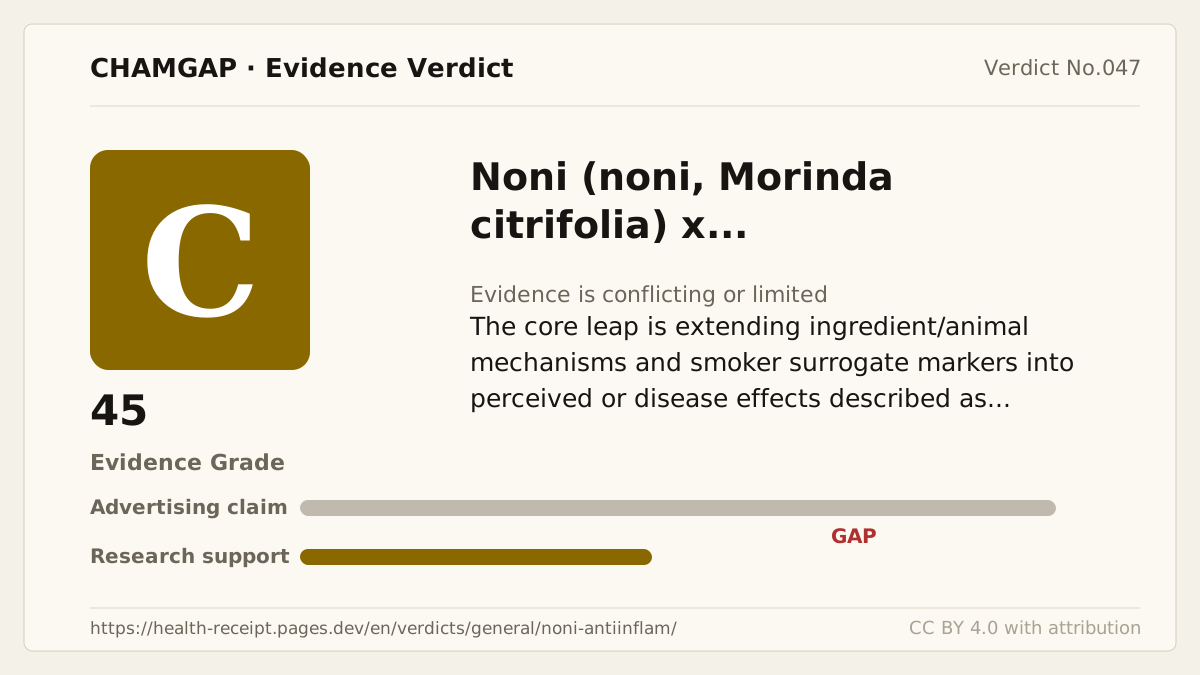
[Chamgap] Noni x anti-inflammatory and cure-all-style claims — Evidence Grade C·45. 12 cited sources checked. Source: https://chamgap.com/en/verdicts/general/noni-antiinflam/ · CC BY 4.0CC BY 4.0 — free to use with attribution; do not distort grades, numbers, or verdict meaning.
What this document does and does not do
Chamgap is an information source. It reports what research has and has not confirmed; it does not tell readers what to take or buy. That decision belongs to readers and, when needed, medical or legal professionals. This verdict reflects literature available up to the search date and may change as new research appears. Nothing here is medical advice.