
Nasal high-flow therapy as primary early respiratory support in preterm infants,
does it really help with Increased treatment failure within 72 hours versus CPAP?
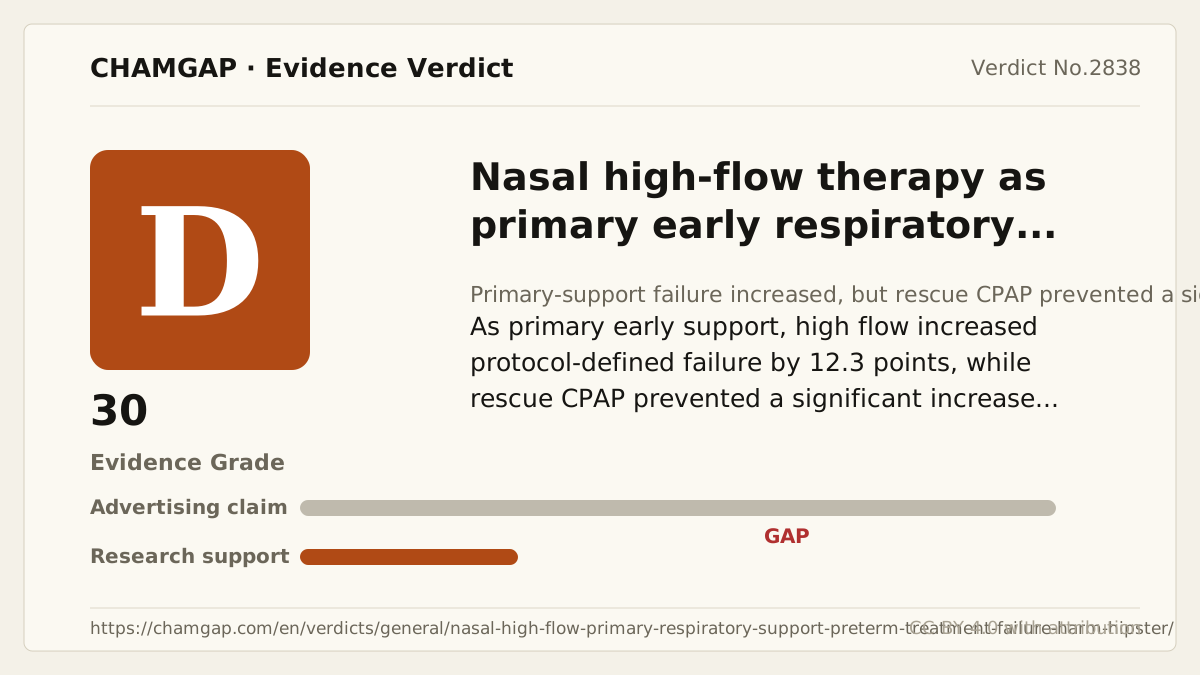
research showsThe grade is D with 30 points. Treatment failure occurred in 71/278 (25.5%) with high flow versus 38/286 (13.3%) with CPAP, an absolute increase of 12.3 points (95% CI 5.8 to 18.7), P<0.001. Rescue CPAP was available, so failure was not equivalent to intubation, death, or permanent harm.
ads claim`2561` asks whether high-flow nasal oxygen immediately after planned extubation in adults reduces reintubation within 72 hours. This verdict concerns primary respiratory support immediately after birth in preterm infants, so both the population and timing differ. The harm finding from this trial cannot be transferred to postextubation use.
Useful facts when choosing a product
- Heated humidified high flow is widely used in South Korean NICUs.
- Nasal trauma was lower with high flow, 8.3% versus 18.5%.
- The protocol assumed immediate access to rescue CPAP and intubation.
What the research actually shows
Nine NICUs analyzed 564 infants born at 28 to 36+6 weeks. Limitation 1: noninferiority design. Listed item: the prespecified margin was 10 percentage points. Avoidability: possible - a stricter superiority design could have tested failure without relying on an accepted-loss margin. Limitation 2: early stopping at an interim-analysis boundary. Listed item: the DSMC used the prespecified P<0.001 boundary after outcome data for 515 infants, versus a target of 750; 564 were analyzed. Avoidability: possible - recruitment to target could reduce early effect inflation, although the committee followed its safety rule. Unblinded subjective endpoint was not counted separately because the paper says, "to minimize bias, we used prespecified, objective criteria", and off-criteria clinician decisions were only 4/71 versus 2/38. NHMRC, hospital-foundation, and NICU funding was public or nonprofit; there was no commercial support. Davis disclosed Fisher & Paykel travel support, but trial-device donation was not reported.
Why this is classified as D (30)
A single noninferiority trial stopped at an interim boundary has two listed limitations. Despite a significant increase in objective-criteria treatment failure, the evidence grade is D with 30 points; this grades evidence structure, not desirability.
Counterpoint. Treatment failure increased, but intubation, death, and overall air leak did not significantly increase.
Rejudgment record. New verdict — A 12.3-point increase in 72-hour treatment failure, objective criteria, rescue CPAP, noninferiority design, and prespecified-boundary early stopping
| Endpoint | P | Patient-reported treatment goal - the symptom is the goal |
| Replication | R1 | Single confirmatory trial |
| Independence | I2 | Decisive evidence is publicly or non-profit funded |
| Effect size | E- | Harm increased in the trials |
| Precision | C0 | The confidence interval leaves room for benefit |
The scoring table and the verdict agree (D).
Sub-claim grades by effect
This ingredient is marketed for several effects. A single overall grade blends strong and weak claims together, so each effect is graded separately here. The overall grade reflects the strongest disconfirming or core claim.
| Effect (sub-claim) | Grade | Basis |
|---|---|---|
| Increased treatment failure within 72 hours | D | The absolute increase was 12.3 points. |
| Increased intubation within 72 hours | D | Rates were 15.5% versus 11.5%, P=0.17. |
Cross-check — Codex and Claude
Evidence Table
| Study | Design | Sample | Funding | Endpoint | Result | Weight |
|---|---|---|---|---|---|---|
| Study 1 | Multicenter randomized noninferiority trial stopped at a prespecified boundary | 564 | NHMRC, Royal Brisbane and Women's Hospital Foundation, and participating NICUs | Treatment failure within 72 hours by prespecified objective criteria or urgent intubation | 25.5% versus 13.3%; absolute difference 12.3 points (95% CI 5.8 to 18.7); P<0.001 | Pivotal harm trial |
Receipt — 1 References
All 1 cited sources were verified for existence at the original page (as of 2026-08-18).
Reviewed and approved: Chamgap Editorial Team · Approval date: 2026-08-18 · Corrections: none
Cite this verdict
[Chamgap] Nasal High-Flow Therapy Increases Treatment Failure as Primary Respiratory Support in Preterm Infants - Harm — Evidence Grade D·30. 1 cited sources checked. Source: https://chamgap.com/en/verdicts/general/nasal-high-flow-primary-respiratory-support-preterm-treatment-failure-harm-hipster/ · CC BY 4.0CC BY 4.0 — free to use with attribution; do not distort grades, numbers, or verdict meaning.
What this document does and does not do
Chamgap is an information source. It reports what research has and has not confirmed; it does not tell readers what to take or buy. That decision belongs to readers and, when needed, medical or legal professionals. This verdict reflects literature available up to the search date and may change as new research appears. Nothing here is medical advice.