
Intravesical BCG,
does it really help with Reduced recurrence in intermediate- and high-risk non-muscle-invasive bladder cancer?
research showsThe grade is B with 72 points. Time to first bladder recurrence was the prespecified primary endpoint in EORTC 30911. At median 9.2 years, recurrence was 103/281 (36.7%) with BCG, 110/277 (39.7%) with BCG plus isoniazid, and 147/279 (52.7%) with epirubicin; pooled BCG HR was 0.62, P<0.001.
ads claimVerdict 1515 is C with 55 points for one immediate gemcitabine instillation in low-grade disease. This verdict concerns repeated BCG induction and maintenance in intermediate- and high-risk Ta/T1 disease.
Useful facts when choosing a product
- Time to first recurrence was the primary endpoint.
- The population included intermediate- and high-risk Ta/T1 disease.
- Toxicity discontinuation was 19% across BCG arms versus 6%.
- Verdict 1515 addresses immediate single-dose gemcitabine in low-grade disease.
What the research actually shows
Patients received six induction instillations followed by three-week maintenance courses through month 36. Only 25% to 29% completed the full schedule. Toxicity stopped treatment in 99 patients (19%) across the BCG arms versus 16 (6%) with epirubicin. Cystitis and hematuria are common; systemic BCG infection is rare but serious.
Why this is classified as B (72)
A large positive primary-endpoint trial plus same-direction older trials supports B, but the pivotal trial used only active controls and its funding could not be confirmed.
Counterpoint. Reduced recurrence does not automatically establish less progression or death.
Rejudgment record. Cross-check applied — The prespecified recurrence endpoint was positive in EORTC 30911 and older TURBT-only trials agreed, but complete author and funding independence of a second pivotal trial was not verified
| Endpoint | H | Hard endpoint - actual events such as death |
| Replication | R1 | Single confirmatory trial |
| Independence | I1 | Mixed funding sources |
| Effect size | E+ | Meets the clinically important threshold |
The scoring table and the verdict agree (B).
Sub-claim grades by effect
This ingredient is marketed for several effects. A single overall grade blends strong and weak claims together, so each effect is graded separately here. The overall grade reflects the strongest disconfirming or core claim.
| Effect (sub-claim) | Grade | Basis |
|---|---|---|
| Reduced first bladder recurrence | B | Rates were 36.7% versus 52.7%. |
| Reduced muscle-invasive progression | D | No significant difference was found. |
Cross-check — Codex and Claude
Evidence Table
| Study | Design | Sample | Funding | Endpoint | Result | Weight |
|---|---|---|---|---|---|---|
| Study 1 | Three-arm randomized active-controlled phase 3 trial | 837 | Not confirmed | Time to first bladder recurrence; primary | BCG 36.7%, BCG+INH 39.7%, epirubicin 52.7%; HR 0.62, P<0.001; median 9.2 years | Pivotal direct trial |
| Study 2 | Synthesis of six randomized trials | 585 | Funding of each original trial not fully verified | Recurrence at 12 months | OR 0.30 (0.21 to 0.43); recurrence-free survival HR 0.44 (0.34 to 0.56) | Same-direction supportive evidence |
Receipt — 2 References
All 2 cited sources were verified for existence at the original page (as of 2026-08-07).
Reviewed and approved: Chamgap Editorial Team · Approval date: 2026-08-07 · Corrections: none
Cite this verdict
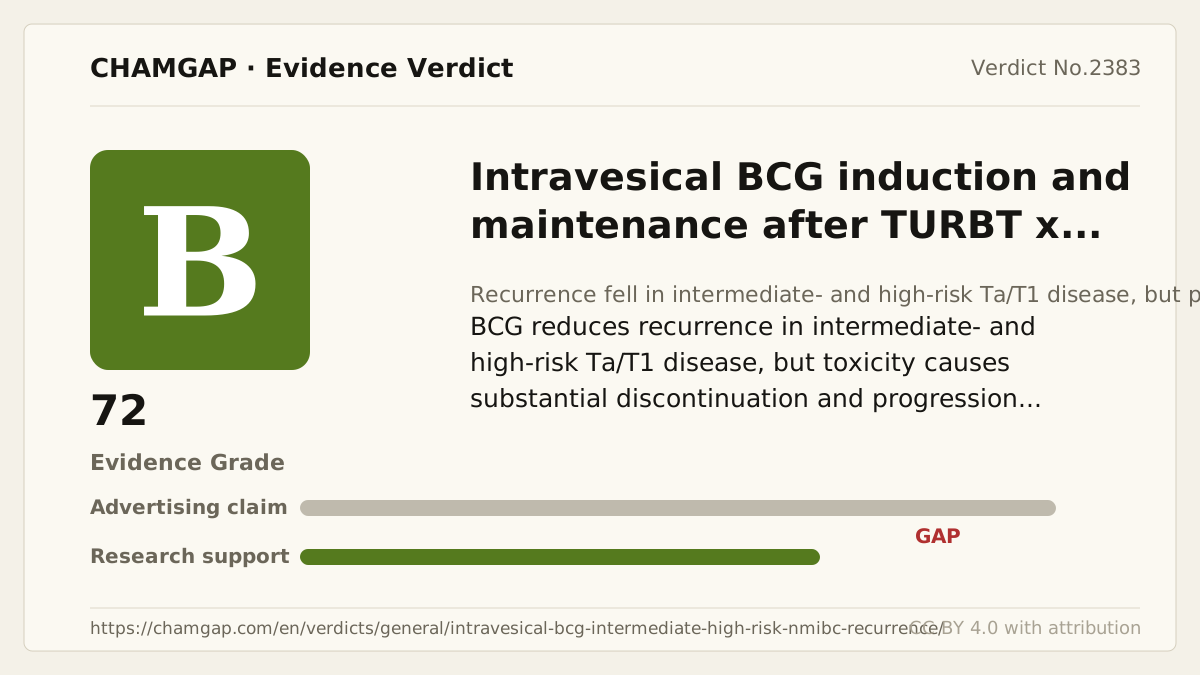
[Chamgap] Intravesical BCG x recurrence in non-muscle-invasive bladder cancer — Evidence Grade B·72. 2 cited sources checked. Source: https://chamgap.com/en/verdicts/general/intravesical-bcg-intermediate-high-risk-nmibc-recurrence/ · CC BY 4.0CC BY 4.0 — free to use with attribution; do not distort grades, numbers, or verdict meaning.
What this document does and does not do
Chamgap is an information source. It reports what research has and has not confirmed; it does not tell readers what to take or buy. That decision belongs to readers and, when needed, medical or legal professionals. This verdict reflects literature available up to the search date and may change as new research appears. Nothing here is medical advice.